
Landscaping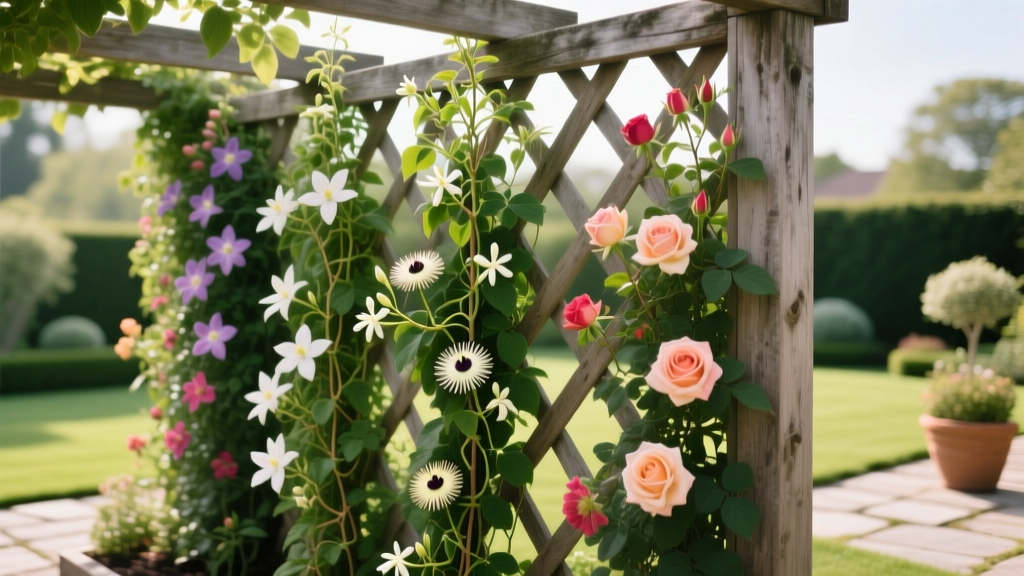
Top Flowers for Trellis: How to Plant, Train, and Maintain Climbers
Match the Vine to the Trellis Architecture
The most common reason climbing flowers fail to thrive on a trellis is a mismatch between the plant's natural climbing mechanism and the thickness or material of the support structure. Vines do not all climb the same way. According to Penn State Extension, understanding these botanical mechanics is the first step in selecting the right flowers for trellis installations.
| Climbing Mechanism | Example Flowers | Ideal Trellis Material | Max Support Thickness |
|---|---|---|---|
| Twining (Stems wrap around supports) | Wisteria, Honeysuckle, Morning Glory | Wood, Metal, Vinyl | Under 1.5 inches |
| Tendril (Leaf stalks reach and grab) | Clematis, Sweet Pea, Passionflower | Wire, Mesh, Thin Twine | Under 0.25 inches |
| Clinging (Aerial rootlets attach to surfaces) | Climbing Hydrangea, Trumpet Vine | Masonry, Stone, Heavy Timber | N/A (Attaches to flat surfaces) |
| Scrambling (Requires manual tying) | Climbing Roses, Bougainvillea | Heavy Timber, Wire Grids | N/A (Tied to any thickness) |
If you attempt to grow a tendril-climber like Clematis on a thick 2x4 wooden lattice, the tendrils will fail to wrap around the wood, resulting in a collapsed, tangled mess. For thick wooden trellises, stick to twining vines or manually tie scrambling roses.
Structural Prep: The 4-Inch Standoff Rule
Never mount a wooden or metal trellis flush against your home's siding or a fence. Flush mounting traps moisture, accelerates wood rot, restricts airflow (inviting powdery mildew), and makes it impossible to paint or repair the wall behind it.
⚠️ Critical Hardware Warning: Clinging vines like Trumpet Vine (Campsis radicans) produce aggressive aerial rootlets that can penetrate wood siding, lift asphalt shingles, and destroy mortar joints. Never plant clinging flowers for trellis structures attached directly to residential siding. Always use a freestanding trellis or mount to a masonry wall.
To create a proper standoff, use 3/8-inch galvanized lag screws paired with 4-inch segments of PVC pipe as spacers. This creates a 4-inch air gap between the trellis and the wall, allowing the vine to fully encircle the structure without touching your home's exterior.
The Planting Protocol: Depth and Soil Amendments
Climbing flowers require specific planting depths and soil structures to establish the massive root systems needed to push vertical growth. Follow this exact protocol for the highest success rate.
- Excavate an Oversized Hole: Dig a hole exactly twice the width of the nursery pot and 1.5 times the depth. For most 1-gallon nursery vines, this means an 18x18-inch hole.
- Amend the Backfill: Do not plant in pure native clay or sand. Mix your backfill using 1/3 native soil, 1/3 organic compost, and 1/3 pine bark fines. This ensures drainage while retaining moisture.
- Inoculate the Roots: Dust the root ball with a mycorrhizal fungi inoculant containing Glomus intraradices. This symbiotic fungus expands the root's absorption capacity by up to 100x, which is critical for the heavy feeding requirements of flowering climbers.
- Adjust Planting Depth by Species:
- Clematis: Plant 2 to 3 inches deeper than it was in the nursery pot. This buries dormant nodes, encouraging basal shoots and protecting the crown from Clematis wilt.
- Honeysuckle & Wisteria: Plant exactly at the same depth as the nursery pot. Planting too deep will cause crown rot.
- Climbing Roses: Ensure the graft union (the swollen knob at the base) is 1 inch above the soil line in warm climates, or 2 inches below the soil line in USDA zones 5 and colder.
Training Tactics: The Figure-8 Tie Method
Once planted, young vines will not automatically find the trellis. You must manually guide the first year of growth. According to the Royal Horticultural Society, proper early training dictates the plant's permanent structural framework.
Never use rigid zip ties, copper wire, or tight string directly around the stem. As the vine thickens, these materials will girdle the stem, cutting off the phloem and killing the plant. Instead, use biodegradable jute twine or stretchy VELCRO Brand Garden Ties.
Execute the Figure-8 Tie:
- Loop the twine around the trellis support and tie a loose knot.
- Cross the twine over itself to form an '8' shape, creating a buffer loop between the hard trellis and the soft stem.
- Loop the second half around the vine stem, leaving enough slack for the stem to double in diameter.
- Tie off securely. The stem should rest in the center of the figure-8, never touching the trellis directly.
Fertilizing for Blooms vs. Foliage
A frequent mistake when growing flowers for trellis structures is over-applying nitrogen. High-nitrogen fertilizers (like a 20-10-10 NPK ratio) will result in a massive, lush, green wall of foliage with zero flowers.
To trigger prolific blooming, switch to a low-nitrogen, high-phosphorus fertilizer. Look for a 5-10-10 or 4-8-4 NPK ratio. Apply a granular organic fertilizer (such as Espoma Rose-Tone or Flower-Tone) in early spring just as buds break dormancy, and a second, lighter application in mid-summer for continuous bloomers. Always water deeply immediately after application to move the nutrients into the root zone.
Pruning Framework for Continuous Bloom
Pruning climbing flowers incorrectly will eliminate an entire season of blooms. The University of Wisconsin-Madison Extension emphasizes that pruning timing must be matched to the plant's specific bloom cycle. Use this decision matrix to determine your pruning strategy:
Group 1: Spring Bloomers (e.g., Clematis montana, Wisteria)
- Bloom Wood: Flowers on old wood (growth produced the previous summer).
- When to Prune: Immediately after flowering finishes in late spring.
- How to Prune: Remove dead or weak stems. Shape the vine by cutting back to a pair of healthy buds. Never prune in late fall or winter, or you will cut off next year's flower buds.
Group 2: Early Summer Bloomers (e.g., Large-flowered Clematis hybrids)
- Bloom Wood: Flowers on old wood in early summer, then produces a second flush on new wood in late summer.
- When to Prune: Late winter/early spring (before bud break).
- How to Prune: Lightly prune only to remove dead wood and shape the plant. Cut just above a pair of plump, green buds. Do not hard prune, or you will lose the primary early summer bloom.
Group 3: Late Summer/Fall Bloomers (e.g., Clematis terniflora, Trumpet Vine)
- Bloom Wood: Flowers exclusively on new wood (current season's growth).
- When to Prune: Late winter or early spring while the plant is fully dormant.
- How to Prune: Hard prune. Cut all stems back to 12–18 inches above the ground. This forces the plant to push vigorous new shoots from the base, resulting in a denser vine and more flowers at eye level rather than just at the top of the trellis.
By matching the botanical mechanics of the vine to your trellis architecture, maintaining a proper wall standoff, and executing species-specific pruning, your climbing flowers will establish a permanent, high-blooming vertical garden that enhances your landscape for decades.

