
Landscaping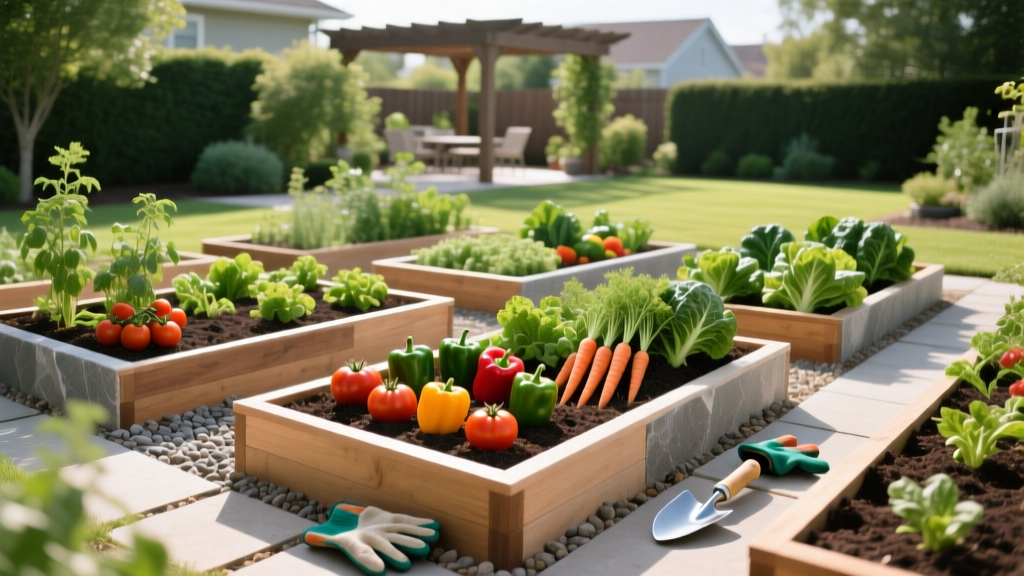
Creative Vegetable Garden Design Layouts for Beginners
Why Traditional Row Gardening Fails Small Yards
When planning a creative vegetable garden design, the first step is abandoning the traditional agricultural row format. Row cropping was engineered for tractor access and large-scale monocultures, not for maximizing yield in a 500-square-foot suburban backyard. Rows waste up to 60% of your available space on walking paths and require extensive weeding. For beginners looking to maximize both aesthetics and caloric output, structured geometric layouts and vertical layering are the definitive solutions.
According to Penn State Extension, high-density planting methods like square-foot gardening can produce the same yield as traditional rows while using 80% less space and 50% less water. By shifting your perspective from 'farming' to 'landscape architecture,' you can integrate edible crops seamlessly into your curb appeal.
The Core Framework: Choosing Your Containment
Before drawing layout lines, you must select your physical boundaries. Contained beds warm up 10 to 14 days earlier in the spring than in-ground soil, extending your growing season. Here is a direct comparison of the two premier materials for beginner hardscaping in 2026:
1. Rough-Sawn Western Red Cedar (2x10 inch)
Cedar is the gold standard for wooden beds. A standard 4x8-foot bed built with 2x10-inch boards provides a 10-inch depth, which is sufficient for 90% of vegetable root systems. Untreated cedar naturally resists rot and insects due to its high tannin content, lasting 10 to 15 years. Avoid pressure-treated lumber stamped with ACQ or MCQ, as the copper compounds can leach into acidic soils over time.
2. Corrugated Galvanized Steel (e.g., Vego Garden 17-inch)
Metal raised beds have surged in popularity due to their zero-maintenance longevity (20+ years) and modern aesthetic. A 17-inch tall modular steel bed eliminates the need for bending and provides superior drainage. The galvanized zinc coating is safe for edibles, and the metal acts as a thermal mass, absorbing heat during the day and releasing it at night to protect tender crops like peppers and eggplants from early frost.
⚠️ Warning: Soil Volume Calculation
Beginners consistently underestimate the volume of soil required. A 4x8-foot bed that is 10 inches deep requires exactly 26.6 cubic feet of soil. Always purchase 30 cubic feet to account for settling after the first heavy watering. Do not use native yard dirt in raised beds; it will compact into concrete and suffocate roots.
3 Creative Layout Configurations for Small Spaces
A successful creative vegetable garden design relies on geometry that dictates human movement and plant hierarchy. Choose one of these three layouts based on your yard's specific dimensions.
The Keyhole Garden
Ideal for square or circular plots, the keyhole design features a 6-foot diameter outer circle with a 2-foot wide path cutting into the center, ending in a 2-foot diameter inner circle. This creates a 'horseshoe' planting bed. The genius of the keyhole is that no point in the planting bed is further than 2 feet from the path, completely eliminating the need to step on the soil. This prevents compaction and keeps your root zones aerated.
The Potager (Kitchen Garden) Grid
The Potager blends strict symmetry with high-yield production. Use four 3x3-foot raised beds arranged in a perfect square, separated by 3-foot wide pathways. In the exact center of the cross-axis, install a 7-foot tall cedar obelisk or iron trellis. Plant indeterminate tomatoes or pole beans to climb the center structure, drawing the eye upward and creating a striking focal point from your patio or kitchen window.
The Spiral Herb and Veggie Tower
Constructed using stacked retaining wall blocks or gabion baskets, a spiral garden creates multiple microclimates in a single 5-foot footprint. The top of the spiral is dry and well-drained (perfect for rosemary, thyme, and oregano), while the bottom retains moisture and collects runoff (ideal for parsley, cilantro, and leafy greens). This layout leverages gravity and hydrology to reduce watering frequency.
Layout Comparison Matrix
| Layout Type | Space Required | Initial Build Cost (2026) | Maintenance Level | Best For |
|---|---|---|---|---|
| Keyhole Circle | 6x6 ft minimum | $150 - $220 (Pavers/Stone) | Medium | Maximizing edge space, small circular lawns |
| Potager Grid | 12x12 ft minimum | $600 - $900 (4 Cedar Beds) | High | Curb appeal, formal backyard aesthetics |
| Spiral Tower | 5x5 ft footprint | $250 - $400 (Wall blocks) | Low | Herbs, microclimates, patio integration |
Hardscaping: Tying the Design Together
The pathways in your creative vegetable garden design are just as important as the beds. Mud and overgrown grass between beds will ruin the aesthetic and harbor pests. According to University of Wisconsin-Madison Extension, proper pathway management reduces slug habitats and improves garden accessibility.
- Decomposed Granite (DG) with Stabilizer: For a premium, permeable surface that looks like natural stone, use DG mixed with a polymeric stabilizer (like Gator Dust). It costs roughly $3.50 per square foot installed, compacts hard, but allows rainwater to percolate into the water table.
- Arborist Wood Chips: The most budget-friendly option (often free from local tree services). Lay down commercial-grade woven geotextile fabric first, then apply a 3-inch layer of chips. Avoid using landscape fabric with plastic backing, which causes water pooling and anaerobic soil conditions.
- Stepping Stones with Creeping Thyme: For a softer, cottage-core look, place 18-inch flagstones 12 inches apart and plant 'Elfin' creeping thyme in the gaps. The thyme tolerates light foot traffic and releases a pleasant fragrance when stepped on.
The 2026 Sustainable Soil Recipe
Do not buy bagged 'topsoil' for raised beds; it is too heavy and lacks nutrients. Build your own mix using the updated, sustainable variant of Mel's Mix. Peat moss harvesting is increasingly restricted due to bog depletion, so substitute it with coco coir.
- 30% Coarse Vermiculite: Provides permanent aeration and water retention. (Ensure it is horticultural grade, not insulation grade).
- 30% Buffered Coco Coir: Replaces peat moss. Must be 'buffered' to prevent it from stripping calcium and magnesium from your soil.
- 40% Blended Compost: Use at least three different sources (e.g., mushroom compost, worm castings, and composted cow manure) to ensure a broad spectrum of micronutrients.
Companion Planting in Geometric Layouts
In tight, creative layouts, every square inch must perform multiple functions. Companion planting deters pests and maximizes vertical space. Use this framework when filling your 4x8 grids:
💡 Pro-Tip: The 3-Sister Matrix
For a single 4x4 square, plant sweet corn in the center (4 stalks). Once the corn is 6 inches tall, plant pole beans at the base of each stalk to climb. Finally, plant sprawling squash varieties around the outer perimeter. The corn provides a trellis, the beans fix nitrogen in the soil, and the squash leaves act as a living mulch to suppress weeds and retain moisture.
| Primary Crop | Companion 1 (Pest Control) | Companion 2 (Spatial) | Spacing Rule |
|---|---|---|---|
| Indeterminate Tomatoes | French Marigolds (Nematode control) | Basil (Ground cover) | Tomatoes 18" apart, Basil 6" from base |
| Brassicas (Kale/Cabbage) | Nasturtiums (Trap crop for aphids) | Dill (Attracts predatory wasps) | Brassicas 12" apart, Nasturtiums on bed edges |
| Pole Beans | Savory (Deters bean beetles) | Radishes (Fast harvest before canopy) | Beans 4" apart, Radishes broadcast sown |
Budgeting Your First Creative Garden
A common failure mode for beginners is undercapitalizing the initial build, leading to stunted plants and frustration. Here is a realistic budget for a highly productive, aesthetically pleasing 80-square-foot Potager setup in 2026:
- Containment (Two 4x8 Cedar Beds): $240
- Hardware (Corner brackets, exterior screws): $35
- Soil Components (Bulk delivery or bagged equivalent): $180
- Pathway (Geotextile fabric + 2 yards of arborist chips): $60
- Irrigation (Drip tape kit with digital timer): $85
- Seeds and Transplants: $75
- Total Estimated Investment: $675
By investing heavily in the soil matrix and hardscaping upfront, you reduce annual maintenance to simple planting, pruning, and harvesting. A well-designed creative vegetable garden is not just a food source; it is a permanent, value-adding landscape feature that bridges the gap between utility and high-end outdoor design.

