
Landscaping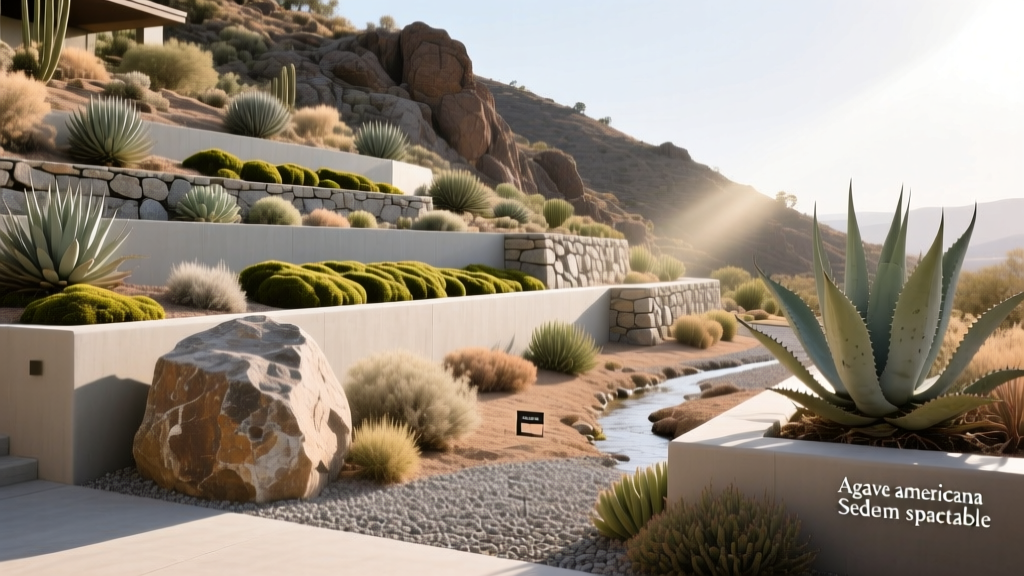
How to Build a Drought-Tolerant Rocky Landscape on a Slope
Transforming a steep, unmanageable incline into a thriving rocky landscape solves two major property issues simultaneously: soil erosion and excessive water consumption. According to the EPA WaterSense program, traditional turfgrass planted on slopes wastes up to 50% of applied water to surface runoff. A properly engineered rocky landscape reduces irrigation needs by 60% to 80% while permanently anchoring the soil.
This guide details the exact engineering, hardscape selection, and botanical choices required to build a stable, low-maintenance rocky landscape on slopes ranging from 15 to 45 degrees.
Site Grading and the Percolation Imperative
Before placing a single stone or plant, you must evaluate the soil's drainage capacity. Slopes often suffer from rapid surface runoff, meaning water never penetrates the root zone. Conversely, the base of a slope may trap water, creating a bog.
⚠️ The Percolation Test: Dig a 12-inch deep test hole on the mid-slope. Fill it with water and let it drain, then refill it. Measure the drop. If it drains slower than 1 inch per hour, you have heavy clay that will suffocate alpine and succulent roots. If it drains faster than 6 inches per hour, it is pure sand and will not hold nutrients.
For heavy clay slopes, amend the top 12 inches of soil with Profile Porous Ceramic (PPC) at a 30% volume ratio. Unlike organic compost, which decomposes and washes away on inclines, PPC is a kiln-fired ceramic aggregate that permanently increases soil porosity and water retention without adding lightweight bulk that contributes to slope slippage.
Hardscape Material Matrix: What to Buy
Choosing the wrong rock for a slope is the most common point of failure. Smooth stones roll downhill during heavy rain, while flat stones require extensive base preparation to stay level. Use the matrix below to select the correct material for your specific slope angle.
| Material | Est. Cost (2026) | Best Slope Angle | Structural Notes |
|---|---|---|---|
| Riprap (Angular) | $55 - $95 / ton | 30° - 45° | Jagged edges interlock naturally. Excellent for erosion control. |
| Flagstone | $18 - $28 / sq ft | 0° - 15° (Terraced) | Requires a 4-inch compacted gravel base. Best for dry-stack retaining. |
| River Rock | $70 - $130 / ton | 0° - 10° ONLY | Smooth surface causes rolling. Never use on un-terraced inclines. |
Dry-Stack Terracing for Moderate Slopes
If your slope exceeds 15 degrees and you prefer a manicured look over raw riprap, you must terrace the land using dry-stack retaining walls. Use 4-inch thick limestone or basalt blocks. Excavate a 6-inch trench at the base and fill it with compacted 3/4-inch minus gravel. As you stack the stones, apply a 'batter' angle—leaning the wall back into the slope by 1 inch for every 12 inches of height. This uses gravity to lock the wall against the soil pressure.
Botanical Anchors: Selecting Deep-Rooted Flora
Shallow-rooted plants will fail on a rocky landscape slope during the first heavy storm. You need fibrous, mat-forming root systems that act as biological rebar. The Colorado State University Extension emphasizes hydro-zoning—grouping plants with identical water needs to maximize efficiency.
- Juniperus horizontalis 'Blue Rug': Roots spread 4 to 6 feet wide and plunge 18 inches deep. It tolerates the intense reflected heat from surrounding boulders and requires zero supplemental water once established.
- Sedum spurium 'Dragon's Blood': A succulent mat-forming groundcover with a 4-inch root depth. It thrives in the shallow pockets between flagstones and riprap. Requires initial drip irrigation for 60 days, then survives on ambient rainfall.
- Festuca glauca 'Elijah Blue': A fibrous bunchgrass with a 12-inch root depth. Its dense basal clumps are excellent for filling gaps between larger boulders and trapping wind-blown soil.
- Ceanothus thyrsiflorus 'Yankee Point': For larger slopes needing deep structural roots. This evergreen shrub sends taproots down 3 to 4 feet, anchoring deep soil layers while providing vibrant blue spring blooms.
For comprehensive planting layouts and regional adaptations, consulting resources like the University of Minnesota Extension on rock gardens can help you adjust these selections to your specific USDA Hardiness Zone.
Irrigation Engineering for Incline Gardens
Standard spray sprinklers are entirely useless on a rocky landscape slope; the water atomizes and blows away, or simply runs off before penetrating the soil. You must install a pressure-compensating drip system with built-in check valves.
💡 Pro Equipment Spec: Use Netafim Techline CV (Continuous Valve) drip tubing. The integrated check valves prevent low-point drainage and siphoning when the system shuts off. This ensures uniform water distribution across a 20-foot elevation change, preventing the bottom of the slope from drowning while the top dries out.
Installation Layout: Run 1/2-inch mainline tubing vertically up the slope, then branch off with 1/2-inch Techline CV tubing zig-zagging horizontally across the contour lines. Space the horizontal runs 18 inches apart. Secure the tubing every 4 feet using 6-inch galvanized steel landscape staples to prevent the lines from creeping downhill over time.
Securing the Slope During the 90-Day Establishment Phase
The highest risk of catastrophic failure occurs in the first 90 days, before the plant roots have fully bound the soil together. To bridge this gap, you must deploy mechanical erosion control.
- Apply Jute Netting: Roll out 100% biodegradable jute erosion control netting (typically sold in 4x225 ft rolls for approximately $85). The jute mesh slows water velocity and catches soil particles.
- Pin Aggressively: Secure the netting with 6-inch U-shaped steel staples every 3 feet along the edges and every 5 feet in the center. Overlap adjacent rolls by at least 6 inches.
- Mulch with Gravel: Top the exposed soil between plants with 2 inches of 3/4-inch crushed angular gravel. Never use wood chips or shredded bark on a slope; they act like tiny boats and will float away during the first heavy rainstorm, clogging your storm drains.
Long-Term Maintenance and Edge Cases
Once the rocky landscape is established, maintenance shifts from watering to debris management and weed suppression. Because the hardscape consists of rock and gravel, you cannot use a metal rake without damaging the shallow crowns of succulents like Sedum.
Use a backpack blower on a low-RPM setting to clear autumn leaves and organic debris from the rock crevices. For weed control, avoid pulling large weeds by hand, as this will dislodge the surrounding gravel and disturb the delicate root mats. Instead, apply a pre-emergent herbicide like prodiamine (Barricade) in early spring at a rate of 1.5 lbs per 1,000 sq ft to stop weed seeds from germinating in the gravel mulch. Spot-treat any breakthrough weeds with a targeted glyphosate application using a shielded wand to protect your botanical anchors.

