
Landscaping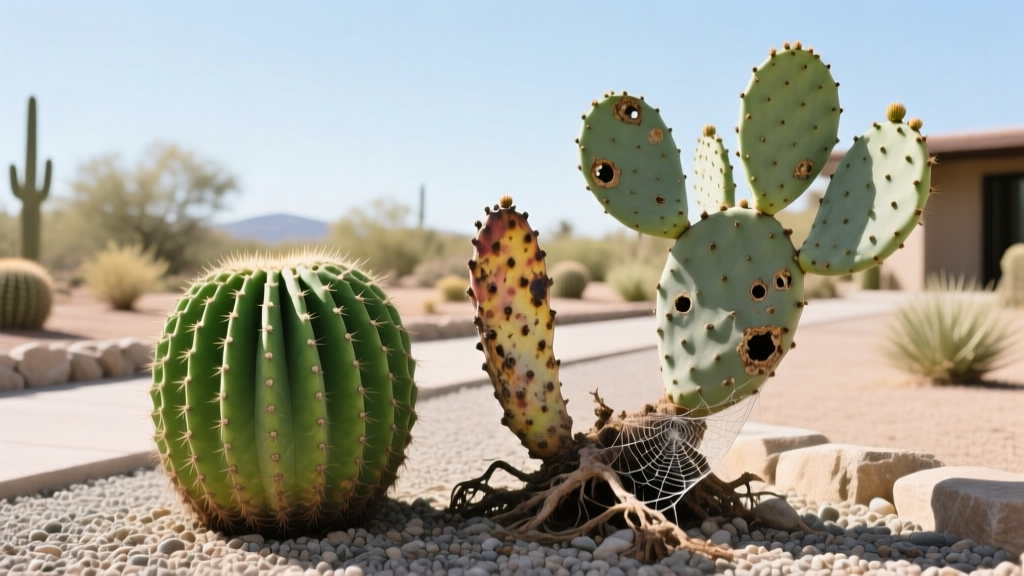
Cactus Landscape Troubleshooting: Fixing Rot, Pests & Scorch
Cactus landscapes are frequently mismanaged because homeowners apply traditional turf-grass irrigation and maintenance logic to desert succulents. While xeriscaping reduces overall water consumption, a poorly designed or improperly maintained cactus landscape will quickly succumb to root rot, epidermal scorch, and specialized pest invasions. Diagnosing these issues requires understanding the unique physiological adaptations of desert flora. Below is a comprehensive diagnostic framework for identifying and resolving the most critical failures in residential cactus and succulent landscapes.
The Silent Killer: Diagnosing Root Rot vs. Underwatering
Root rot is the leading cause of mortality in residential cactus landscapes. It is almost always triggered by soil asphyxiation—when pore spaces fill with water, depriving roots of oxygen and inviting Phytophthora and Pythium pathogens. However, the visual symptoms of advanced root rot (shriveled, wrinkled skin) are nearly identical to severe underwatering. Misdiagnosis leads to the fatal mistake of watering an already rotting plant.
The Toothpick Moisture Test
Before administering water, perform a physical soil check. Insert an untreated wooden skewer or soil probe 6 to 8 inches deep near the base of the cactus. Leave it for five minutes, then extract it. If the wood feels cool or shows dark moisture staining, the root zone is saturated. Do not water. If the skewer emerges completely dry and at ambient temperature, the plant requires hydration.
Warning: The Peat Moss Trap
Many commercial cactus soils rely heavily on peat moss. When peat dries out completely, it becomes hydrophobic, repelling water. Conversely, when overwatered, it acts like a sponge, holding moisture against the cactus taproot for weeks. For in-ground landscapes, abandon bagged potting mixes. Instead, build a custom matrix: 50% 1/4-inch pumice (e.g., General Pumice, approx. $45 per cubic foot), 25% coarse quartz sand, and 25% composted pine bark to ensure rapid macropore drainage.
Many commercial cactus soils rely heavily on peat moss. When peat dries out completely, it becomes hydrophobic, repelling water. Conversely, when overwatered, it acts like a sponge, holding moisture against the cactus taproot for weeks. For in-ground landscapes, abandon bagged potting mixes. Instead, build a custom matrix: 50% 1/4-inch pumice (e.g., General Pumice, approx. $45 per cubic foot), 25% coarse quartz sand, and 25% composted pine bark to ensure rapid macropore drainage.
Surgical Intervention for Advanced Rot
If the base of the cactus is soft, black, or emits a foul odor, rot has breached the vascular cylinder. Small columnar or globular cacti can sometimes be saved via surgical amputation. Using a serrated knife sterilized with 70% isopropyl alcohol, cut away all mushy tissue until only firm, clean green and white tissue remains. Dust the exposed wound heavily with sulfur powder (such as Bonide Sulfur Plant Fungicide, approx. $8) to desiccate the cut and prevent secondary fungal infections. Allow the callus to cure in deep shade for 14 days before replanting in dry, amended soil.
Sunburn and Epidermal Scorch: Acclimation Failures
Cacti purchased from commercial nurseries are typically grown under 30% to 50% shade cloth. When transplanted directly into an unshaded, south-facing xeriscape bed, the sudden spike in ultraviolet radiation destroys the plant's chloroplasts, resulting in permanent epidermal scorch. This presents as bleached, yellow, or crispy brown patches on the side of the plant facing the afternoon sun.
Unlike human skin, a cactus cannot heal sunburned tissue; the scarred epidermis will remain discolored for the rest of the plant's life, and severe scorch can compromise the structural integrity of the stem, leading to collapse.
The Hardening-Off Protocol
To prevent UV shock, implement a graduated acclimation schedule. For the first two weeks post-planting, drape a 50% Aluminet shade cloth over a wire hoop frame above the cactus. Aluminet is superior to black polypropylene shade cloth because its reflective aluminum threads bounce infrared heat away from the plant tissue. In week three, switch to a 30% shade cloth. By week four, remove the shade entirely, provided the ambient temperature has not spiked above 105°F (40°C). According to the University of California Agriculture and Natural Resources, gradual light exposure allows the plant to synthesize protective UV-absorbing flavonoids in its epidermal layers.
Pest Invasions: Cochineal Scale and the Snout Weevil
Desert landscapes are not immune to pests. In fact, monoculture xeriscapes can create ideal breeding grounds for specialized sap-sucking and boring insects. Early detection is the only way to prevent landscape-wide infestations.
| Pest | Diagnostic Signs | Targeted Treatment |
|---|---|---|
| Cochineal Scale (Dactylopius coccus) |
Fluffy, white, cotton-like masses clustered in the areoles (spine nodes). Crush a mass to reveal a deep crimson fluid. | Blast with a high-pressure hose nozzle to dislodge. Follow with a spray of 2% insecticidal soap or neem oil applied at dusk to avoid leaf burn. |
| Agave Snout Weevil (Scyphophorus acupunctatus) |
Accordion-pleated lower leaves, small entry holes near the base, and a rotting, foul odor. The plant will rock easily in the soil. | No cure once infested. Remove and destroy the plant. Preventatively drench surrounding Agaves with Imidacloprid (e.g., Bayer Advanced 12 Month, approx. $25) in early March. |
| Cactus Longhorn Beetle (Moneilema gigas) |
Dark, oozing wounds on the stems of cholla and prickly pear. Black, tar-like excrement near the base of the damage. | Hand-pick the large, black-and-white beetles at dawn when they are sluggish. Apply Spinosad-based sprays to the stems during summer monsoon season. |
Frost Damage and Microclimate Mapping
Many homeowners assume all cacti are inherently frost-tolerant. While species like the Opuntia (Prickly Pear) and Echinocereus (Hedgehog Cactus) can survive temperatures down to 10°F (-12°C), popular landscape staples like the Saguaro (Carnegiea gigantea) and Mexican Fence Post (Pachycereus marginatus) suffer severe tissue damage when temperatures drop below 25°F (-4°C). Frost damage manifests as black, mushy, water-soaked tissue that eventually dries into a brittle, corky scab.
"Successful xeriscaping relies on microclimate mapping. Placing a frost-tender columnar cactus in a low-lying 'frost pocket' where cold air settles guarantees winter mortality, whereas planting it on a slight berm or near a south-facing masonry wall provides enough radiant thermal mass to survive the freeze."
— Adapted from guidelines by the Southern Nevada Water Authority on desert landscape design.
Winterization Tactics
When a hard freeze is forecasted, protect vulnerable specimens using spun-bond polypropylene frost cloth (such as Agribon AG-30 or AG-50, approx. $35 for a 10x30 ft roll). This material allows moisture to escape while trapping ground heat. Never use plastic sheeting; plastic traps condensation against the cactus epidermis, which will freeze solid and cause worse damage than the ambient air temperature. Secure the cloth to the ground with landscape staples to prevent wind displacement, and remove it immediately the following morning once temperatures rise above freezing to prevent greenhouse-effect overheating.
For long-term frost mitigation, integrate large boulders (minimum 200 lbs) into the landscape design behind your cactus groupings. These stones absorb solar radiation throughout the day and slowly release it as thermal mass overnight, raising the immediate ambient temperature around the plants by 3°F to 5°F. Combining proper soil architecture, rigorous pest monitoring, and strategic microclimate placement ensures a cactus landscape that thrives rather than merely survives.
For further reading on sustainable desert plant selection and irrigation auditing, consult the Royal Horticultural Society's cacti and succulents database, which offers extensive botanical profiles and hardiness zone mapping.

