
Landscaping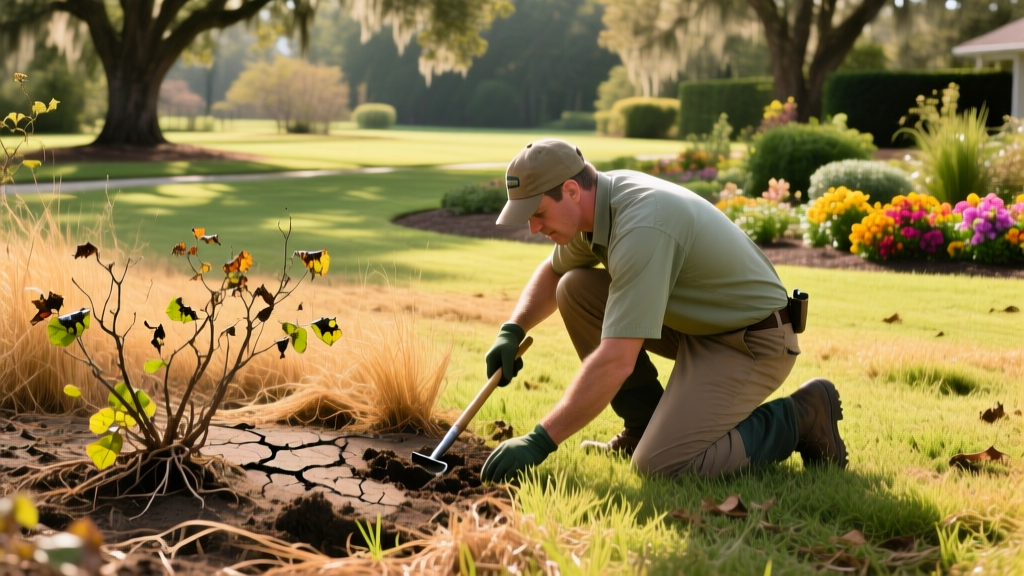
Diagnosing Failing Savannah Landscapes: Causes and Restoration Fixes
The Ecological Trap: Why Savannah Landscapes Fail
Residential savannah landscapes—characterized by an open tree canopy (10% to 30% cover) and a continuous, diverse understory of native warm-season bunchgrasses and forbs—are highly sought after for their drought tolerance and biodiversity. However, homeowners frequently encounter a severe ecological trap: without active disturbance regimes, these landscapes naturally undergo successional climax, transforming into dense, shaded woodlands within five to seven years. When the canopy closes, the shade-intolerant graminoids and wildflowers die off, leaving behind a barren, mossy floor prone to erosion and invasive weed colonization.
"A savanna is not a static planting; it is a dynamic ecosystem maintained by disturbance. If you plant a savanna and walk away, you are simply planting the early stages of a forest." — Xerces Society for Invertebrate Conservation Habitat Guidelines.
Diagnosing the failure of a savannah landscape requires looking past the symptoms (dying grasses, sparse blooms) and identifying the broken ecological mechanisms. Below is a comprehensive diagnostic framework and actionable restoration protocols to rescue your failing native yard.
Diagnostic Matrix: Symptoms, Causes, and Triage
| Visual Symptom | Underlying Ecological Cause | Immediate Triage Action |
|---|---|---|
| Understory grasses thinning; moss or shade-tolerant weeds appearing. | Canopy closure exceeding 40%, blocking critical PAR (Photosynthetically Active Radiation). | Perform structural crown thinning on dominant trees; remove encroaching volunteer saplings. |
| Cool-season grasses (fescue, bluegrass) choking out native bunchgrasses. | Nitrogen loading from adjacent turf; lack of spring competitive suppression. | Apply selective grass-specific herbicide (Fluazifop-P-butyl) during early spring dormancy. |
| Water pooling after rain; deep-rooted forbs (e.g., Compass Plant) dying. | Soil compaction destroying macropores; hydrophobic crusting on the soil surface. | Deep-tine core aeration followed by an expanded shale top-dressing. |
| Woody shrubs (e.g., Eastern Redcedar, Dogwood) forming dense thickets. | Absence of historical fire or grazing disturbance regimes. | Mechanical brush cutting combined with winter mowing surrogates. |
Deep Dive: Reversing Woody Encroachment and Canopy Closure
The most common reason a savannah landscape fails is the unchecked growth of the overstory. Species like Bur Oak (Quercus macrocarpa) or Longleaf Pine (Pinus palustris) are essential anchor trees, but their expanding canopies eventually starve the understory of sunlight. Furthermore, wind-dispersed woody shrubs and volunteer trees will rapidly colonize the open spaces.
Canopy Management Specifications
To restore the critical 15% to 30% canopy cover required for a healthy savanna, you must employ targeted arboricultural techniques rather than indiscriminate clearing:
- Crown Thinning: Hire an ISA-certified arborist to perform structural crown thinning on your anchor trees. The goal is to remove 15% to 20% of the inner lateral branches, creating "light gaps" that allow dappled sunlight to reach the forest floor. Expect to pay $250 to $450 per mature tree for this specialized work.
- Crown Raising: Remove the lower third of the tree's branches to allow low-angle morning and evening light to penetrate beneath the canopy.
- Volunteer Eradication: Use a commercial-grade brushcutter (such as the Stihl FS 56 C-E with a 4-tooth clearing blade) to mechanically sever volunteer saplings below the root collar. Do not pull them, as soil disturbance will trigger the germination of dormant weed seeds.
The Bunchgrass Battle: Eradicating Cool-Season Invaders
Native savanna grasses like Little Bluestem (Schizachyrium scoparium) and Big Bluestem (Andropogon gerardii) are warm-season (C4) plants. They remain dormant until soil temperatures reach 60°F in late spring. Cool-season (C3) invasive grasses, such as Tall Fescue or Kentucky Bluegrass, begin growing aggressively in early spring, monopolizing soil moisture and nutrients before the native grasses even break dormancy.
Warning: Broadleaf Herbicide Misapplication
Never use broad-spectrum herbicides like Glyphosate or standard 2,4-D broadleaf killers in a savanna landscape. These will indiscriminately kill your native forbs and wildflowers (like Coneflowers and Milkweed), which are vital for pollinator support as outlined by the National Wildlife Federation's Garden for Wildlife protocols. You must use highly selective graminicides.
Step-by-Step Selective Herbicide Protocol
To eliminate cool-season grasses without harming your dormant native bunchgrasses, utilize Fluazifop-P-butyl (commonly sold under the brand name Ornamec or Grass-B-Gon). This systemic herbicide targets C3 grasses specifically.
- Timing: Apply in early spring when daytime air temperatures are consistently between 55°F and 65°F, and cool-season grasses are actively growing, but native warm-season grasses are still completely dormant (brown).
- Mixing: Mix Fluazifop-P-butyl at a rate of 0.5 to 0.75 oz per 1,000 square feet. Crucially, add a non-ionic surfactant at 0.25% v/v to ensure the chemical penetrates the waxy cuticle of the fescue.
- Application: Use a backpack sprayer equipped with a flat-fan nozzle (e.g., TeeJet 8002) calibrated to 20 PSI. Spray evenly until the foliage is wet, but avoid runoff.
- Follow-up: Wait 14 to 21 days. The invasive grasses will turn chlorotic (yellow) and collapse. Spot-treat any surviving patches with a second application.
Suburban Fire Surrogates: The Winter Mowing Regime
In natural ecosystems, savannas are maintained by frequent, low-intensity fires that consume accumulated dead biomass, return nutrients to the soil as ash, and suppress woody seedlings. Because prescribed fire is rarely legal or safe in suburban residential zones, you must implement a mechanical surrogate: winter mowing with biomass removal.
In late February or early March, just before the native grasses break dormancy, mow the entire savanna understory to a height of 4 to 6 inches. You must bag and remove all clippings. Leaving the clippings on the ground simulates a thick thatch layer, which harbors fungal pathogens and blocks sunlight from reaching the basal crowns of the bunchgrasses. Removing the biomass simulates the nutrient export of a fire, preventing the soil from becoming overly enriched with nitrogen, which favors aggressive weeds over slow-growing native perennials.
Soil Hydrology: Fixing Compacted Savanna Substrates
Savanna plants are deeply rooted; species like Compass Plant (Silphium laciniatum) can send taproots down 10 to 15 feet to access deep moisture. However, suburban construction severely compacts the subsoil, creating a hardpan that restricts root penetration and causes surface water to pool. According to USDA NRCS Soil Health Management guidelines, restoring soil macroporosity is essential for deep-rooted native perennials.
The Expanded Shale Aeration Method
Standard lawn aeration is insufficient for savanna restoration. You must permanently alter the soil structure using expanded shale (often sold under the brand name PermaTill). Expanded shale is a lightweight, porous aggregate that permanently fractures compacted clay and creates lasting air and water channels.
- Step 1: Rent a walk-behind core aerator (such as a Billy Goat AET55) and make two overlapping passes over the affected zone, pulling 3-inch deep soil plugs.
- Step 2: Purchase bulk expanded shale (typically $60 to $85 per cubic yard). Spread it evenly over the aerated area to a depth of 0.5 inches.
- Step 3: Use a heavy steel drag mat or a stiff push broom to aggressively work the shale particles down into the open aeration holes.
- Step 4: Water the area deeply (applying at least 1 inch of water) to wash the shale into the subsoil macropores and settle the soil plugs back into the turf.
By systematically diagnosing canopy density, selectively eradicating cool-season competitors, simulating fire through biomass removal, and permanently fracturing compacted subsoils, you can halt ecological succession and restore the vibrant, biodiverse balance of a true savannah landscape.

