
Landscaping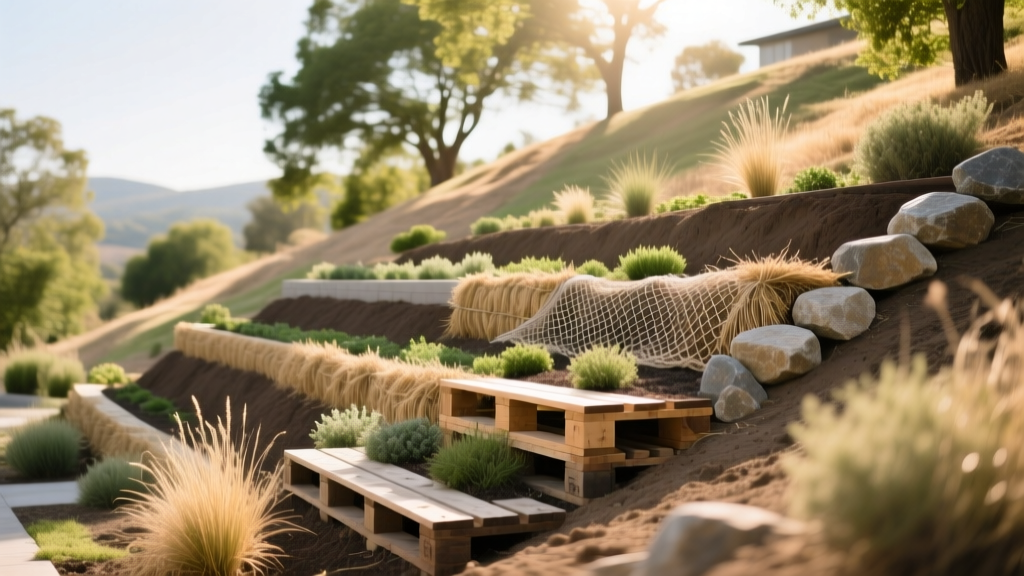
Practical Hillside Landscaping Ideas on a Budget: DIY Erosion Control
Unstabilized slopes lose topsoil, wash out mulch, and create unusable dead zones in residential yards. Professional retaining walls and extensive hardscaping can easily exceed $15,000 for a moderate incline. However, by leveraging gravity-defying planting matrices, biodegradable erosion control blankets (ECBs), and DIY timber terracing, homeowners can execute effective hillside landscaping ideas on a budget, typically keeping a 500-square-foot slope stabilization project under $800.
The Physics of Slope Failure: Why Cheap Shortcuts Fail
Before moving dirt, you must understand shear stress. According to the USGS Water Science School, erosion accelerates exponentially as slope gradient increases because water velocity outpaces soil infiltration rates. When the gravitational pull on saturated soil exceeds its internal shear strength, mass wasting (slumping) occurs. Budget landscaping fails when it only addresses the surface (like laying sod on a 30-degree angle without netting) rather than reinforcing the root zone and managing subsurface hydrostatic pressure.
DIY Timber Terracing: The $300 Retaining Solution
For slopes between 15 and 35 degrees, timber terracing breaks a single steep incline into manageable, flat planting shelves. In 2026, pressure-treated lumber remains the most cost-effective structural material for DIY retaining walls under 3 feet in height.
Materials and 2026 Pricing Estimates
- 4x4 UC4B Pressure-Treated Pine: ~$9.50 per linear foot. UC4B rating is mandatory for ground contact and soil retention.
- 3/8-inch Galvanized Rebar (36-inch lengths):strongstrong> ~$4.20 per piece. Used for pinning timbers to the earth.
- 3/4-inch Crushed Gravel: ~$55 per cubic yard. Essential for the base trench and backfill drainage.
- Landscape Timber Spikes (10-inch): ~$18 for a 5-lb box.
Step-by-Step Installation
- Excavate a Level Trench: Dig a trench 6 inches deep and 10 inches wide at the base of the slope. The first 4x4 timber must be buried halfway to resist the lateral earth pressure of the soil behind it.
- Lay the Gravel Base: Fill the trench with 3 inches of 3/4-inch crushed gravel and compact it with a hand tamper. Never place timber directly on bare soil; capillary action will rot the wood prematurely.
- Pin the First Course: Drill 1/2-inch holes through the timber every 3 feet. Drive the 36-inch rebar through the holes into the subgrade, leaving 1 inch of rebar below the timber surface.
- Install Deadmen Anchors: For walls over 24 inches high, attach perpendicular timber braces (deadmen) every 4 linear feet, extending 3 feet back into the slope. Secure with 10-inch galvanized spikes.
- Backfill with Gravel: Place 6 inches of crushed gravel directly behind the timber wall before adding topsoil. This prevents hydrostatic pressure buildup that blows out retaining walls during heavy rain.
Budget Plant Matrix: Deep-Root vs. Surface Spreaders
Selecting the right vegetation is the most cost-effective long-term erosion control strategy. The University of Minnesota Extension emphasizes that a mix of deep-rooted structural plants and surface-spreading groundcovers provides the best slope armoring. Avoid standard turfgrass on slopes steeper than 25 degrees; its shallow 2-inch root system offers negligible shear reinforcement.
| Plant Species | Root Depth | Max Slope Angle | Cost per Plug | Best Use Case |
|---|---|---|---|---|
| Juniperus horizontalis (Blue Rug) | 18 - 24 inches | 45 degrees | $3.50 - $4.50 | Sunny, dry, rocky slopes |
| Hemerocallis (Daylilies) | 24 - 36 inches | 35 degrees | $2.00 - $3.00 | Wet zones, runoff paths |
| Pachysandra terminalis | 8 - 12 inches | 20 degrees | $1.20 - $1.80 | Shaded, under-tree slopes |
| Crownvetch (Securidaca) | 36+ inches | 50 degrees | Seed: $15/lb | Large, unmaintained rural banks |
⚠️ Warning: Invasive Species Check
Before planting Hedera helix (English Ivy) or Euonymus fortunei (Wintercreeper) for cheap ground cover, verify your local county extension regulations. Many regions have banned these aggressive spreaders because they escape residential yards and strangle native forest canopies. Stick to native or non-invasive cultivars like Creeping Phlox or Bearberry.
Before planting Hedera helix (English Ivy) or Euonymus fortunei (Wintercreeper) for cheap ground cover, verify your local county extension regulations. Many regions have banned these aggressive spreaders because they escape residential yards and strangle native forest canopies. Stick to native or non-invasive cultivars like Creeping Phlox or Bearberry.
Jute Netting & Hydroseeding: The $150 Erosion Hack
If terracing is outside your budget or physical capability, erosion control blankets (ECBs) combined with hydroseeding offer immediate slope stabilization. Jute netting is a 100% biodegradable, open-weave mat that holds seed and soil in place until root systems establish.
The Shingle Application Method
Most DIYers install netting incorrectly by starting at the bottom of the hill. You must install jute netting from the top down, overlapping each row by 6 inches like roof shingles. If you overlap bottom-up, water will slide under the seams and wash the soil out from beneath the mat.
- Trench the Crest: Dig a 6-inch deep trench at the very top of the slope. Bury the leading edge of the netting and pin it to prevent water from getting underneath.
- Staple Spacing: Use 6-inch galvanized U-shaped staples. Pin every 3 feet along the seams and every 5 feet in the center of the roll. On slopes exceeding 30 degrees, double the staple density.
- Hydroseed Injection: Rather than laying seed under the net (which causes uneven germination), lay the net first, then spray a cellulose-based hydroseed slurry directly through the jute weave. The cellulose mulch binds to the jute fibers, creating a monolithic erosion shield.
Managing Runoff: The Gravel French Drain
Surface landscaping will fail if subsurface water isn't managed. When water infiltrates a slope, it creates a slip plane between the topsoil and the clay subgrade. A budget-friendly French drain intercepts this groundwater.
'The most common cause of retaining wall failure on residential hillsides is not the weight of the soil, but the weight of trapped water. A $100 gravel trench saves a $5,000 wall.' — Certified Landscape Technician Structural Guidelines
Dig a 12-inch wide by 18-inch deep trench parallel to the base of your slope. Line it with non-woven geotextile fabric (woven fabrics clog with fine silt within two seasons). Lay a 4-inch corrugated slotted PVC pipe with the slots facing down (this forces water to filter up through the gravel bed, keeping the slots clear of debris). Fill the trench with 3/4-inch washed gravel and fold the fabric over the top before covering with 2 inches of topsoil.
Cost Breakdown: 500 Sq. Ft. Slope Stabilization
Below is a realistic material cost comparison for stabilizing a 500-square-foot sloped yard (approx. 20x25 feet with a 4-foot vertical drop) using budget-conscious DIY methods versus hiring professional hardscapers in 2026.
| Project Component | DIY Budget Approach | Professional Hardscape |
|---|---|---|
| Retaining Structure | $320 (4x4 Timber Terracing) | $4,500 (Segmental Concrete Block) |
| Erosion Matting | $85 (Jute Netting + Staples) | $350 (Synthetic TRM Installation) |
| Plant Material | $180 (50 Plugs + Seed) | $1,200 (15-Gallon Mature Shrubs) |
| Drainage | $110 (Pipe, Fabric, Gravel) | $850 (Engineered French Drain) |
| Labor | $0 (Weekend DIY) | $3,500 - $5,000 |
| Total Estimated Cost | $695 | $10,400 - $11,900 |
Troubleshooting Common Hillside Failures
Problem: Mulch Washing Out During Heavy Rain
Cause: Using lightweight hardwood or cedar mulch on an incline.
Fix: Switch to shredded bark or pine straw, which knit together to form a cohesive mat. Alternatively, install wooden landscape edging stakes every 4 feet horizontally across the slope to create micro-terraces that catch sliding mulch.
Problem: Groundcover Plants Dying at the Top of the Slope
Cause: The crest of a hill dries out fastest due to wind exposure and rapid gravitational drainage.
Fix: Install a soaker hose along the very top edge of the slope, covered by mulch. Run it for 30 minutes twice a week during the first growing season to establish deep taproots that will eventually seek out subsurface moisture.
Problem: Timber Retaining Wall Bowing Outward
Cause: Lack of deadmen anchors or improper backfill causing hydrostatic pressure.
Fix: If the wall is under 3 feet, you can retrofit it by driving 4-foot galvanized steel earth anchors through the face of the timber at a 15-degree downward angle into the subgrade, then tightening the anchor plates against the wood.

