
Landscaping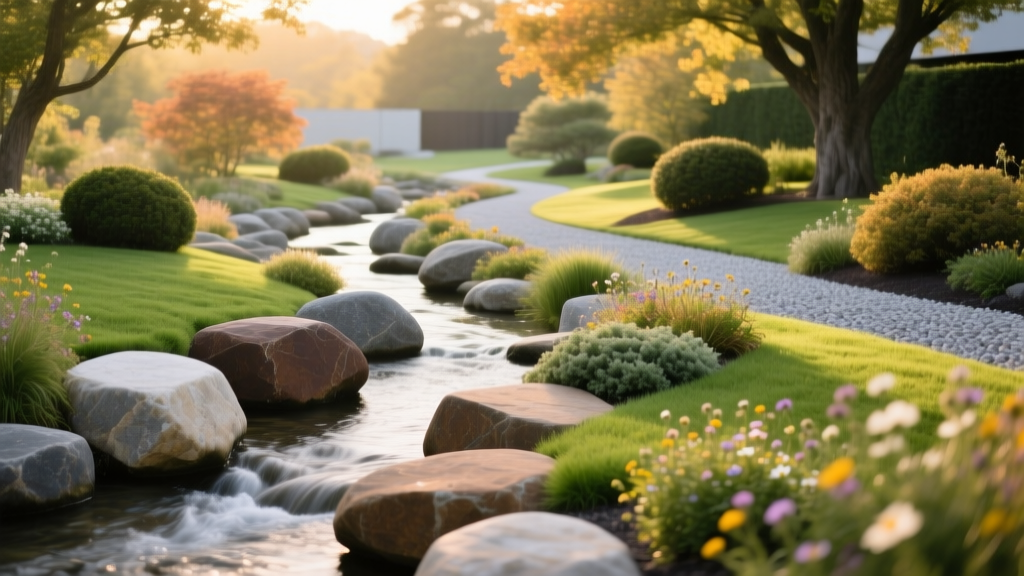
How to Build a River Rock Landscape: A Beginner's Guide
Why Choose a River Rock Landscape?
River rock is a naturally tumbled, smooth stone harvested from riverbeds and quarries. Unlike crushed gravel, which features angular edges that interlock to form a rigid surface, river rock is rounded. This makes it ideal for decorative landscaping, dry creek beds, and low-maintenance garden borders where a natural, fluid aesthetic is desired. According to the Penn State Extension, inorganic mulches like river rock do not decompose, meaning they will not deplete soil nitrogen or require annual top-offs like organic wood mulch. However, a successful river rock landscape requires precise installation to prevent sinking, weed infiltration, and washouts.
Sizing Up Your River Rock: Which Diameter Do You Need?
Selecting the correct stone diameter is the most critical decision in your project. Rocks that are too small will scatter into your lawn or wash away in heavy rain, while rocks that are too large can overwhelm delicate plantings and make walking uncomfortable. Use the matrix below to match the rock size to your specific application.
| Rock Classification | Diameter Size | Best Applications | Avg. Cost (Per Ton) |
|---|---|---|---|
| Pea Gravel | 1/4' to 3/8' | Walkways, patio bases, playgrounds | $40 - $60 |
| Small River Rock | 3/4' to 1' | Dry creek beds, borders, potted plant top-dressing | $50 - $80 |
| Medium River Rock | 1' to 3' | General garden beds, water features, large borders | $60 - $100 |
| Large River Rock | 3' to 8' | Focal points, heavy erosion control, pond edges | $80 - $150 |
Pro Tip for Beginners: For standard foundation planting beds, 1' to 3' medium river rock is the gold standard. It is heavy enough to resist displacement by leaf blowers and heavy rain, but small enough to lay evenly around shrubs and perennials.
The Hidden Layer: Why Landscape Fabric is Non-Negotiable
The most common failure in DIY rock landscaping is skipping the geotextile underlayment or using the wrong type. If you place river rock directly onto topsoil, the stones will gradually sink into the earth due to the freeze-thaw cycle and soil compaction, while aggressive weeds like nutsedge and bermudagrass will easily penetrate the rock layer.
You must use a woven geotextile fabric (often labeled as slit-film). Do not use non-woven (spunbound) fabric, which is designed for French drains and retaining wall drainage, not surface weed suppression. A professional-grade option like DeWitt Pro 5 or GroundCover Woven offers a water permeability rate of 12 to 15 gallons per minute per square foot, ensuring your soil drains properly while blocking 99% of weed germination.
Step-by-Step Installation Framework
Follow this exact sequence to ensure your river rock landscape remains stable and weed-free for decades.
Step 1: Excavation and Grading
Dig out the designated bed area to a depth of 3 inches. If you are installing 1' to 3' river rock, a 3-inch depth allows the stones to sit slightly below the surrounding soil grade, preventing them from migrating into adjacent walkways. Grade the soil base with a 1% slope (a 1-inch drop for every 8 feet) away from your home's foundation to direct water runoff away from the structure.
Step 2: Pre-Emergent Application (Optional but Recommended)
Before laying the fabric, treat the bare soil with a professional pre-emergent herbicide. Prodiamine 65 WDG applied at a rate of 1.15 lbs per 1,000 square feet will create a chemical barrier in the top inch of soil that stops weed seeds from germinating for up to 6 months. This provides a secondary defense line in case the fabric is punctured during installation.
Step 3: Fabric Deployment
Roll out your woven geotextile fabric over the excavated area. Where two rolls meet, overlap them by a minimum of 6 inches. Secure the fabric using 6-inch galvanized landscape staples (pins) driven into the soil every 3 feet along the seams and every 4 feet in the center of the rolls. Cut X-shaped slits in the fabric only where you need to plant new shrubs or trees.
Step 4: Install Containment Edging
River rock will spread laterally over time. Install a physical barrier before adding the stone. For a permanent, invisible edge, use 6-inch Permaloc aluminum edging. Drive 16-inch steel stakes through the edging loops every 4 feet. Aluminum will not warp, crack, or degrade under UV exposure like cheap plastic coil edging.
Step 5: Calculate and Spread the Rock
Use this exact formula to calculate your material needs: Length (ft) x Width (ft) x Depth (inches) / 324 = Cubic Yards. For a 10x10 foot bed at a 3-inch depth, you need 0.92 cubic yards (round up to 1 cubic yard). Dump the rock onto the fabric and spread it evenly with a steel landscape rake to a consistent 3-inch depth. Avoid using metal shovels directly on the fabric to prevent tearing.
Troubleshooting Common River Rock Failures
Even with proper installation, environmental factors can impact your landscape. Here is how to diagnose and fix the three most common issues.
Issue 1: Windblown Debris and Weed Growth
Cause: Over time, wind deposits a thin layer of organic dust and soil on top of the river rock. Weed seeds land in this dust layer and germinate above the fabric.
Fix: Use a leaf blower on a low setting to clear organic debris from the rock bed every autumn. If weeds appear, pull them manually or use a targeted post-emergent spray like Roundup Precision Gel to avoid chemical runoff onto the stones.
Issue 2: Rock Washouts During Heavy Rain
Cause: Water velocity from roof downspouts or steep slopes exceeds 2 feet per second, carrying smaller stones away.
Fix: Redirect downspouts into buried PVC drain lines that daylight past the rock bed. For sloped beds, integrate a 'dry creek bed' design using large 3' to 8' river rock in the center of the water flow path to break the water's kinetic energy, bordered by smaller 1' rocks.
Maintaining Your River Rock Landscape
Unlike organic mulches that require 2 to 3 inches of fresh material annually, river rock is a permanent installation. According to the Clemson University Home & Garden Information Center, inorganic mulches do not improve soil structure or add nutrients. Therefore, you must fertilize the plants within the rock bed directly at their root zones using a slow-release granular fertilizer (such as Osmocote Smart-Release) applied in early spring. Occasionally, the rocks may accumulate algae or hard water stains from irrigation. You can restore their natural luster by pressure washing the rock bed on a low setting (under 1,500 PSI) with a 40-degree fan tip, taking care not to displace the stones or tear the underlying fabric.

