
Landscaping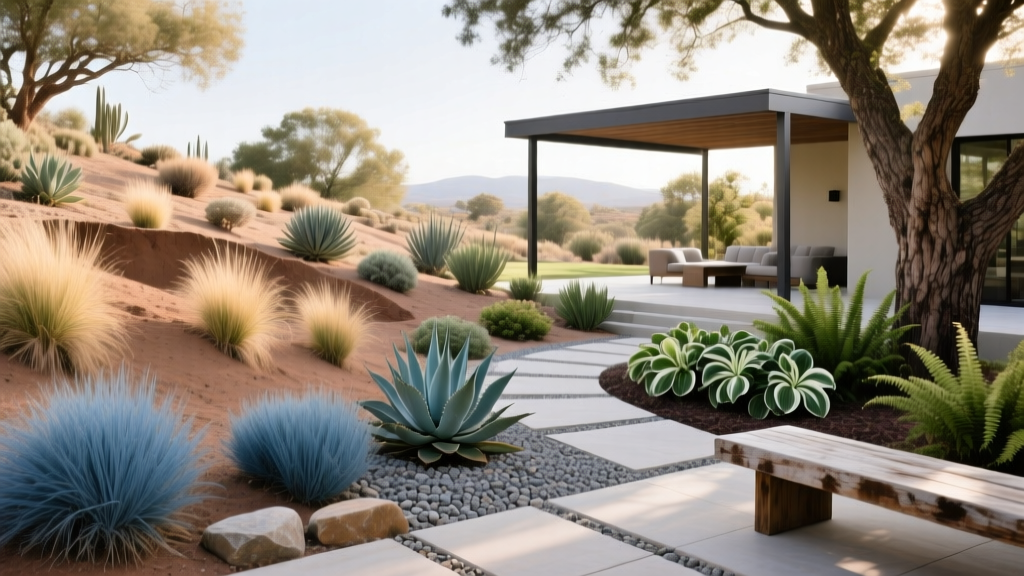
Drought Resistant Landscaping for Problem Yards: Clay, Slopes & Shade
Standard xeriscaping advice usually assumes a blank canvas: well-draining loam, full sun, and flat topography. But real-world properties rarely cooperate. When you are battling heavy clay that suffocates roots, steep slopes that shed water before it penetrates, or mature tree canopies that create dry shade, simply swapping a thirsty lawn for drought-tolerant plants will result in mass die-offs. True drought resistant landscaping requires site-specific engineering. Below is a diagnostic framework and actionable prescription guide for solving the three most common site-condition failures in water-wise landscape design.
Diagnosing Your Site: Why Standard Xeriscaping Fails
The core principle of drought resistant landscaping is matching plant evapotranspiration rates to available soil moisture. However, site anomalies disrupt this balance. According to the EPA's WaterSense program, improper soil preparation and ignoring microclimates are the leading causes of xeriscape failure. Before selecting a single plant, you must identify the physical barriers preventing water infiltration and root establishment on your specific lot.
Problem 1: Heavy Clay Soil and Root Asphyxiation
Clay particles are microscopic and pack tightly, creating a perched water table. When it rains, water pools in the amended planting hole rather than draining, drowning the roots of drought-adapted plants like succulents and Mediterranean natives. Conversely, during dry spells, clay bakes into a hydrophobic brick that repels irrigation.
The Prescription: Structural Soil Amendment
Do not rely on compost alone to fix clay for xeriscaping; organic matter breaks down and the clay will re-compact. You must introduce inorganic structural porosity.
- The Ratio: Till the top 8 inches of native soil. Incorporate 30% expanded shale or pumice by volume, and 15% coarse pine bark fines. This creates permanent macropores that allow rapid drainage while retaining minimal moisture.
- Plant Selection: Avoid shallow-rooted sedums. Opt for tap-rooted species that can penetrate the clay subsoil. Asclepias tuberosa (Butterfly Weed) and Baptisia australis (False Indigo) develop deep taproots that bypass the amended topsoil and anchor into the clay below.
- Elevation Trick: For highly sensitive plants like Agave parryi 'Truncata' (hardy to 0°F), plant them on 6-inch berms of a 50/50 mix of native soil and crushed granite to ensure the root crown never sits in winter moisture.
Problem 2: Steep Slopes and Hydrophobic Runoff
On slopes greater than a 15% grade, gravity pulls water downhill faster than dry, compacted soil can absorb it. Applying standard drip irrigation or relying on rainfall results in severe erosion and zero deep-soil hydration.
The Prescription: Velocity Interruption and Terracing
To make a slope viable for drought resistant landscaping, you must slow the water down and force it into the soil profile.
- Construct Check Dams: Dig shallow, crescent-shaped swales (4 inches deep, 12 inches wide) on the contour of the slope. Fill the trenches with 1-inch river rock. This creates a series of micro-terraces that catch runoff and allow it to percolate.
- Segmental Retaining Walls: For slopes exceeding 20%, install terraced retaining walls. Use pin-connected segmental blocks like the Belgard Mega-Tandem system. Backfill the wall cavity with 3/4-inch open-graded clean gravel to prevent hydrostatic pressure buildup.
- Groundcover Anchors: Plant deep-rooting, spreading groundcovers immediately below the check dams. Juniperus horizontalis 'Blue Rug' roots at the nodes as it spreads, creating a living net that holds the soil in place while requiring zero supplemental water once established.
Problem 3: The Dry Shade Canopy Paradox
Dry shade is the most hostile environment in landscaping. Mature trees like oaks and maples have vast, shallow root networks that aggressively consume all available surface moisture, while their canopies block both rain and the UV light required for plant transpiration.
The Prescription: Sub-Canopy Zoning and Drip Emitters
Do not attempt to rototill the soil under mature trees; you will sever critical feeder roots and invite fatal fungal pathogens like Armillaria.
- Planting Technique: Dig individual, small planting holes only where necessary. Select plants that naturally evolved in woodland understories and tolerate intense root competition. Epimedium grandiflorum (Barrenwort) and Dryopteris erythrosora (Autumn Fern) are exceptional choices that thrive on minimal water once their initial root mass establishes.
- Irrigation Zoning: Install a dedicated drip zone using 0.5 GPH (gallons per hour) pressure-compensating emitters. Place emitters exactly 6 inches from the root ball of the new plant. This delivers water directly to the new plant without feeding the surrounding tree roots.
- Mulch Depth: Apply exactly 2 inches of shredded hardwood mulch. Exceeding 3 inches under a tree canopy will suffocate the tree's surface roots and invite collar rot.
Plant Selection Matrix for Problem Sites
Use this decision matrix to match specific drought-tolerant species to your exact site constraints.
| Site Condition | Primary Challenge | Recommended Plant Species | Mature Size | Water Need (Post-Establishment) |
|---|---|---|---|---|
| Heavy Clay (Full Sun) | Winter root rot, summer cracking | Salvia greggii 'Furman's Red' | 2-3 ft tall | Deep soak every 21 days |
| Steep Slope (Full Sun) | Erosion, rapid runoff | Muhlenbergia rigens (Deer Grass) | 3-4 ft tall | Natural rainfall only |
| Dry Shade (Under Oaks) | Root competition, low light | Epimedium x rubrum | 1-1.5 ft tall | Drip 1x per month |
| Alkaline Soil (pH > 7.5) | Iron chlorosis, nutrient lockout | Yucca rostrata (Beaked Yucca) | 8-10 ft tall | Natural rainfall only |
Hardscape Solutions: Capturing the Rain That Does Fall
Drought resistant landscaping is not just about plants; it is about hydrology. According to Colorado State University Extension, integrating water-harvesting hardscapes can reduce supplemental irrigation needs by up to 40%.
Material Spotlight: Permeable Interlocking Concrete Pavers (PICP)
Replace solid concrete patios and driveways with permeable pavers, such as the Belgard Urbana Permeable line. These systems feature wider joints filled with 3/8-inch open-graded crushed stone. Beneath the pavers, a 12-inch base of clean, angular aggregate acts as an underground cistern, capturing rainwater and allowing it to slowly infiltrate the subsoil, directly hydrating adjacent drought-tolerant planting beds.
Budgeting Your Drought Resistant Landscaping Overhaul
Transitioning a problem yard requires upfront capital, but yields massive long-term utility savings. Below are the average 2026 installed costs for site-remediation materials.
- Expanded Shale / Pumice Amendment: $45 - $65 per cubic yard (plus delivery).
- Segmental Retaining Wall Blocks: $8 - $14 per square foot of face (materials only).
- Permeable Paver Installation: $18 - $28 per square foot (includes excavation, aggregate base, and pavers).
- Smart Drip Irrigation Controller: $150 - $250 (e.g., Rachio 3 Smart Sprinkler Controller with flow meter).
Frequently Asked Questions
Can I plant drought-resistant species directly into unamended clay?
Only if you select native species that evolved in that specific clay ecology, such as Echinacea purpurea or Rudbeckia hirta. Non-native xeriscape plants like lavender, rosemary, and agave will suffer fatal root rot in unamended clay due to poor winter drainage.
How long does it take for xeriscape plants to become truly drought-tolerant?
The "establishment period" typically lasts 18 to 24 months. During the first two summers, you must provide deep, infrequent watering (e.g., 1 inch of water every 10 days) to force roots to grow deep into the soil profile. Once established, the plants can survive on natural rainfall or minimal supplemental drip.
Is synthetic turf a good alternative for drought resistant landscaping?
While synthetic turf eliminates irrigation, it creates a heat island effect (surface temperatures can exceed 150°F in summer) and halts all soil biological activity. For ecological health and stormwater management, living permeable groundcovers or permeable hardscapes are vastly superior site-condition solvers.

