
Landscaping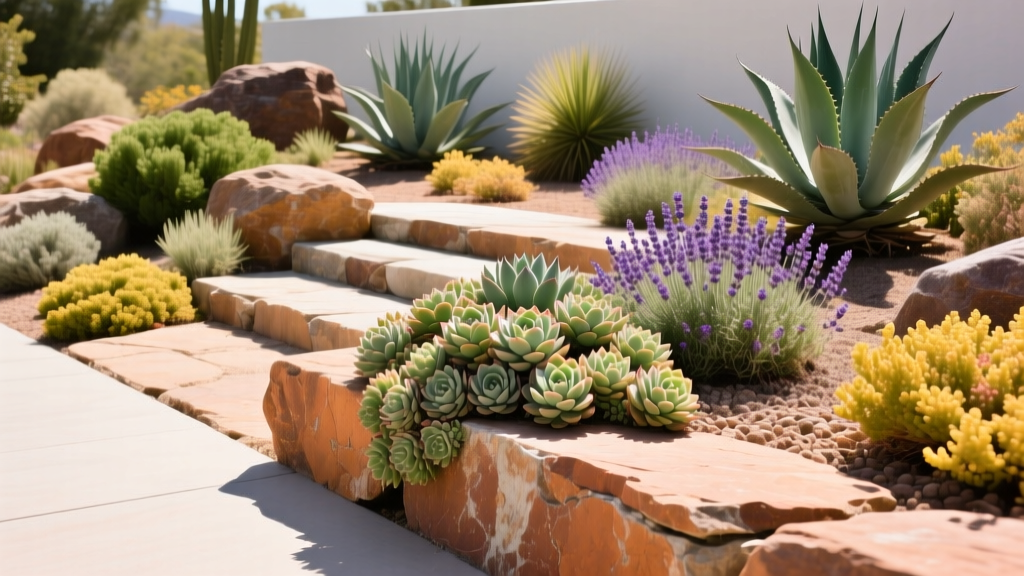
Solving High-Heat Sites: Best Drought Tolerant Plants for Rock Gardens
The Microclimate Challenge of Rock Gardens
Rock gardens are often deployed as site-condition problem solvers for steep slopes, heavy clay drainage issues, and barren yard edges. However, the very elements that make them functional also create a hostile microclimate. Boulders and gravel absorb solar radiation during the day and release it at night, elevating localized soil temperatures by 10 to 15 degrees Fahrenheit above ambient air temperature. Standard landscape shrubs and perennials quickly succumb to this radiant heat and the rapid moisture evaporation inherent to rocky terrain.
To succeed, you must select drought tolerant plants for rock gardens that possess specific physiological adaptations: succulent leaves, deep taproots, or silver-hued foliage that reflects UV radiation. This guide moves beyond generic plant lists to provide exact cultivar selections, engineered soil matrices, and precise establishment protocols tailored for high-heat, low-water site conditions.
Site Assessment Warning: The Albedo Effect
Light-colored rocks like decomposed granite and white river rock reflect sunlight (high albedo), which can scorch the underside of plant canopies. If using light-colored stone, prioritize plants with rigid, upward-facing foliage rather than sprawling, ground-hugging varieties that will trap reflected heat against their stems.
Engineering the Rock Garden Soil Matrix
The most common failure point in rock garden installation is planting drought-adapted species into unamended native clay or standard, moisture-retaining topsoil. According to the Colorado State University Extension, xeric plants require exceptional drainage to prevent winter crown rot, which kills more alpine and rock garden plants than summer drought.
Do not rely on standard bagged potting soil. Instead, construct a custom mineral-heavy matrix. Below is the comparative breakdown of soil components and their functional roles in a high-heat rock garden environment.
| Component | Volume Ratio | Functional Role | Sourcing & Cost |
|---|---|---|---|
| Crushed Granite (1/4 inch minus) | 35% | Provides permanent structural aeration and prevents soil compaction over time. | $45 - $65 per cubic yard (bulk) |
| Horticultural Pumice | 25% | Holds moisture internally within porous pockets while allowing rapid external drainage. | $8 - $12 per 1.5 cu ft bag |
| Native Site Soil (Screened) | 25% | Introduces local mycorrhizal fungi and anchors the mix to the existing subgrade. | Free (excavated on-site) |
| Fine Pine Bark or Compost | 15% | Provides minimal, slow-release organic matter without creating a moisture-retaining sponge. | $6 - $9 per 2 cu ft bag |
Pro Tip: Never use play sand or masonry sand in your rock garden mix. The fine, uniform particle size of these sands actually packs tightly together, creating a concrete-like barrier that suffocates roots and pools water at the crown level.
Top-Tier Plant Selections by Site Condition
When sourcing drought tolerant plants for rock gardens, skip the generic species tags and look for these specific, high-performance cultivars that have proven resilience in extreme thermal zones.
Condition A: Radiant Heat Reflectors (South-Facing Boulders)
South and west-facing boulders act as thermal batteries. Plants placed within 18 inches of these stones must withstand root-zone temperatures exceeding 110 degrees Fahrenheit in mid-summer.
- Delosperma 'Jewel of Desert Garnet' (Ice Plant): This cultivar produces intense ruby-red blooms from late spring to early fall. Unlike older ice plant varieties that become woody and die back in the center, 'Garnet' maintains a tight, low-growing mat (2 to 4 inches tall). Cost: $14 per 1-gallon pot. Spacing: 12 inches.
- Sedum rupestre 'Angelina' (Stonecrop): Features brilliant golden-yellow, needle-like foliage that shifts to copper-orange in winter. It thrives in the shallowest soil pockets and reflects intense heat. Cost: $4 to $6 per 3-inch plug. Spacing: 8 inches.
Condition B: Shallow Soil Creepers (Crevices and Dry-Stack Walls)
Crevice gardens and retaining wall gaps offer less than 4 inches of soil depth. Plants here must rely on extensive lateral root systems to scavenge trace moisture.
- Dianthus gratianopolitanus 'Firewitch' (Cheddar Pink): A powerhouse for shallow crevices. It forms dense, blue-gray mounds of grass-like foliage and produces fragrant, magenta flowers. It is highly alkaline-tolerant, making it ideal for limestone or concrete retaining walls. Cost: $12 per 1-gallon pot. Spacing: 10 inches.
- Sempervivum 'Ruby Heart' (Hens and Chicks): A classic alpine succulent that requires virtually zero soil depth. 'Ruby Heart' offers striking deep-red rosette centers that intensify in full sun and drought conditions. Cost: $6 per 4-inch pot. Spacing: 6 inches.
Condition C: Deep-Rooted Anchors (Perimeter and Berm Edges)
The outer edges of a rock garden berm require plants that can send taproots deep into the subgrade to stabilize the soil and provide vertical structure.
- Perovskia atriplicifolia 'Denim 'n Lace' (Russian Sage): Reaching 28 to 32 inches tall, this cultivar offers a refined, non-floppy habit compared to older varieties. Its deeply dissected, silvery leaves reflect sunlight, and its taproot easily penetrates compacted sub-soils. Cost: $18 per 2-gallon pot. Spacing: 24 inches.
- Artemisia schmidtiana 'Silver Mound': Provides a striking, finely-textured silver dome that contrasts beautifully with dark boulders. It thrives on neglect and requires zero supplemental fertilizer. Cost: $15 per 1-gallon pot. Spacing: 18 inches.
Cost Framework: 100 Square Foot Rock Garden
Establishing a 100 sq. ft. rock garden with engineered soil and premium cultivars typically costs between $850 and $1,200 for materials (excluding decorative boulders). To reduce costs, purchase creeping sedums and dianthus as bare-root plugs or 3-inch pots rather than 1-gallon containers; they will fill the same square footage within 90 days for a fraction of the price.
The 90-Day Establishment Protocol
A common misconception promoted in general landscaping advice is that drought tolerant plants for rock gardens require no water upon installation. While mature specimens are highly xeric, their root systems must first establish. The EPA WaterSense Landscaping Guide emphasizes that even low-water plants need strategic irrigation during their first growing season to develop the deep root structures required for long-term survival.
- Days 1 to 14 (Root Shock Phase): Apply 0.5 gallons of water directly to the base of each plant every 3 days. Do not use overhead sprinklers; the goal is to keep the immediate root ball moist while the surrounding mineral soil remains dry, encouraging outward root growth.
- Days 15 to 60 (Exploratory Phase): Reduce frequency to 1 gallon per plant every 7 days. This forces roots to chase receding moisture deeper into the pumice and granite matrix.
- Days 61 to 90 (Weaning Phase): Apply a deep soak of 2 gallons per plant every 14 days. Monitor foliage for wilting. If leaves remain turgid during peak afternoon heat, extend the interval to 21 days.
- Year Two and Beyond: Rely entirely on natural precipitation, intervening only during severe, multi-week summer droughts with a single deep soaking per month.
Troubleshooting Edge Cases and Failure Modes
Even with the correct plant selection and soil matrix, site-specific anomalies can cause failures. Use this decision framework to diagnose and correct common rock garden issues.
Symptom: Black, Mushy Stems at the Soil Line (Crown Rot)
Cause: Winter moisture accumulation. In freezing climates, snowmelt pools around the base of the plant, and the freezing/thawing cycle destroys the crown tissue of alpine species.
Solution: Elevate the planting zone. When installing susceptible plants like Sempervivum or Dianthus, mound the custom soil mix 2 to 3 inches above the surrounding grade and collar the immediate base of the plant with a 1-inch layer of pure, dry pea gravel. This gravel collar acts as a wicking barrier, pulling moisture away from the stem.
Symptom: Plants are Leggy, Flopping, and Losing Form
Cause: Excessive soil nitrogen. Rock garden plants are adapted to nutrient-poor environments. If your native soil was heavily amended with rich compost or manure prior to rock garden construction, the plants will produce weak, rapid, vegetative growth that cannot support itself.
Solution: Cease all fertilization immediately. Top-dress the area with a 1-inch layer of pure crushed granite to dilute the surface organic matter. Prune back the leggy growth by one-third in late summer to encourage tight, woody basal branching.
'The secret to a thriving rock garden is not just what you plant, but what you withhold. Withholding water, withholding fertilizer, and withholding rich organic matter forces these plants to express their most vibrant, resilient, and architecturally interesting forms.' - Dr. James E. Henrich, Alpine Plant Specialist
Symptom: Foliage Scorch and Bleached Leaves
Cause: Reflected heat from light-colored gravel mulch combined with overhead watering during mid-day sun, creating a magnifying glass effect on the leaves.
Solution: Switch to dark-colored mulch materials like 3/4-inch crushed basalt or dark river cobbles, which absorb rather than reflect light. Always water rock gardens in the early morning hours before solar intensity peaks.
By treating your rock garden as a specialized, engineered environment rather than a standard flower bed, you can transform problematic, high-heat slopes into resilient, low-maintenance landscape features. Selecting the precise cultivars and adhering to a strict mineral-soil matrix ensures your drought tolerant plants for rock gardens will thrive for decades with minimal intervention.

