
Landscaping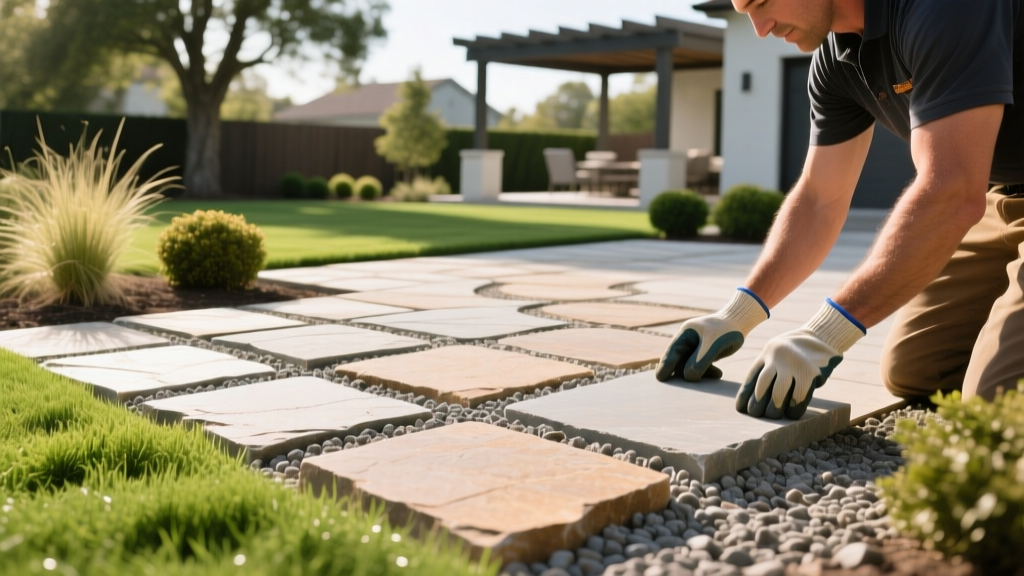
How to Build Dry-Laid Flagstone Patio Designs: Expert Guide
The Case for Dry-Laid Flagstone Patio Designs
When evaluating hardscape options, dry-laid flagstone patio designs consistently outperform mortared alternatives in climates with seasonal freeze-thaw cycles. A dry-laid system relies on a compacted aggregate base and a sand setting bed, allowing the patio to flex with ground movement. According to the Environmental Protection Agency (EPA), permeable hardscape systems also significantly reduce stormwater runoff by allowing water to infiltrate the subgrade, mitigating local flooding and filtering pollutants.
Pro-Tip: Wet vs. Dry Installation
Wet-laid (mortared) flagstone requires a poured concrete slab sub-base, which is prone to cracking in freezing temperatures and is virtually impossible to repair seamlessly. Dry-laid flagstone allows you to lift individual stones, re-grade the base, and reset the stone if settling occurs.
Wet-laid (mortared) flagstone requires a poured concrete slab sub-base, which is prone to cracking in freezing temperatures and is virtually impossible to repair seamlessly. Dry-laid flagstone allows you to lift individual stones, re-grade the base, and reset the stone if settling occurs.
Material Selection and 2026 Cost Breakdown
Selecting the right stone dictates both the aesthetic and the structural longevity of your patio. Flagstone is typically sold by the ton or by the pallet. Below is a comparison of the most common varieties used in residential landscaping.
| Stone Type | Origin | Avg. Cost (Per Ton) | Durability & Notes |
|---|---|---|---|
| Pennsylvania Bluestone | Northeast US | $600 - $850 | Highly durable, dense sandstone. Excellent for wet climates. |
| Arizona Buff | Southwest US | $450 - $650 | Lighter color reflects heat. Slightly more porous; requires sealing in wet climates. |
| Colorado Red | Rocky Mountains | $550 - $750 | Striking iron-rich hues. Very hard, but can be brittle during cutting. |
| Tennessee Crab Orchard | Southeast US | $500 - $700 | Mottled brown and gray tones. High density, excellent frost resistance. |
For the base materials, budget approximately $45 to $65 per ton for 3/4-inch minus crushed limestone or granite, and $35 to $50 per ton for ASTM C33 washed concrete sand. Total material costs for a standard 200-square-foot dry-laid patio typically range from $1,800 to $3,200, excluding tool rentals.
Step 1: Excavation and Sub-Base Preparation
The most common point of failure in any hardscape project is an inadequate base. For a dry-laid flagstone patio, you must excavate to a depth that accommodates the base, the setting bed, and the stone itself.
- Target Depth Calculation: 6 inches (compacted base) + 1 inch (sand setting bed) + 1.5 inches (average stone thickness) = 8.5 inches total excavation depth.
- Slope: Establish a grade sloping away from your home's foundation at a minimum rate of 1/8 inch per foot (preferably 1/4 inch per foot) to ensure positive drainage.
Fill the excavated trench with 3/4-inch minus crushed aggregate. This specific mix contains stone dust that locks together when compacted. Lay the gravel in 2-inch lifts (layers), compacting each layer with a vibratory plate compactor (minimum 80 lbs of centrifugal force) before adding the next. Watering the aggregate slightly during compaction helps the stone dust bind.
Step 2: The Setting Bed and Stone Layout
Once the base is fully compacted and graded, apply a 1-inch layer of bedding sand. Critical specification: Use ASTM C33 washed concrete sand. Do not use mason sand or play sand; the particles are too uniform and round, which prevents them from locking together and causes the stones to shift underfoot.
Screed the sand using two 1-inch PVC pipes as guides and a straight 2x4 board. Lay your flagstones directly onto the screeded sand. Start from a fixed corner or edge and work outward. Maintain joint widths between 1/2 inch and 1 inch. Tighter joints look more formal but require precise cutting; wider joints allow for a rustic look and accommodate ground-cover plants.
Step 3: Cutting, Fitting, and Safety Protocols
Fitting irregular flagstone requires cutting. Use a 4.5-inch or 5-inch angle grinder (such as the DeWalt DWE4120) equipped with a continuous-rim diamond masonry blade for clean edges, or a segmented turbo blade for faster, rougher cuts.
WARNING: Crystalline Silica Exposure
Dry-cutting natural stone generates respirable crystalline silica dust, a known carcinogen. The Occupational Safety and Health Administration (OSHA) mandates strict exposure limits. Always wear a NIOSH-approved N95 or P100 half-face respirator, safety goggles, and hearing protection. Whenever possible, use a wet-cutting saw or attach a water-feed system to your grinder to suppress dust at the source.
Dry-cutting natural stone generates respirable crystalline silica dust, a known carcinogen. The Occupational Safety and Health Administration (OSHA) mandates strict exposure limits. Always wear a NIOSH-approved N95 or P100 half-face respirator, safety goggles, and hearing protection. Whenever possible, use a wet-cutting saw or attach a water-feed system to your grinder to suppress dust at the source.
When fitting stones, tap them into the sand bed using a heavy rubber mallet. Place a level across adjacent stones to ensure they are flush. If a stone sits too high, lift it and scrape away excess sand. If it sits too low, add a handful of sand beneath it and re-tamp.
Step 4: Jointing Options
The material you use to fill the gaps between stones dictates the maintenance requirements and visual style of your patio.
Decomposed Granite (DG)
DG provides a natural, permeable joint that blends seamlessly with the stone. It must be compacted and wetted down to form a semi-solid surface. Expect to top-dress the joints every 2 to 3 years as the material washes out during heavy rains.
Polymeric Sand
When activated with water, polymeric sand binds together to form a rigid, weed-resistant joint. It is ideal for patios with high foot traffic. However, it requires the joints to be completely dry before application and can fail if the patio base retains too much moisture, leading to a white hazy residue on the stone surface.
Living Joints
For a softer, integrated landscape design, fill joints with a mix of topsoil and compost, then plant creeping thyme (Thymus serpyllum) or Irish moss (Sagina subulata). These plants tolerate light foot traffic, suppress weeds, and thrive in the microclimate created by the surrounding stone.
Troubleshooting Common Flagstone Failures
Symptom: Individual stones wobble or sink after the first winter.
Cause: Inadequate base compaction or water pooling under the setting bed.
Fix: Lift the affected stones. Excavate the soft subgrade an additional 2 inches, backfill with crushed aggregate, compact thoroughly, and reset the stones with fresh bedding sand.
Symptom: White, crusty haze on the surface of bluestone after applying polymeric sand.
Cause: Polymeric dust was not completely blown off the stone surface before the activation water was applied, or the sand was over-watered.
Fix: Use a specialized polymeric haze remover or a diluted muriatic acid solution (1 part acid to 10 parts water) applied with a stiff-bristle brush. Always test on an inconspicuous stone first.
Building dry-laid flagstone patio designs requires physical labor and precise grading, but the result is a highly durable, permeable, and visually striking outdoor space that integrates naturally with your surrounding landscape.

