
Landscaping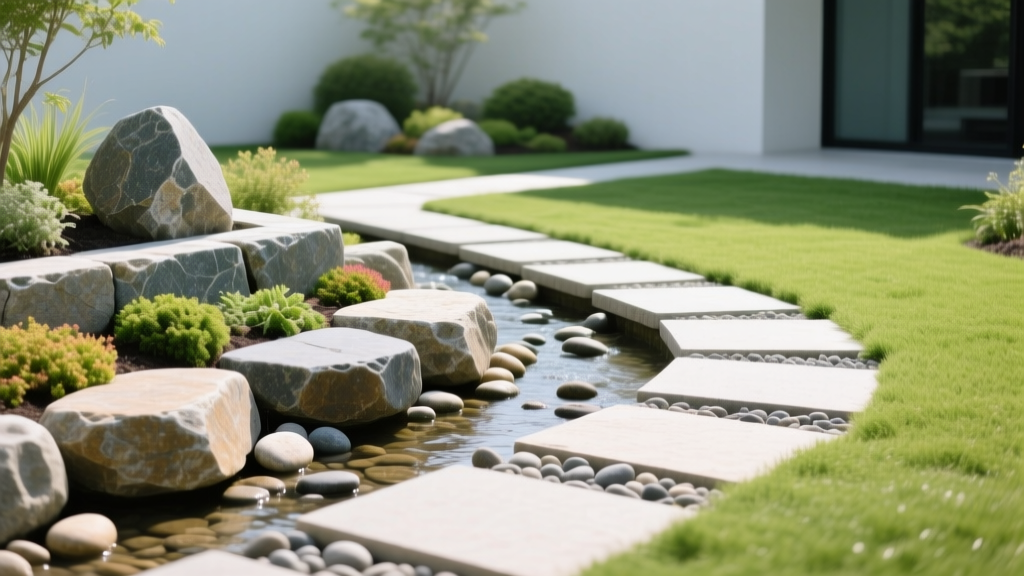
Easy Landscaping Ideas With Rocks And Stones For Beginners
The Foundation: Why Hardscaping with Stone Works
Transitioning a high-maintenance turf lawn into a resilient, textured landscape does not require heavy machinery or a professional design degree. When executed correctly, landscaping ideas with rocks and stones solve three critical yard problems simultaneously: poor drainage, persistent weed growth, and excessive irrigation demands. According to the EPA WaterSense program, replacing non-functional turf with permeable hardscaping and drought-tolerant xeriscaping can reduce outdoor water use by up to 50%.
For beginners, the secret to stone landscaping lies below the surface. Eighty percent of stone pathway failures and rock bed migrations occur because the base preparation was skipped. Before purchasing a single ton of gravel, you must understand the substrate requirements.
The Golden Rule of Stone Bases: Never place decorative rock or flagstone directly on topsoil. Always excavate 4 to 6 inches, lay a 4.8 oz woven polypropylene geotextile fabric (never use cheap black plastic sheeting, which suffocates soil microbiology and tears under UV exposure), and compact a 2-inch base layer of 3/4-inch minus crushed gravel.
5 Beginner-Friendly Landscaping Ideas With Rocks And Stones
1. The Dry Creek Bed for Drainage Management
If your yard suffers from standing water after heavy rainfall, a dry creek bed is the most functional and aesthetically pleasing solution. This project mimics natural water flow while directing runoff away from your home's foundation.
- Map the Flow: Trace the natural water path. Dig a trench that is 2 to 3 feet wide and 6 inches deep, tapering the sides to create a U-shape.
- Line and Base: Lay your 4.8 oz geotextile fabric, overlapping seams by 12 inches. Pin it down with 6-inch landscape staples.
- Place the Boulders: Position 6- to 12-inch fieldstones along the edges to create natural "banks." Bury at least one-third of each boulder's height to anchor it and create a natural look.
- Fill the Channel: Pour 1- to 3-inch smooth river rock into the center channel. Smooth river rock is mandatory here; angular rock will trap debris and leaves, causing blockages.
2. Flagstone Stepping Paths with Living Joints
Rigid concrete pathways crack with frost heave. Flagstone stepping paths offer a permeable, flexible alternative that integrates seamlessly into garden beds.
- Stone Selection: Choose Pennsylvania Bluestone or Arizona Flagstone, cut to a minimum thickness of 1.5 inches to prevent snapping underfoot.
- Spacing: Leave exactly 2 to 3 inches between each stone.
- Joint Planting: Instead of filling joints with polymeric sand, use a mix of compost and plant creeping thyme (Thymus serpyllum) or Irish moss. These groundcovers tolerate foot traffic, stabilize the stones with their root systems, and absorb surface runoff.
3. Boulder Seating and Retaining Walls
For gentle slopes (under a 2-foot drop), mortared retaining walls are overkill. Dry-stacked granite boulders provide excellent erosion control and double as rustic seating.
"When sizing boulders for seating, aim for stones that are 14 to 18 inches in diameter. A 15-inch granite boulder weighs approximately 160 pounds. Always use a mechanical lifting clamp or a two-person carry system to avoid lower back injuries."
Place the largest boulders at the base of the slope, burying them 25% deep into the soil for structural anchoring. Stagger the second tier behind the first, ensuring each upper stone rests on the joint between the two stones below it.
4. Xeriscape Rock Mulch Beds
Replacing organic wood mulch with inorganic rock mulch eliminates the need for annual replenishment and prevents fungal growth in humid climates. This is a core component of USDA Sustainable Land Management practices for arid regions.
Use 3/4-inch crushed granite or basalt. The angular edges of crushed stone lock together, preventing the rocks from washing away during heavy rain—unlike smooth pea gravel, which scatters easily. Install ProFlex aluminum landscape edging around the perimeter to create a sharp barrier that prevents the stone from migrating into adjacent turfgrass.
5. Tree Ring Drainage Basins
Protecting mature trees from lawnmower damage and soil compaction is vital. Build a 4-foot diameter ring around the tree's drip line using 4- to 6-inch river rock. Crucial Warning: Keep all rocks and geotextile fabric at least 6 inches away from the actual tree trunk to prevent collar rot and rodent nesting. Fill the 6-inch gap with loose arborist wood chips.
Material Cost and Sizing Matrix
Budgeting for stone requires understanding how it is sold. Most landscape suppliers sell bulk stone by the ton, while premium flagstone is sold by the square foot or on pallets. Below is a current pricing matrix to help you calculate your material costs.
| Material Type | Size / Grade | Avg. Cost (Bulk) | Best Application |
|---|---|---|---|
| Cherokee River Rock | 1" to 3" Smooth | $120 - $160 / ton | Dry creek beds, drainage zones |
| Crushed Granite | 3/4" Minus (Angular) | $85 - $110 / ton | Xeriscape beds, pathway bases |
| Pennsylvania Bluestone | 1.5" Thick (Pallet) | $6.50 - $9.00 / sq ft | Stepping paths, formal patios |
| Red Lava Rock | 3/4" Porous | $140 - $180 / ton | Fire pit surrounds, high-contrast mulch |
| Fieldstone Boulders | 12" to 24" Diameter | $200 - $350 / ton | Retaining walls, focal anchors |
Critical Installation Mistakes to Avoid
Warning: The "Plastic Sheet" Error
Using 6-mil black plastic under rock beds is a beginner trap. Plastic blocks water and oxygen from reaching the soil, killing nearby tree roots and beneficial microbes. It also degrades into microplastics within three years. Always invest in woven geotextile fabric.
Using 6-mil black plastic under rock beds is a beginner trap. Plastic blocks water and oxygen from reaching the soil, killing nearby tree roots and beneficial microbes. It also degrades into microplastics within three years. Always invest in woven geotextile fabric.
Warning: The "Pea Gravel" Pathway Error
Pea gravel is smooth and round. When walked on, the stones roll against each other like ball bearings, making it impossible to push a wheelbarrow or walk comfortably. Always use angular, crushed stone (like decomposed granite or 3/4" crushed limestone) that mechanically locks together for pathways.
Pea gravel is smooth and round. When walked on, the stones roll against each other like ball bearings, making it impossible to push a wheelbarrow or walk comfortably. Always use angular, crushed stone (like decomposed granite or 3/4" crushed limestone) that mechanically locks together for pathways.
Frequently Asked Questions
How deep should landscape rock be to prevent weeds?
For standard mulch replacement, a 2-inch layer of 3/4-inch crushed stone over geotextile fabric is sufficient. If you are using smaller gravel (like 1/4-inch), increase the depth to 3 inches. Going deeper than 3 inches does not improve weed suppression and only wastes material and money.
Can I put rocks directly over existing grass?
No. Grass will eventually grow through thin layers of rock, and the decaying turf will create an uneven, spongy base that causes the stones to sink. You must kill the existing turf using a non-residual herbicide or solarization, remove the top 2 inches of sod, and lay your fabric before adding stone.
How do I calculate how many tons of rock I need?
Use this formula: (Length in feet × Width in feet × Depth in inches) ÷ 324 = Tons of rock. For example, a 10-foot by 10-foot bed covered with 2 inches of river rock requires (10 × 10 × 2) ÷ 324 = 0.61 tons. Always order 10% extra to account for compaction and edge settling.

