
Landscaping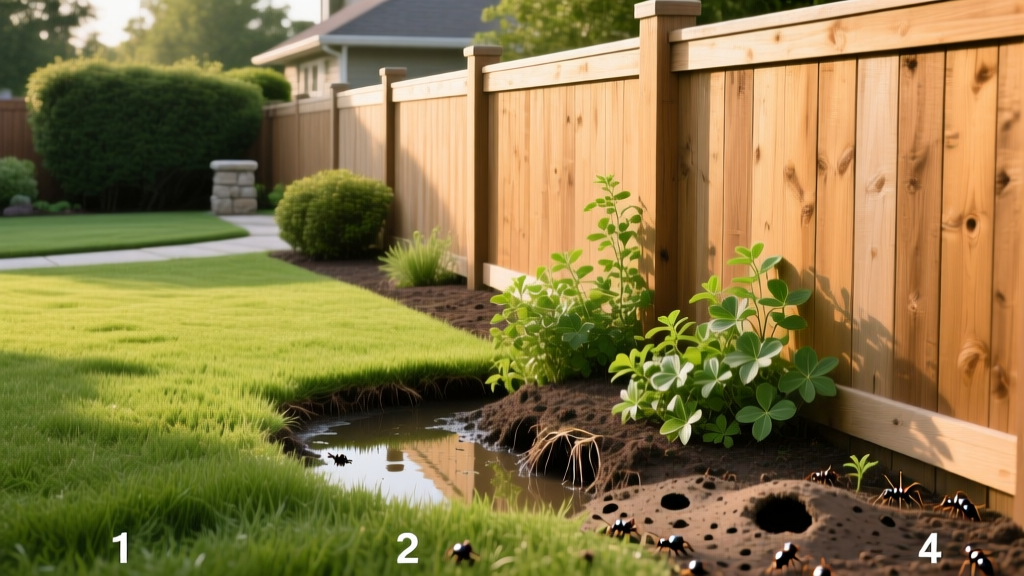
Landscaping Along Fence Bases: Diagnosing and Fixing 4 Yard Problems
The Hidden Microclimate of Your Fence Line
Landscaping along fence lines creates unique, often hostile microclimates that standard yard maintenance guides ignore. A solid privacy fence doesn't just mark a property line; it acts as a massive windbreak, a rain deflector, and a heat sink. When homeowners plant traditional garden beds directly against these structures, they inadvertently trigger a cascade of structural and botanical failures. From accelerated wood rot to heaved concrete footings, the problems are predictable and preventable.
This diagnostic guide breaks down the four most common failures encountered when landscaping along fence borders, providing exact material specifications, installation depths, and 2026 pricing benchmarks to fix them permanently.
Problem 1: Base Rot and Moisture Trapping
Diagnosis: Flaking paint, black fungal spots, or soft, spongy wood on the bottom 6 to 12 inches of fence posts and pickets. Soil is piled directly against the wood, often covered by moisture-retaining mulch or dense groundcover like ivy.
The Root Cause
Wood rot requires three elements: moisture, oxygen, and temperatures above 40°F. When soil or organic mulch touches a wooden fence, it creates a permanent moisture wick. Even pressure-treated lumber rated for ground contact will eventually succumb to fungal decay if constantly buried in damp, shaded soil. According to the American Wood Protection Association, standard above-ground treated wood (UC3B) will decay within 3 to 5 years if subjected to continuous soil contact.
The Solution: The 6-Inch Gravel Buffer and Geotextile Slope
To stop rot, you must break the moisture wick. Do not rely on standard 6-mil black plastic landscape fabric, which traps water and creates a muddy slip-plane against the fence.
- Excavate a Trench: Dig a 12-inch wide, 4-inch deep trench running parallel to the fence.
- Install Woven Geotextile: Line the trench with a non-woven geotextile fabric rated for 150 gallons per minute per square yard (gpm/sy) drainage. Pin it to the fence base using galvanized landscape staples.
- Backfill with Crushed Gravel: Fill the trench with 3/4-inch crushed angular gravel (not smooth river rock, which shifts). Angular gravel locks together and allows rapid water percolation.
- Grade the Soil: Ensure the soil on the planting side of the gravel slopes away from the fence at a minimum 2% grade (1/4 inch drop per foot).
Cost Estimate: Crushed 3/4-inch gravel costs approximately $45 to $65 per ton in 2026. A 50-foot fence line requires roughly 1.5 tons, bringing material costs to under $100 for a permanent rot-prevention system.
Problem 2: Invasive Roots Heaving Fence Posts
Diagnosis: Fence posts leaning outward, cracked concrete footings at the base, or thick surface roots visibly pushing up the soil and turf within 3 feet of the fence line.
The Root Cause
Planting fast-growing trees or aggressive shrubs (like Lilac, Bamboo, or certain Maples) too close to a fence leads to structural damage. Tree roots do not intentionally attack concrete; they follow paths of least resistance and moisture. When a root encounters a concrete footing, it grows over or under it, eventually expanding in diameter and exerting thousands of pounds of lateral pressure, cracking the footing and heaving the post. The Arbor Day Foundation notes that the vast majority of a tree's absorbing roots are located in the top 12 to 18 inches of soil, directly in the path of shallow fence footings.
The Solution: 80-Mil HDPE Root Barriers
If you must plant trees or large shrubs within 10 feet of a fence, a physical root barrier is mandatory. Chemical root inhibitors are unreliable and can leach into neighboring properties.
- Material Specification: Use an 80-mil High-Density Polyethylene (HDPE) root barrier. The older 60-mil standard is prone to cracking during soil freeze-thaw cycles.
- Installation Depth: Dig a trench 24 to 30 inches deep, 18 inches away from the fence line. Bury the barrier vertically, leaving exactly 2 inches protruding above the soil line to stop surface rhizomes from creeping over the top.
- Sealing Joints: Overlap barrier panels by 6 inches and secure them with stainless steel batten strips and screws. Do not use duct tape or standard zip ties, which degrade in UV light and soil acidity.
Pro Tip: If planting bamboo, the barrier must form a complete, enclosed circle around the plant, not just a straight line along the fence, as rhizomes will simply bypass the ends of a linear barrier.
Problem 3: The Rain Shadow Desert and Deep Shade
A 6-foot solid wood or vinyl privacy fence blocks prevailing winds and deflects rainfall. This creates a "rain shadow" on the leeward side of the fence—a strip of soil 24 to 36 inches wide that receives almost zero natural precipitation during angled storms. Furthermore, a fence blocking the southern or western sun creates a permanent deep-shade zone where standard turfgrass and sun-loving perennials will inevitably starve and die.
Diagnostic Matrix: Selecting the Right Plants
Stop trying to force Kentucky Bluegrass or full-sun Roses to grow in a fence shadow. Use the NC State Extension Plant Database to verify shade tolerance before purchasing. Below is a framework for selecting plants that thrive in the harsh fence-line microclimate.
| Plant Species | Root Depth | Shade Tolerance | Best Use Case |
|---|---|---|---|
| Hosta 'Patriot' | Shallow (6-10") | High (Deep Shade) | North-facing fence bases; high moisture areas. |
| Liriope muscari (Big Blue Lilyturf) | Medium (12-15") | Moderate to High | Erosion control on sloped fence lines; drought tolerant. |
| Taxus cuspidata (Japanese Yew) | Deep (24"+) | High | Evergreen privacy screening; requires root barrier. |
| Astilbe 'Fanal' | Shallow (8-12") | High | Adding vertical color to dark, shaded fence corners. |
Solving the Rain Shadow: Drip Irrigation Bypasses
Because standard rotor sprinklers cannot reach the rain shadow zone without spraying the neighbor's property or wasting water on the fence itself, you must install dedicated drip irrigation. Run a 1/2-inch polyethylene drip line directly along the base of the plants in the rain shadow, equipped with 1.0 GPH (gallons per hour) pressure-compensating emitters spaced every 12 inches. This delivers water directly to the root zone, bypassing the fence's deflection entirely.
Problem 4: The Neighbor-Side Weed and Maintenance Trap
When landscaping along a fence, homeowners often forget about the "other side." If you plant spreading shrubs or vines that grow through or over the fence, you lose the ability to trim them without accessing your neighbor's yard. Conversely, if you leave a gap, wind-blown weed seeds from the neighbor's property will invade your pristine garden beds.
The Solution: Hardscape Edging and Shrub Buffers
The Golden Rule of Fence Landscaping: Never plant anything that will mature wider than the distance between the fence and your primary walkway. Always maintain a 2-foot hardscape or mulch buffer on the inside of the fence to allow for painting, staining, and weed-whacking without trespassing.
To block neighbor-side weeds, install a vertical steel landscape edging (minimum 14-gauge, 4-inch height) flush against the fence base on your side. Backfill with a 3-inch layer of premium hardwood bark mulch. Avoid dyed mulches, as the colorants can bleed onto white vinyl or painted wood fences during heavy rains.
Frequently Asked Questions
Can I attach trellises directly to my wooden fence for climbing plants?
Attaching trellises directly to a wooden fence traps moisture between the wood and the plant foliage, accelerating rot and voiding most fence warranties. Instead, install standalone trellis panels 3 to 4 inches away from the fence, anchored in their own concrete-free gravel footings to allow air circulation and maintenance access.
How close can I plant a tree to a vinyl fence?
Vinyl fences are resistant to rot, but their posts are usually set in concrete. Plant trees with aggressive surface roots (like Silver Maples or Willows) at least 15 feet away. For smaller ornamental trees (like Dogwoods or Redbuds), a 6-foot clearance is sufficient, provided an 80-mil HDPE root barrier is installed between the tree and the fence line.
Who is responsible for maintaining the plants that grow through the fence?
Legally, if you plant vegetation on your property that grows through or over the property line, you are responsible for maintaining and trimming it. If it damages the neighbor's property or the shared fence, you may be liable for repair costs. Always plant slow-growing, compact cultivars near boundary lines to avoid future disputes.

