
Landscaping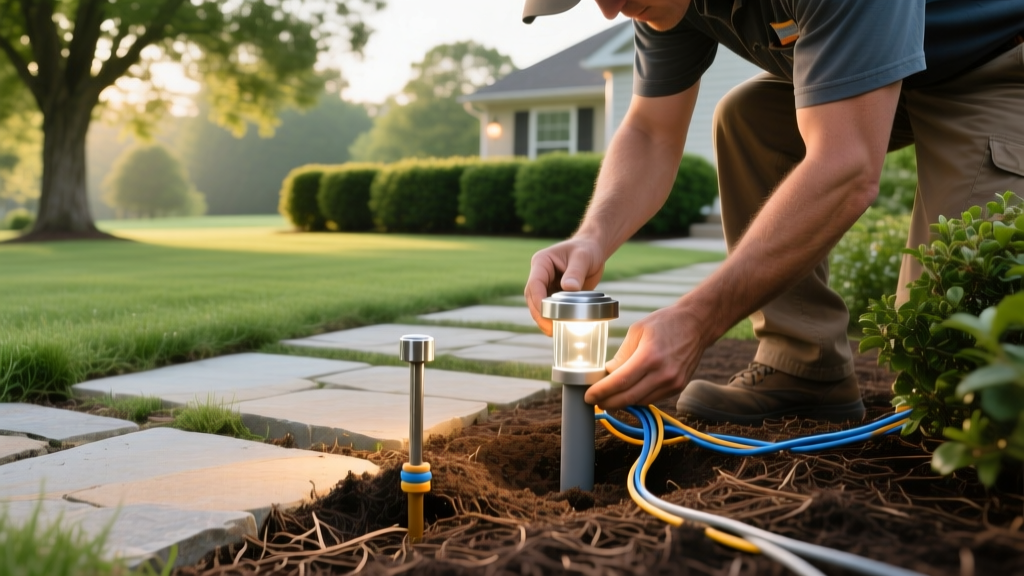
Fort Thomas Landscape Lighting: Step-by-Step Installation Guide
Designing and installing Fort Thomas landscape lighting requires more than just placing fixtures along a walkway. Situated in Campbell County, Fort Thomas features a unique microclimate, steep topographical grades, and heavy clay-based soils (primarily Rosine silt loam and Bedford shale derivatives). Standard low-voltage lighting guides often fail here because they ignore the aggressive freeze-thaw cycles and soil density that cause shallow wiring to snap and fixtures to heave out of the ground.
This practical guide provides a site-specific framework for wiring, fixture selection, and trenching in Northern Kentucky’s challenging terrain, ensuring your system survives the winter and properly illuminates historic Craftsman and Tudor-style properties.
Assessing Your Property for Lighting Zones
Before digging, map your yard into distinct illumination zones. Fort Thomas properties often feature mature canopy trees (like Ohio buckeyes and red oaks) and multi-tiered retaining walls. According to the Association of Outdoor Lighting Professionals (AOLP), effective design relies on layering three types of light: ambient, task, and accent.
Historic District Consideration: If your home is located near the Highland Avenue or Alexandria Pike historic corridors, avoid cool-white (4000K+) LEDs that create a harsh, commercial glare. Opt for 2700K to 3000K color temperatures to complement historic brickwork and limestone foundations while complying with local dark-sky friendly guidelines.
- Architectural Uplighting: Place brass well lights 18 inches from the foundation to graze Tudor-style stucco or brick textures.
- Retaining Wall Wash: Use linear LED hardscape lights under the capstones of limestone retaining walls to illuminate steep grade transitions safely.
- Pathway Task Lighting: Deploy staggered bollard lights on 8-foot centers along sloped walkways to prevent tripping hazards on uneven brick paths.
Selecting Fixtures That Survive Kentucky Freeze-Thaw Cycles
The biggest mistake homeowners make in Campbell County is purchasing die-cast aluminum fixtures from big-box stores. Aluminum oxidizes rapidly in acidic clay soils, leading to structural failure within two to three seasons. For Fort Thomas landscape lighting, you must invest in solid brass or copper fixtures.
| Fixture Material | Average Cost Per Unit | Clay Soil Resistance | Frost-Heave Durability | Recommended Use Case |
|---|---|---|---|---|
| Die-Cast Aluminum | $25 - $45 | Poor (Corrodes quickly) | Low (Brittle in cold) | Avoid entirely in KY |
| Stamped Copper | $60 - $90 | Excellent (Patina protects) | Medium (Can dent) | Pathway and spread lights |
| Solid Cast Brass | $85 - $140 | Superior (Non-reactive) | High (Heavy, resists heave) | Well lights, uplights, hardscape |
| Polycarbonate/Composite | $30 - $50 | Good (Non-corrosive) | Medium (UV degradation risk) | Temporary or hidden deck lights |
For uplighting mature trees, look for solid brass well lights with adjustable, glare-free baffles (such as the Coast LED CL-WL1-Brass or WAC Lighting InvisiLED series). The added weight of brass helps anchor the fixture against the upward pressure of expanding clay during spring thaws.
Trenching and Wiring in Campbell County Clay Soil
Northern Kentucky’s soil is notorious for poor drainage and high compaction. When soil freezes, the moisture trapped in the clay expands, causing "frost heave." If your low-voltage wire is buried too shallow, the heaving soil will stretch, kink, and eventually snap the copper strands.
Step-by-Step Trenching Protocol
- Call 811 Before Digging: Fort Thomas has a dense network of underground utilities, including older gas and water lines. Always have utilities marked at least 48 hours before trenching.
- Set the Depth: While the U.S. Department of Energy recommends a minimum of 6 inches for low-voltage wire, Fort Thomas’s frost line dictates you should trench 8 to 10 inches deep in garden beds to bypass the active frost-heave zone.
- Use the Right Wire: Do not use standard 14/2 wire for runs exceeding 50 feet. Use 12 AWG direct burial copper wire (e.g., Southwire 12/2 UF-B). The thicker gauge reduces voltage drop and provides a heavier physical barrier against shovel nicks and rodent chewing.
- Cut Through Shale: When hitting Bedford shale pockets, use a mattock or a reciprocating saw with a carbide-grit blade to cut a narrow channel rather than trying to pry the rock out, which can collapse the trench walls.
- Seal Connections Properly: Standard wire nuts will fail in damp clay. Use silicone-filled waterproof wire connectors (like the 3M DBY/Y-2 series) or heat-shrink tubing with marine-grade sealant for every splice.
Transformer Sizing and Voltage Drop Calculations
Because Fort Thomas yards are often sloped, wire runs from the transformer to the furthest fixture can easily exceed 100 feet. Low-voltage LED systems require between 10.5V and 12V to operate correctly. If voltage drops below 10V, fixtures will flicker or fail to turn on.
The Voltage Drop Formula:
Voltage Drop = (2 × Length of Run in Feet × Total Wattage) / Wire Constant
(For 12 AWG copper wire, the constant is approximately 7500).
Real-World Example: You are running 120 feet of 12/2 wire to power six 3-watt LED path lights (Total = 18 watts).
Calculation: (2 × 120 × 18) / 7500 = 0.57 Volts dropped.
If your transformer outputs 12V, the fixtures receive 11.43V. This is perfectly within the safe operating range.
However, if you upgrade to 5-watt fixtures (Total = 30 watts) on the same run: (2 × 120 × 30) / 7500 = 0.96 Volts dropped. The fixtures receive 11.04V, which is still acceptable but nearing the lower threshold. If your run exceeds 150 feet, you must upgrade to a multi-tap transformer that allows you to dial the output up to 13V or 14V at the source to compensate for the loss over distance.
Smart Transformer Integration for 2026
Modern landscape lighting relies on smart transformers that integrate with home automation ecosystems, eliminating the need for outdated mechanical astronomic timers that frequently lose their calibration during power outages.
Top Smart Transformer Pick: The WAC Lighting Smart Transformer (Model BST-300) features built-in Wi-Fi, a 300-watt capacity, and multiple 12V/13V/14V taps. It allows you to adjust individual zone brightness via a smartphone app and integrates seamlessly with Lutron Caseta and smart home hubs, providing precise control over your Fort Thomas landscape lighting schedule based on local GPS sunset data.
Winterizing and Maintenance
Even with deep trenching, the extreme freeze-thaw cycles of January and February can push fixtures upward. Perform a "push-down" maintenance check in early March. Firmly press the top of each well light and path light to re-seat it into the soil. If a fixture repeatedly heaves, excavate a 12-inch perimeter around it and backfill with 3/4-inch crushed limestone gravel. The gravel provides a non-expansive drainage buffer that prevents the surrounding clay from gripping and lifting the fixture housing during the freeze cycle.
By respecting the local soil composition, calculating voltage drops accurately, and utilizing non-corrosive brass materials, your Fort Thomas landscape lighting system will provide safe, beautiful illumination for decades without requiring constant seasonal repairs.

