
Landscaping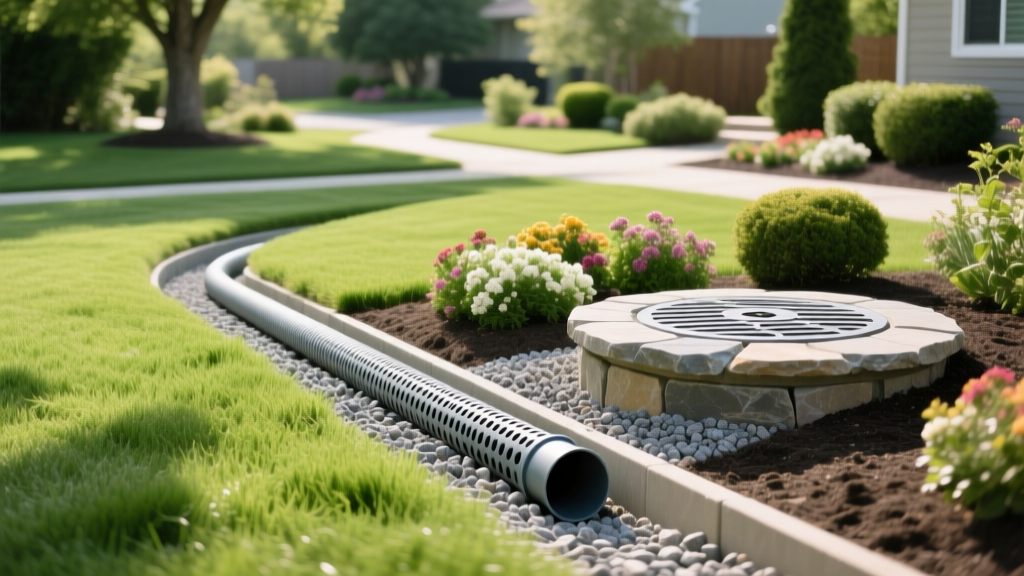
French Drains & Dry Wells: Proven Backyard Drainage Solutions
Standing water in your yard is more than just a nuisance that ruins weekend barbecues; it is a direct threat to your home's structural integrity and your landscape's health. Prolonged soil saturation suffocates turfgrass roots, breeds mosquitoes, and can cause hydrostatic pressure to crack basement foundations. Implementing effective backyard drainage solutions requires moving beyond temporary fixes like adding more topsoil and instead engineering a subsurface water management system.
This guide details the exact materials, slope calculations, and installation protocols for the three most reliable backyard drainage solutions: French drains, subsurface dry wells, and grading swales. According to Penn State Extension, managing stormwater at the source through infiltration and subsurface routing is critical for preventing localized flooding and soil erosion.
Diagnosing Your Yard's Hydrology: The Perk Test
Before purchasing PVC or gravel, you must determine your soil's infiltration rate. Heavy clay soils hold water near the surface, while sandy loams allow rapid percolation. Perform a simple percolation test to dictate which drainage solution will actually work.
The 12-Inch Perk Test Protocol:
- Dig a hole 12 inches deep and 12 inches wide in the area where water typically pools.
- Fill the hole completely with water and let it drain overnight to saturate the surrounding soil.
- Refill the hole to the top and measure the water level with a ruler.
- Wait exactly one hour and measure the drop in water level.
Interpretation: If the water drops less than 1 inch per hour, you have heavy clay and require a French drain to physically move water off-site. If it drops 1 to 6 inches per hour, a dry well will work to store and slowly percolate water into the subsoil.
Solution 1: The French Drain Trench System
A French drain is a gravel-filled trench containing a perforated pipe that intercepts subsurface water and routes it to a designated discharge point, such as a storm drain, dry creek bed, or municipal curb. The most common point of failure in DIY French drains is material selection. Avoid cheap corrugated black pipe; it crushes under soil load and its ridges trap sediment, leading to clogs within three years.
Specifying the Right Materials
- Pipe: Use SDR 35 (Standard Dimension Ratio) rigid PVC pipe with pre-drilled holes, or rigid Schedule 40 PVC. SDR 35 is the industry standard for residential drainage because it balances structural rigidity with cost (approximately $35 to $45 per 10-foot stick).
- Gravel: Use 3/4-inch to 1-1/2-inch washed drain rock. Never use crushed limestone or pea gravel. Limestone compacts into a hardpan and leaches calcium carbonate, which alters soil pH and harms acid-loving landscape plants.
- Geotextile Fabric: Use a 6 oz to 8 oz per square yard non-woven, needle-punched geotextile fabric. Woven silt fences will clog with fine clay particles within a single season, rendering the drain useless.
Step-by-Step Installation Protocol
Proper slope is non-negotiable. A French drain requires a minimum 1% grade, which translates to a 1/8-inch drop per linear foot. Over a 50-foot run, the trench must drop at least 6.25 inches from start to finish.
- Call 811: Have all underground utilities marked before breaking ground.
- Trenching: Dig a trench 12 inches wide and 18 inches deep. Use a rotary laser level and grade stakes to ensure the 1/8-inch per foot slope is maintained along the entire run.
- Lining:Drape the 6 oz non-woven geotextile fabric into the trench, leaving at least 12 inches of excess fabric hanging over both edges. Do not wrap the pipe directly in fabric (the "burrito method"); this traps fines against the pipe holes.
- Base Gravel: Add 3 inches of washed drain rock to the bottom of the fabric-lined trench.
- Pipe Placement: Lay the SDR 35 PVC pipe on the gravel bed with the perforations facing down. Water enters from the bottom up, keeping the top of the pipe clear of sediment.
- Covering: Fill the trench with washed rock until it is 3 inches below the ground surface.
- Wrapping and Finishing: Fold the excess fabric over the gravel to create a complete envelope, then cover the final 3 inches with topsoil and lay sod to hide the trench.
Solution 2: Subsurface Dry Wells for High-Volume Runoff
If your municipality prohibits discharging yard water into storm sewers, or if you lack a downhill discharge point, a dry well is the optimal backyard drainage solution. A dry well is an underground chamber that captures high-volume runoff—typically from roof downspouts—and holds it while it slowly percolates into the surrounding subsoil.
Modern dry wells utilize modular plastic chambers rather than gravel pits, which are prone to collapsing. The NDS Flo-Well series (e.g., the 50-gallon or 90-gallon models) is constructed from high-density polyethylene (HDPE) and can support significant surface loads when buried correctly. According to the Natural Resources Defense Council (NRDC), capturing roof runoff in subsurface infiltration systems drastically reduces the burden on municipal stormwater infrastructure and replenishes local groundwater tables.
Dry Well Sizing and Placement
To size a dry well for a roof downspout, calculate the catchment area. A 1,000-square-foot roof section generates roughly 600 gallons of water during a 1-inch rain event. A standard 50-gallon NDS Flo-Well handles the initial surge, while the surrounding 3/4-inch gravel bed (typically a 3-foot wide by 3-foot deep excavation around the unit) provides the remaining storage and infiltration capacity. Always place dry wells at least 10 feet away from your home's foundation to prevent hydrostatic pressure buildup against basement walls.
Comparing Backyard Drainage Solutions
Choosing the right system depends on your soil type, budget, and the volume of water you need to manage. Use the matrix below to determine the best approach for your specific landscape.
| Solution | Best Use Case | Estimated DIY Cost | Volume Handled |
|---|---|---|---|
| French Drain | Heavy clay soils; moving water off-site to a curb or ditch. | $12 - $18 per linear ft | Continuous subsurface flow |
| Dry Well | Sandy/loam soils; capturing concentrated downspout runoff. | $250 - $450 per unit | High-volume surge events |
| Grading Swale | Large properties; shallow surface sheet flow redirection. | $400 - $800 (machine rental) | Moderate surface runoff |
Solution 3: Regrading and Swale Construction
Before installing subsurface pipes, evaluate if surface grading can solve the issue. A swale is a shallow, broad, vegetated ditch designed to slow and redirect surface water. If your yard slopes toward your foundation, you must regrade the soil to create a minimum 5% slope (6 inches of drop over the first 10 feet) away from the house.
For larger yards, construct a grassy swale by excavating a U-shaped channel 6 to 12 inches deep and 3 to 5 feet wide. Line the swale with heavy sod or erosion-control blanket matting to prevent the channel itself from washing out during heavy rains. Swales are highly effective when combined with deep-rooted native plants like switchgrass or blue flag iris, which act as biological filters and stabilize the soil.
Critical Installation Failures to Avoid
Even with premium materials, backyard drainage solutions will fail if these common engineering mistakes are made:
- The "Burrito" Fabric Wrap: Wrapping the perforated pipe directly in geotextile fabric before adding gravel is a widespread DIY error. Fine clay particles migrate through the soil, hit the fabric, and clog the weave, effectively sealing the pipe. The fabric must line the trench walls, with a gravel buffer between the fabric and the pipe.
- Insufficient Discharge Elevation: A French drain must daylight (exit the ground) at a point lower than the trench bottom. If the discharge point becomes submerged during heavy rain, water will back up into the pipe. Install a pop-up emitter valve at the discharge end to prevent debris and rodents from entering the system while allowing water to push out under pressure.
- Ignoring Roof Gutters: A 2,000-square-foot roof sheds 1,200 gallons of water per inch of rain. If your downspouts dump directly onto the lawn near your foundation, no subsurface French drain can keep up. Always extend downspouts via solid (non-perforated) PVC pipe directly into your dry well or daylight them 15 feet away from the house.
Pro Tip for Winter Climates: If you live in a region with deep frost lines, ensure your drainage pipes are buried below the frost depth (typically 36 to 48 inches in northern zones). Water trapped in shallow pipes will freeze, expand, and shatter rigid PVC. If burying below the frost line is impossible, ensure the pipe maintains a strict 2% slope so it drains completely dry between storms.
Implementing these backyard drainage solutions requires precise grading and material selection, but the investment protects your landscape and foundation from catastrophic water damage. By utilizing SDR 35 PVC, washed drain rock, and non-woven geotextiles, you ensure a system that functions reliably for decades without maintenance.

