
Landscaping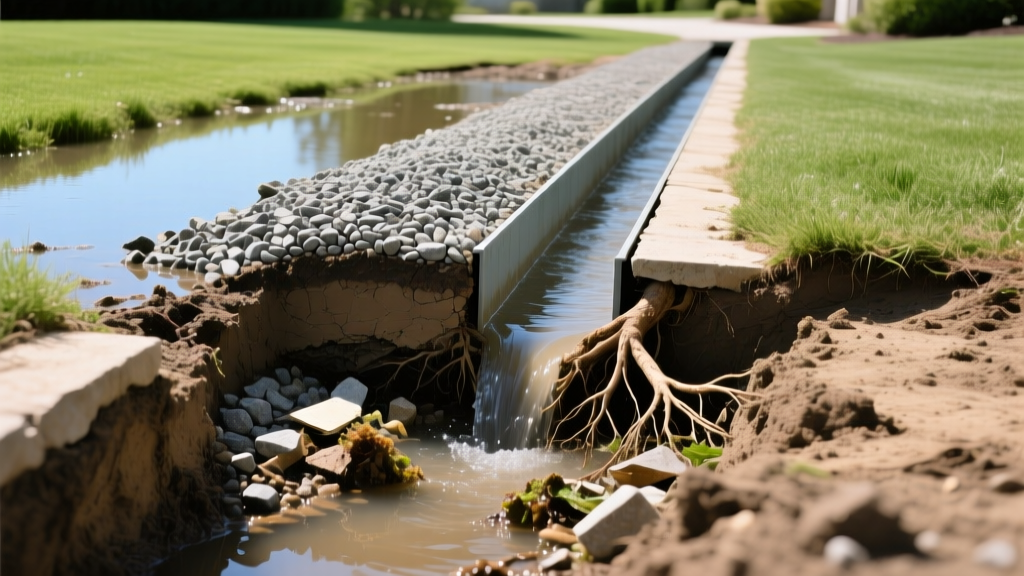
French Drain Gravel Failures: Diagnose and Fix Clogged Drains
A French drain is only as effective as the aggregate envelope surrounding its pipe. When homeowners experience sudden yard flooding, basement seepage, or sinkholes along a drainage path, the immediate instinct is to blame the perforated pipe. However, in over 80% of residential drainage failures, the root cause is the degradation, improper sizing, or contamination of the French drain gravel. Understanding how aggregate interacts with soil hydrology is critical for long-term landscape drainage.
The Anatomy of a French Drain Gravel Failure
Gravel in a French drain serves two distinct purposes: it provides a high-permeability pathway for water to reach the pipe, and it acts as a structural filter to prevent surrounding soil from collapsing into the trench. When this system fails, it is almost always due to fines migration or aggregate lock-up.
Symptom 1: Surface Ponding Over the Trench
If water pools directly above the buried trench line during heavy rainfall, the gravel envelope has lost its hydraulic conductivity. This occurs when microscopic clay and silt particles (fines) from the surrounding native soil wash into the gravel voids. Over time, these fines cement the gravel together, creating an impermeable subterranean barrier. According to principles outlined by the USGS Water Science School, soil texture and percolation rates dictate how quickly fine particles will migrate into coarse aggregates without proper geotextile separation.
Symptom 2: Slow Drainage and Soil Erosion
Conversely, if the gravel is too large or lacks a proper filter fabric, water may bypass the pipe entirely, washing away the subgrade. This leads to voids beneath the gravel, causing the trench to settle and creating linear sinkholes in your lawn.
CRITICAL WARNING: Never use unwashed gravel, crushed limestone with stone dust, or recycled concrete for a French drain. The 'fines' (stone dust) inherent in these materials will turn into a concrete-like sludge when wet, permanently clogging the perforated pipe slots within a single season.
The Gravel Sizing and Selection Matrix
Choosing the correct aggregate is a matter of matching the stone size to your native soil type and pipe specifications. Below is a diagnostic matrix to help you identify if the wrong material was used in your original installation.
| Gravel Type | Size / Profile | Clog Risk | Best Application |
|---|---|---|---|
| #57 Washed Stone | 3/4' to 1' (Angular) | Low (if washed) | Standard residential French drains; pairs well with 4-inch SDR-35 PVC pipe. |
| Washed Pea Gravel | 1/4' to 3/8' (Rounded) | Moderate | Shallow curtain drains; high clay soils where smaller voids prevent clay intrusion. |
| #3 Washed Stone | 1.5' to 2' (Angular) | Very Low | High-volume commercial drains or deep retaining wall weep holes. |
| Crushed Granite (Unwashed) | Variable (Contains dust) | Extreme | NEVER use in French drains. Reserved for driveway bases and paver bedding. |
Diagnosing the Clog: A Step-by-Step Field Test
Before excavating your yard, perform a hydraulic flow test to confirm that the gravel envelope or pipe is the point of failure. Research from Penn State Stormwater Management emphasizes the importance of verifying inlet-to-outlet flow rates before attempting invasive landscape repairs.
- Locate the Exit Point: Find where your French drain daylight (exits) at the curb, dry well, or pop-up emitter.
- Clear the Outlet: Remove any debris, rodent nests, or root intrusions from the exposed pipe end.
- Conduct the Bucket Test: Place a 5-gallon bucket under the outlet. Using a garden hose, run water at a moderate, consistent pressure (approximately 5 gallons per minute) directly into the upstream catch basin or trench inlet.
- Measure the Lag Time: Time how long it takes for water to appear at the outlet. In a healthy 50-foot drain with clean #57 gravel and smooth-wall PVC, water should exit within 15 to 30 seconds.
- Interpret the Results: If the bucket fills rapidly, your pipe is clear, and the issue is surface grading. If water trickles out slowly, or not at all, the gravel envelope is clogged with silt, or the pipe has collapsed/root-intruded.
Solutions: Flushing vs. Complete Aggregate Replacement
Once you have confirmed a gravel or pipe clog, you must choose between mechanical flushing or full trench excavation. Your decision depends on the age of the drain and the type of pipe installed.
Method 1: Hydro-Jetting the Trench (For PVC Pipes Only)
If your drain was built using smooth-wall PVC (such as SDR-35 or Schedule 40), you can attempt to clear the gravel voids and pipe using a high-pressure sewer jetter. Rent a jetter capable of 3,000 to 4,000 PSI. Feed the hose into the upstream cleanout or catch basin. The backward-facing water jets will blast accumulated silt out of the gravel matrix and flush it through the pipe. Note: Never hydro-jet corrugated flexible black pipe; the high pressure will easily rupture the thin walls and disconnect the couplings.
Method 2: Full Excavation and Rebuild (2026 Cost Estimates)
If the drain utilizes corrugated pipe, or if hydro-jetting fails to restore flow, the gravel is permanently compromised and must be replaced. As of 2026, professional excavation and replacement costs average $22 to $38 per linear foot, depending on regional labor rates and soil composition (heavy clay requires wider trenches). Washed #57 gravel currently costs between $45 and $65 per ton delivered. A standard 50-foot trench requires approximately 3 to 4 tons of gravel.
'When rebuilding a failed French drain, the most common mistake is reusing the excavated native soil to backfill over the new gravel. Always import clean topsoil or use a layer of coarse sand to cap the gravel trench before laying sod, preventing surface clay from immediately washing back into the aggregate.'
Advanced Upgrades: Geotextiles and Pipe Swaps
To ensure your repaired French drain lasts for decades, implement these modern material upgrades during the rebuild phase:
- Non-Woven Geotextile Fabric: Wrap the entire gravel envelope in a 4 oz to 6 oz per square yard non-woven polypropylene geotextile. Do not use woven landscape fabric; woven fabrics are designed for weed suppression and structural stabilization, and their tight weave will rapidly clog with silt, defeating the purpose of the drain.
- Upgrade to Smooth-Wall PVC: Replace corrugated flexible pipe with 4-inch SDR-35 smooth-wall PVC. The interior ridges of corrugated pipe trap silt, biofilm, and tree roots, reducing flow capacity by up to 40% over five years. Smooth PVC maintains a near-frictionless interior.
- NDS EZ-Flow Alternative: For shallow applications where hauling tons of gravel is impractical, consider NDS EZ-Flow drainage bundles. These consist of a perforated pipe surrounded by a rigid polystyrene aggregate matrix wrapped in geotextile, eliminating the need for loose gravel entirely while providing equivalent hydraulic conductivity.
Frequently Asked Questions
Can I use river rock instead of crushed gravel for a French drain?
Yes, washed river rock is highly effective because its rounded edges create larger, more consistent void spaces than angular crushed stone, allowing for faster water percolation. However, because it does not interlock, it is more prone to shifting in high-flow scenarios. It is best used in low-gradient residential yard drains rather than heavy-duty retaining wall applications.
How deep should the gravel bed be beneath the pipe?
Always maintain a minimum of 2 to 3 inches of washed gravel beneath the perforated pipe. This base layer prevents the pipe from resting directly on the native soil subgrade, which can cause the pipe to settle, create low spots (bellies), and pool stagnant water that breeds mosquitoes and algae.
Why is my gravel turning white and crusty?
A white, chalky crust on French drain gravel is efflorescence—a mineral deposit left behind by hard, alkaline water leaching through concrete foundations or limestone-based aggregates. While unsightly, it rarely clogs the drain. If severe, consider switching to a granite or basalt-based washed stone in future replacements to eliminate the calcium carbonate source.

