
Landscaping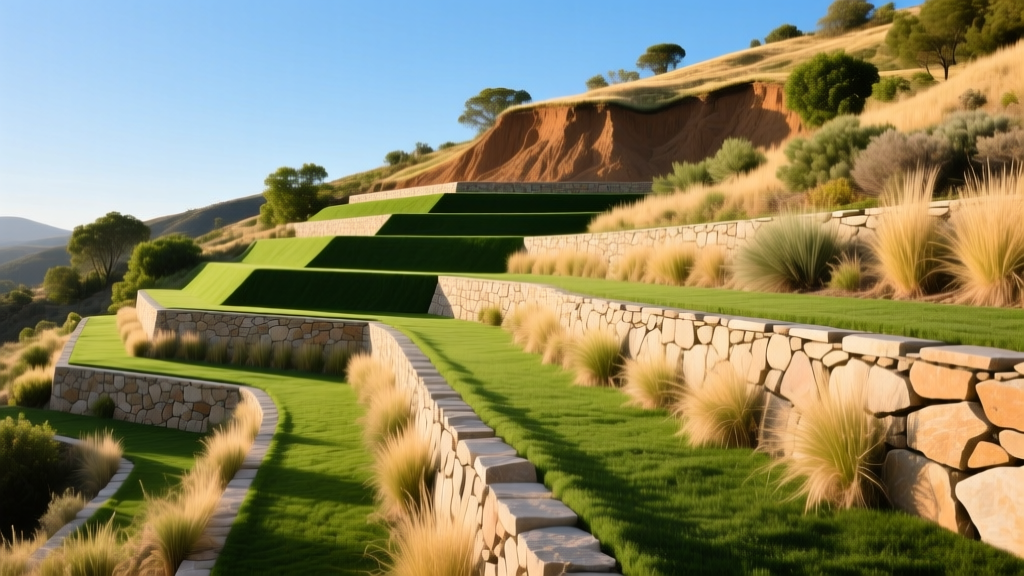
Landscaping for a Hill: Erosion Control and Terracing Guide
The Physics of Slope Failure: Why Hills Erode
Landscaping for a hill is fundamentally an exercise in hydrology and soil mechanics. When water flows down a slope, it exerts shear stress on the soil surface. If that stress exceeds the soil's cohesive strength, particles detach and wash away. According to the USDA Natural Resources Conservation Service, unprotected sloped soils can lose up to 5 tons of topsoil per acre annually during heavy rain events. Before selecting plants or building walls, you must calculate the slope's grade. A slope exceeding 33% (a 1-foot vertical drop for every 3 feet of horizontal distance) generally requires structural intervention rather than just planting.
Warning: The Angle of Repose
Most residential loam soils have a natural angle of repose between 30 and 35 degrees. If your hill is steeper than this and lacks deep-rooted vegetation or retaining structures, it is actively prone to slumping and surface erosion. Do not attempt to mow slopes steeper than 30 degrees; use a string trimmer or transition to groundcover.
Tier 1 Solutions: Subsurface Drainage and Swales
Erosion is rarely a surface-only problem; it is usually a symptom of poor subsurface water management. If water is pooling behind your hill or saturating the soil from within, surface fixes will fail.
Installing a Hillside French Drain System
- Trenching: Dig a trench 12 inches wide and 18 inches deep along the contour line at the top of the slope to intercept runoff before it accelerates.
- Pipe Selection: Use 4-inch SDR 35 PVC pipe rather than corrugated HDPE. PVC maintains its structural integrity under heavy soil loads and doesn't trap sediment in its ridges.
- Envelope Protection: Wrap the pipe in a non-woven geotextile fabric (minimum 4 oz/sq yd weight) to prevent fine clay particles from clogging the gravel matrix.
- Backfill: Surround the pipe with 3/4-inch washed crushed stone. Avoid pea gravel, which lacks the angularity needed to lock together and maintain void space for water flow.
Tier 2 Solutions: Retaining Walls and Terracing
When landscaping for a hill requires flattening usable space, terracing breaks a single steep slope into multiple level steps. This reduces the velocity of runoff and creates flat planting zones. For walls exceeding 36 inches in height, structural engineering and geogrid reinforcement are mandatory.
Retaining Wall Material Comparison Matrix
| Material | Installed Cost (per sq ft) | Expected Lifespan | Max Unreinforced Height | Best Use Case |
|---|---|---|---|---|
| Treated Timber (6x6) | $18 - $25 | 15 - 20 Years | 3 Feet | Budget-friendly, rustic, low-load garden beds. |
| Segmental Block (e.g., Allan Block) | $30 - $45 | 50+ Years | 4 Feet (without geogrid) | Curved terraces, high-load areas, permanent hardscaping. |
| Poured Concrete | $60 - $90 | 100+ Years | 10+ Feet (with rebar) | Tall structural walls, modern aesthetics, heavy vehicular loads above. |
| Natural Boulders (Limestone/Granite) | $40 - $65 | 100+ Years | 3 Feet | Woodland settings, naturalistic drainage swales. |
Engineering Note: For segmental block walls over 4 feet, you must integrate biaxial geogrid (such as Mirafi 500X) every 2 to 3 courses, extending back into the compacted soil a distance equal to 60% of the wall's total height. This ties the wall face to the soil mass, preventing rotational failure. Consult Allan Block's engineering guidelines for precise geogrid spacing calculations based on your specific soil type.
Tier 3 Solutions: Deep-Root Plant Matrices
If your slope is under 33% grade and you prefer softscaping, you must deploy a deep-root plant matrix. Turfgrass roots typically only reach 2 to 4 inches deep, offering negligible erosion control. You need fibrous, woody root systems that penetrate 18 to 36 inches to physically stitch the soil layers together.
Recommended Slope-Stabilizing Species
- Creeping Juniper (Juniperus horizontalis): Roots reach 24 inches deep. Drought-tolerant once established. Plant at 3-foot centers in a staggered diamond pattern.
- Crownvetch (Securigera varia): A nitrogen-fixing legume with roots extending up to 36 inches. Aggressive spreader; use only on large, isolated highway-style embankments where it won't invade adjacent garden beds.
- Daylilies (Hemerocallis): Dense, fibrous root mats that hold topsoil exceptionally well. Requires moderate maintenance to remove dead foliage annually.
- Japanese Spurge (Pachysandra terminalis): Ideal for heavily shaded northern slopes. Forms a dense, evergreen carpet that intercepts raindrop impact.
Pro Tip: The Jute Netting Technique
When planting a hill, seeds and young plugs will wash away before roots establish. Pin down biodegradable jute erosion control netting (photodegradable plastic netting is an ecological hazard and should be avoided) over the freshly planted slope. Secure it with 6-inch landscape staples every 3 feet. The jute will hold the soil for 12-18 months, then decompose as the plant canopy closes.
Common Hill Landscaping Mistakes to Avoid
Even well-funded projects fail when contractors ignore the unique physics of sloped terrain. Avoid these critical errors:
- Using Plastic Weed Barrier on Slopes: Woven or solid plastic sheeting creates a hydroplaning effect. Water sheets off the plastic, accelerating at the bottom edge and carving deep trenches. Always use permeable geotextile fabrics.
- Applying Mulch Too Thickly: A 4-inch layer of hardwood mulch on a 20-degree slope will slide during the first heavy rain. Limit mulch to 2 inches on slopes and use shredded bark (which interlocks) rather than rounded wood chips.
- Ignoring the Toe of the Slope: Water exiting the bottom of a hill scours the flat ground below. Always install a riprap apron (a 2-foot wide bed of 3-inch river rock) at the toe of the slope to dissipate water energy.
Cost Breakdown for a 1,500 Sq Ft Slope Project
Budgeting for hill stabilization requires factoring in both access difficulties and material volumes. Below is a realistic 2026 cost estimate for stabilizing a 50x30 foot slope (1,500 sq ft) with a moderate 25% grade using a combination of terracing and planting.
| Project Phase | Materials & Labor Details | Estimated Cost Range |
|---|---|---|
| Site Prep & Grading | Skid steer rental, manual trenching, soil amendments | $1,200 - $1,800 |
| Subsurface Drainage | 150 linear ft of 4-inch SDR 35 PVC, gravel, geotextile | $850 - $1,400 |
| Segmental Retaining Wall | Two 25-ft long terraces (2 ft and 3 ft high), block, base aggregate | $4,500 - $7,000 |
| Planting & Erosion Control | 150 Creeping Juniper plugs, jute netting, staples, shredded bark | $1,100 - $1,600 |
| Total Project Cost | Comprehensive stabilization and aesthetic upgrade | $7,650 - $11,800 |
Frequently Asked Questions
Can I use retaining wall blocks for a curved terrace on a hill?
Yes. Segmental retaining wall blocks (SRWs) like Versa-Lok or Allan Block are specifically designed with a pin-and-lip or setback system that allows for sweeping curves. When building curves, the blocks naturally fan out at the top; you will need to use a masonry saw to cut alternating blocks to maintain a tight face joint and prevent soil from washing through the gaps.
How do I water new plants on a steep slope without causing runoff?
Do not use oscillating sprinklers on hills; the application rate exceeds the soil's infiltration rate, causing immediate runoff. Instead, install a drip irrigation system using 1/2-inch emitter tubing with 1-gallon-per-hour (GPH) pressure-compensating emitters placed at the base of each plant. The slow drip allows water to percolate vertically into the root zone.
What is the best groundcover for a shaded, steep hill?
For shaded slopes, University of Minnesota Extension recommends English Ivy (in non-invasive zones) or Japanese Spurge (Pachysandra). If you are in a region where those are restricted, native Wild Ginger (Asarum canadense) provides excellent, low-maintenance soil binding in deep shade, though it spreads slower than commercial alternatives.

