
Landscaping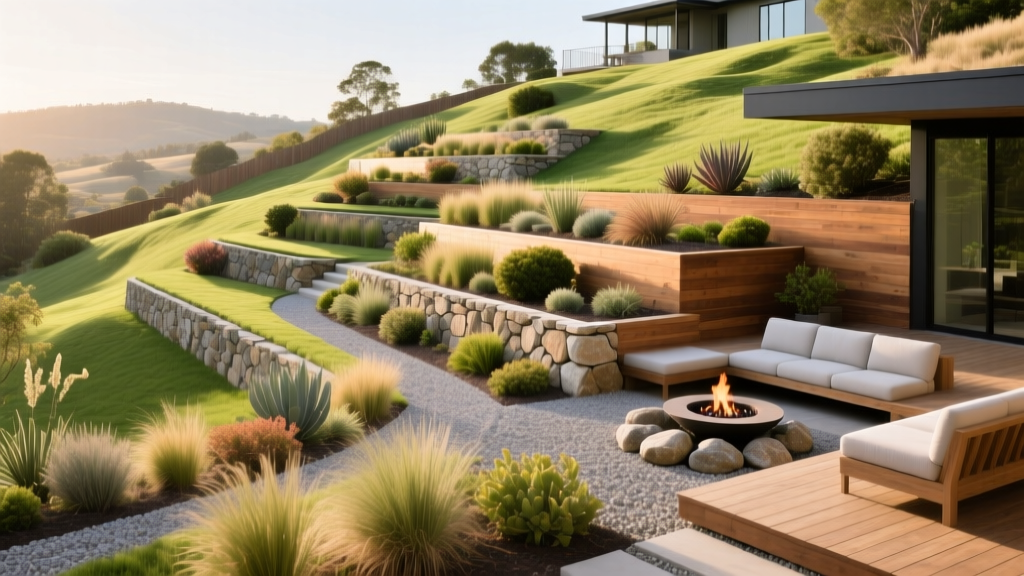
Hilly Backyard Landscaping Ideas: 5 Beginner-Friendly Slope Fixes
The Physics of a Sloped Yard: Why Gravity and Water Matter
Landscaping a hilly backyard is fundamentally an exercise in managing gravity and water runoff. When rain hits a slope, it accelerates, stripping away topsoil and exposing shallow root systems. Before selecting plants or building structures, you must calculate your yard's exact slope grade. This dictates which hilly backyard landscaping ideas will actually survive long-term.
How to Calculate Your Slope Grade
Drive a stake at the top of your hill and another at the bottom. Tie a string to the top stake at ground level, pull it taut to the bottom stake, and use a line level to ensure it is perfectly horizontal. Measure the distance from the ground to the string at the bottom stake (the rise) and the total length of the string (the run). Divide the rise by the run, then multiply by 100 to get your percentage grade.
The Slope Assessment Matrix
| Slope Grade | Risk Level | Recommended Strategy |
|---|---|---|
| Under 10% | Low | Standard turfgrass, light mulching |
| 10% - 20% | Moderate | Deep-rooted native groundcovers, erosion blankets |
| 20% - 35% | High | Terraced retaining walls, dry creek beds |
| Over 35% | Severe | Engineered geogrid walls, riprap rock armoring |
1. Terraced Retaining Walls (For 20%+ Grades)
Terracing breaks a single steep slope into a series of flat, usable plateaus. For beginners, segmental retaining wall (SRW) blocks are vastly superior to poured concrete or timber. As of 2026, high-quality SRW blocks meeting the ASTM C1372 standard cost between $3.50 and $6.00 per unit and feature built-in lip systems that automatically set the correct backward tilt (batter) for structural integrity.
The Non-Negotiable Base Trench
The most common failure mode for DIY retaining walls is settling and bulging. This happens when builders use round pea gravel or dirt for the base. You must excavate a trench 6 to 8 inches deep and fill it with angular crushed stone (ASTM D2940, typically 3/4-inch minus). The sharp edges of angular stone lock together when compacted with a mechanical plate compactor, creating a rigid foundation that will not shift under the wall's weight.
2. Deep-Rooted Native Groundcovers (For 10%-20% Grades)
Standard Kentucky Bluegrass or Tall Fescue have shallow, fibrous root systems that easily tear away on slopes exceeding a 15% grade. Instead, utilize deep-rooted, creeping evergreens that act as a living net over the soil.
- Blue Rug Juniper (Juniperus horizontalis 'Wiltonii'): Roots deeply and spreads horizontally up to 8 feet. Drought-tolerant once established. Plant on an 18-to-24-inch staggered grid.
- Creeping Phlox (Phlox subulata): Ideal for sunny slopes, providing dense spring blooms and a mat-like root structure that holds topsoil firmly in place.
- Allegheny Spurge (Pachysandra procumbens): The premier choice for heavily shaded hilly areas where grass refuses to grow.
Pro Tip: When planting on a slope, never leave bare soil exposed between the new plants. Cover the exposed dirt with a Type 2 erosion control blanket (ECB)—a biodegradable straw mat sandwiched between jute netting. Pin it to the soil using 6-inch steel U-staples every 3 feet to prevent the mat from washing away before the plant roots anchor the hill.
3. Dry Creek Beds for Water Routing
If your hilly backyard suffers from heavy water runoff that carves gullies into the lawn, a dry creek bed is a highly effective, beginner-friendly hilly backyard landscaping idea that turns a drainage problem into a focal point.
Sizing and Layering the Rock
A functional dry creek bed requires a parabolic cross-section (U-shaped), typically 12 to 18 inches deep in the center. Do not just dump rocks on the dirt. Follow this specific layering protocol:
- Base Layer: Line the trench with a heavy-duty woven polypropylene geotextile fabric (minimum 3.2 oz per square yard). Never use cheap, non-woven black plastic sheeting, which traps moisture and causes soil rot.
- Armor Layer: Place 3-to-8-inch riprap (angular crushed rock) at the bottom of the trench. This heavy base prevents the water's kinetic energy from displacing the channel.
- Aesthetic Layer: Cap the riprap with 1-to-3-inch smooth river rock to soften the visual appearance and mimic a natural waterway.
Warning: The Drainage Pipe Mistake
Many beginners place a perforated PVC pipe at the bottom of a retaining wall or dry creek bed without wrapping it in a fabric 'sock'. Without the sock, fine soil particles wash into the pipe's weep holes, eventually clogging the system and causing hydrostatic pressure to build up and blow out the wall. Always use sock-wrapped corrugated drain pipe.
Many beginners place a perforated PVC pipe at the bottom of a retaining wall or dry creek bed without wrapping it in a fabric 'sock'. Without the sock, fine soil particles wash into the pipe's weep holes, eventually clogging the system and causing hydrostatic pressure to build up and blow out the wall. Always use sock-wrapped corrugated drain pipe.
Cost and ROI Comparison for 2026
Budgeting for slope stabilization requires looking at both initial installation costs and long-term maintenance. Below is a realistic breakdown of the most common hilly backyard landscaping ideas based on current 2026 contractor and material averages.
| Landscaping Method | Material Cost (Per Sq Ft) | Professional Install Cost | Lifespan | Maintenance Level |
|---|---|---|---|---|
| Segmental Retaining Wall | $8.00 - $15.00 | $25 - $50 per sq ft | 50+ Years | Low |
| Native Groundcovers | $1.50 - $3.00 | $4 - $8 per sq ft | 15 - 20 Years | Moderate (Weeding) |
| Dry Creek Bed | $4.00 - $7.00 | $12 - $18 per linear ft | 25+ Years | Low (Debris clearing) |
Expert Resources and Erosion Science
Understanding the mechanics of soil erosion is critical before moving earth on your property. The United States Environmental Protection Agency (EPA) provides extensive data on how soil degradation and runoff impact local watersheds, emphasizing the importance of permeable landscaping solutions over impermeable concrete barriers.
Furthermore, the United States Geological Survey (USGS) offers detailed guides on the natural processes of erosion and deposition, which can help homeowners understand how water naturally wants to move through their specific topography. By working with the natural flow of water rather than fighting it with flat barriers, your hilly backyard landscaping will remain stable and beautiful for decades.

