
Landscaping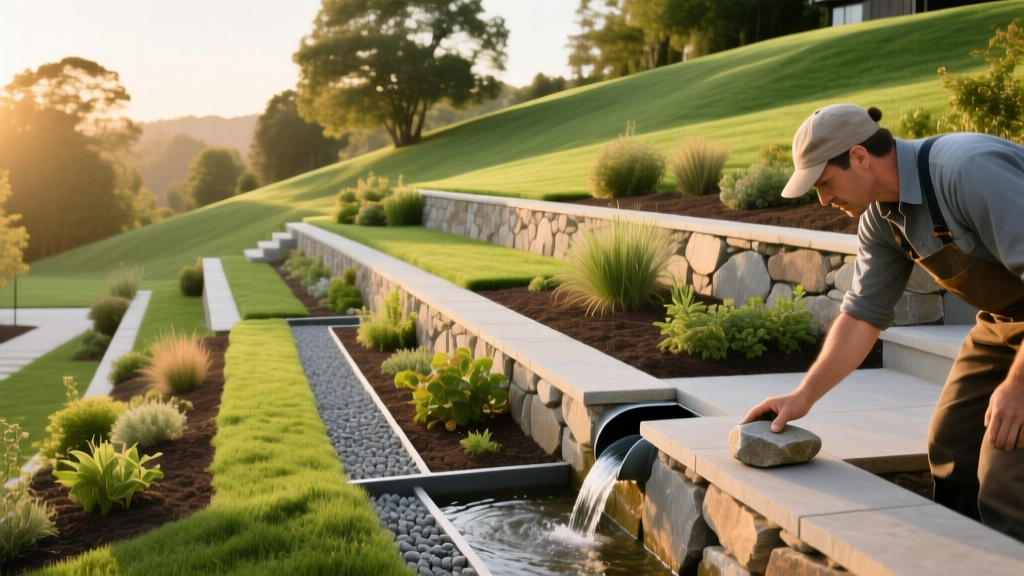
Practical Landscape Ideas for a Hilly Yard: Terracing and Drainage
Assessing Your Slope Gradient and Soil Mechanics
Before selecting landscape ideas for a hilly yard, you must quantify the exact gradient and understand the underlying soil mechanics. Guessing the slope leads to catastrophic retaining wall failures and severe topsoil erosion. To calculate your slope percentage, drive a stake at the top of the hill and another at the bottom. Tie a string to the top stake at ground level, pull it taut to the bottom stake, and use a wooden line level to ensure it is perfectly horizontal. Measure the horizontal distance (run) and the vertical drop from the string to the ground at the bottom stake (rise). Divide the rise by the run, then multiply by 100 to get your grade percentage.
Next, identify your soil composition using the USDA Web Soil Survey. Clay-heavy soils retain water and expand, exerting massive lateral pressure on retaining structures, while sandy soils drain quickly but lack cohesive strength for steep, unreinforced cuts.
Safety Warning: Never operate a zero-turn or standard ride-on mower on a slope exceeding a 15% grade (roughly an 8.5-degree angle). The rollover risk is severe. For slopes between 15% and 33%, use a commercial-grade string trimmer or a remote-controlled slope mower.
Tier 1 Solutions: Gentle Slopes (Under 15% Grade)
For mild inclines, deep-rooting native groundcovers are the most cost-effective erosion control method. Avoid shallow-rooted turfgrass like Kentucky Bluegrass, which requires frequent, dangerous mowing and offers minimal soil stabilization.
Recommended Plantings for Slope Stabilization
- Creeping Juniper (Juniperus horizontalis 'Wiltonii'): Roots penetrate 12 to 18 inches deep, creating a dense mat. Cost: $3.50 to $5.00 per plug. Verify hardiness zones via the USDA Plants Database.
- Crownvetch (Securigera varia): A leguminous perennial that fixes its own nitrogen, thriving in poor, rocky soils. Spreads rapidly via rhizomes. Cost: $18 per pound of seed.
- Daylilies (Hemerocallis 'Stella de Oro'): Excellent for transitional zones. Their fibrous, tuberous root systems lock topsoil in place. Cost: $8 to $12 per bare-root division.
Tier 2 Solutions: Terracing Moderate to Steep Slopes (15% - 35%)
When the grade exceeds 15%, water velocity increases, stripping topsoil and carving gullies. Terracing breaks a long, steep slope into a series of shorter, level benches. This requires retaining walls, which must be engineered to withstand both the weight of the soil (surcharge load) and the water trapped behind it.
Retaining Wall Material Comparison
According to structural guidelines outlined by the University of Minnesota Extension, material selection dictates your maximum unreinforced height and long-term maintenance costs.
| Material | Max Unreinforced Height | Estimated Cost (Per Sq. Ft. of Face) | Lifespan | Best Use Case |
|---|---|---|---|---|
| 6x6 Pressure-Treated Timber | 3 feet | $25 - $35 | 15 - 20 years | Budget-friendly, rustic tiers |
| Segmental Concrete (e.g., Allan Block) | 4 feet (with geogrid: 15+ ft) | $45 - $75 | 50+ years | Primary structural terracing |
| Natural Limestone / Flagstone | 3 feet (mortared) | $85 - $120 | 75+ years | High-end curb appeal, formal gardens |
| Gabion Baskets (Wire + Riprap) | 6 feet (per tier) | $60 - $90 | 50+ years | Severe slopes, modern/industrial aesthetics |
Pro Tip: If your segmental concrete wall exceeds 3 feet in height, you must integrate biaxial geogrid (such as Mirafi 500X) into the block courses and extend it back into the compacted soil at a distance equal to 60% of the wall's height.
Hydrostatic Pressure: The Silent Wall Killer
The most common reason landscape ideas for a hilly yard fail is ignoring hydrostatic pressure. When rain saturates the soil behind a retaining wall, water weight increases the lateral load by up to 4,000%. If the water cannot escape, the wall will bulge, crack, and eventually overturn.
Step-by-Step: Installing a Slope-Intercept French Drain
Never use corrugated black flexible pipe for retaining wall drainage; it crushes under soil load and the slits clog with silt. Use rigid 4-inch SDR 35 PVC pipe.
- Excavate the Base Trench: Dig a trench 6 inches below the lowest grade, plus an additional 1 inch of depth for every 1 foot of planned wall height. Fill with 3/4-inch angular crushed stone and compact to 95% Proctor density.
- Lay the Geotextile: Line the trench with a 4 oz non-woven geotextile fabric. Do not use woven landscape fabric, which lacks the flow rate required for heavy rainfall.
- Position the Pipe: Lay the 4-inch SDR 35 PVC pipe with the perforations facing down. This prevents silt from washing into the top of the pipe while allowing water to enter from the saturated gravel bed below.
- Backfill with Washed Gravel: Cover the pipe with at least 12 inches of washed #57 stone. Avoid crushed limestone dust or pea gravel, which either compact too tightly or lack the interlocking friction required for drainage.
- Wrap and Cap: Fold the excess geotextile fabric over the top of the gravel to create a "burrito" wrap, preventing topsoil from migrating down into the drainage aggregate. Cap with 2 inches of native soil.
Tier 3 Solutions: Severe Slopes (Over 35% Grade)
For extreme inclines, traditional terracing becomes cost-prohibitive due to the massive volume of excavation and engineered fill required. Here, gabion baskets offer a highly permeable, structurally sound alternative.
Gabions are heavy-gauge galvanized steel wire cages filled with 4- to 8-inch angular riprap stone. Because they are entirely permeable, they do not trap water and therefore do not require weep holes or complex French drain systems. A standard 3-foot high by 3-foot wide by 6-foot long gabion basket weighs approximately 4,500 pounds when filled, providing immense gravity-wall resistance against slope creep. Installation requires a mini-excavator and a skid steer with a grapple attachment, pushing labor costs to $85 to $120 per linear foot.
Budgeting and Permitting Realities
Executing professional-grade landscape ideas for a hilly yard requires realistic financial planning. For a standard 50-foot long, 4-foot high segmental concrete retaining wall project, expect the following 2026 material and labor baselines:
- Excavation and Haul-off: $1,200 - $1,800 (removing native clay)
- Base Aggregate (Crushed Stone): $450 - $600 (delivered)
- Wall Blocks and Caps: $2,500 - $3,200
- Drainage Aggregate (#57 Stone): $800 - $1,100
- Geogrid and Geotextile: $400 - $550
- Professional Labor (Certified ICPI Installer): $4,500 - $7,000
Total project costs typically range from $9,850 to $14,250. Furthermore, any retaining wall exceeding 4 feet in height (measured from the bottom of the base trench to the top of the wall cap) legally requires a stamped engineering plan and a municipal building permit in nearly all US jurisdictions. Attempting to bypass this by building a 3.9-foot wall on a 2-foot soil mound is a known code violation that will result in fines and mandatory teardowns.
By matching the correct structural intervention to your specific slope gradient and prioritizing subsurface water management, you can transform an eroding, unusable hillside into a stable, multi-tiered outdoor living space.

