
Landscaping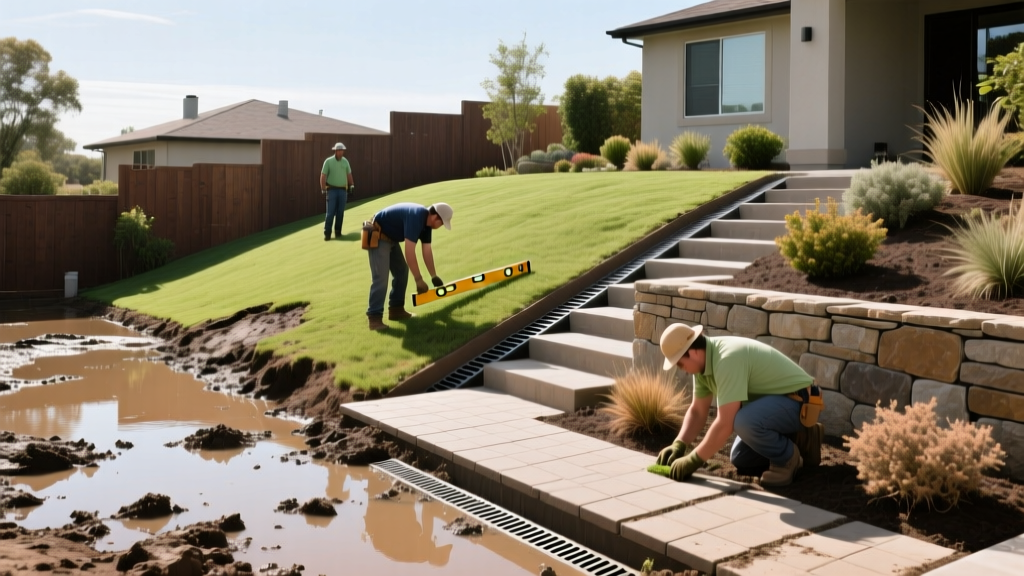
How to Landscape a Problem Yard: Fixing Drainage and Slope Issues
The Diagnostic Phase: Stop Planting, Start Engineering
A yard that holds water for 48 hours after a storm or features a 30-degree eroding slope is not a planting bed; it is an engineering problem. Homeowners often attempt to solve these issues by planting water-loving shrubs or dumping topsoil on low spots, which only masks the symptoms while worsening foundation risks. Before learning how to landscape a challenging property, you must conduct a rigorous site audit to identify the exact failure points in your soil composition and grading.
The Soil Percolation and Composition Test
Do not guess your soil type. Heavy clay retains water and causes root rot, while sandy soil drains too quickly and fails to support slope-stabilizing root structures. Perform a dual-test analysis:
- The Mason Jar Test: Dig a 6-inch core sample from three different zones in your yard. Place the soil in a clear quart jar, fill with water, add a teaspoon of dish soap, and shake vigorously. Let it settle for 48 hours. Sand settles in 1 minute, silt in 2 hours, and clay in 24 hours. If your clay layer exceeds 40%, you have a drainage problem that requires mechanical intervention.
- The Percolation Test: Dig a 12x12x12-inch hole. Fill it with water and let it drain completely to saturate the soil. Refill it and measure the water level drop every hour. A drop of less than 1 inch per hour indicates severe compaction or heavy clay, necessitating deep-tilling or the installation of subsurface drainage systems before any hardscaping begins.
Mapping the Grade and Water Flow
Water must flow away from your home's foundation at a minimum 2% grade (a 1/4-inch drop per horizontal foot) for the first 10 feet. Use a rotary laser level, such as the Johnson Level 40-6111, mounted on a tripod with a grade rod. Mark areas where water pools or where the slope reverses toward the foundation. These 'zero-grade' zones are your primary targets for hardscape correction.
⚠ Critical Foundation Warning: Never attempt to fix a negative grade (slope toward the house) simply by adding mulch or topsoil against the siding. This traps moisture against the sill plate and invites termite intrusion and wood rot. You must excavate and regrade the native soil, or install a concrete swale.
Engineering Solutions: Hardscape and Drainage Infrastructure
Once you have mapped the water flow and soil limitations, you must build the infrastructure. Softscape (plants) cannot fix a structural grading failure. The EPA Green Infrastructure Guidelines emphasize managing stormwater at the source through permeable surfaces and subsurface routing.
French Drains vs. Dry Creek Beds
Choosing between a subsurface French drain and a surface dry creek bed depends on your yard's aesthetic goals and the volume of water moving through the area.
| Feature | Subsurface French Drain | Surface Dry Creek Bed |
|---|---|---|
| Best For | Chronic pooling, foundation protection, flat yards | High-velocity runoff, sloped yards, aesthetic focal points |
| Materials | NDS 4" EZ-Flow pipe, 3/4" angular crushed stone, Mirafi 500x geotextile | 3-8" river rock, landscape fabric, boulders for edging |
| Trench Depth | 18 to 24 inches deep, 12 inches wide | 4 to 6 inches deep, 24 to 36 inches wide |
| 2026 Pro Cost | $28 - $45 per linear foot | $12 - $20 per linear foot |
Stabilizing Slopes with Retaining Walls
If your yard features a slope steeper than a 3:1 ratio (3 feet horizontal for every 1 foot vertical), turf grass will fail to establish, and mowing becomes a safety hazard. You must terrace the slope using retaining walls. For DIY landscapers, segmental retaining wall (SRW) blocks like the Allan Block Courtyard or Belgard Weston Wall systems offer pin-less, lip-locked installation.
For any wall exceeding 36 inches in height, structural reinforcement is non-negotiable. You must integrate a biaxial geogrid (such as Miragrid 1000XT) between the block courses, extending it back into the compacted gravel base a distance equal to 60% of the total wall height. This ties the wall face to the soil mass, preventing hydrostatic pressure from blowing out the blocks during spring thaws.
Botanical Solutions: Plants That Solve Problems
Once the drainage infrastructure is in place and slopes are terraced, you can deploy specific flora to manage residual moisture and prevent topsoil erosion. The University of Minnesota Extension provides extensive data on utilizing deep-rooted native plants for water management and slope stabilization.
Flora for Heavy Clay and Wet Zones
Do not fight heavy clay by amending it with endless bags of peat moss; the surrounding clay will simply create a 'bathtub' effect that drowns your amended soil. Instead, plant species evolved to thrive in anaerobic, waterlogged conditions:
- Ilex verticillata (Winterberry Holly): Tolerates standing water and heavy clay while providing brilliant winter color. Plant in masses of 3-5 for a screening effect.
- Matteuccia struthiopteris (Ostrich Fern): Aggressive rhizomatous spreader that excels in boggy, shaded clay soils where turf refuses to grow.
- Panicum virgatum (Switchgrass): Features a root system that can penetrate up to 10 feet deep into compacted clay, naturally aerating the soil profile over time.
Flora for Dry Shade and Erosion Control
The area under mature maples or oaks presents a dual problem: aggressive tree roots steal all available moisture, and the canopy blocks rainfall. To stabilize the soil here without damaging tree roots, use shallow-rooted, drought-tolerant groundcovers:
- Epimedium (Barrenwort): Thrives in the driest shade. Its wiry root mat holds topsoil in place on gentle slopes without competing heavily with tree roots.
- Helleborus orientalis (Lenten Rose): Evergreen in zones 5-9, providing year-round slope stabilization and requiring zero supplemental irrigation once established.
- Pachysandra terminalis: A classic, dense evergreen mat that chokes out weeds on shaded slopes, though it requires well-draining soil to avoid fungal leaf spot.
Budgeting Your Landscape Rehabilitation
Rehabilitating a problem yard requires front-loading your budget into hardscaping and drainage. A common mistake is spending 80% of the budget on mature trees and only 20% on grading, resulting in dead plants and washed-out mulch beds.
💡 The 70/30 Infrastructure Rule: For problem yards, allocate 70% of your total landscaping budget to subsurface drainage, grading, and retaining walls. The remaining 30% should cover soil amendments, plants, and mulch. Infrastructure adds permanent property value; plants can be added incrementally over three to five years.
By approaching your yard as an engineering site first and a garden second, you eliminate the recurring costs of replacing dead plants, re-seeding washed-out lawns, and repairing water-damaged foundations. Proper diagnosis and heavy-duty infrastructure are the true foundations of a resilient landscape.

