
Landscaping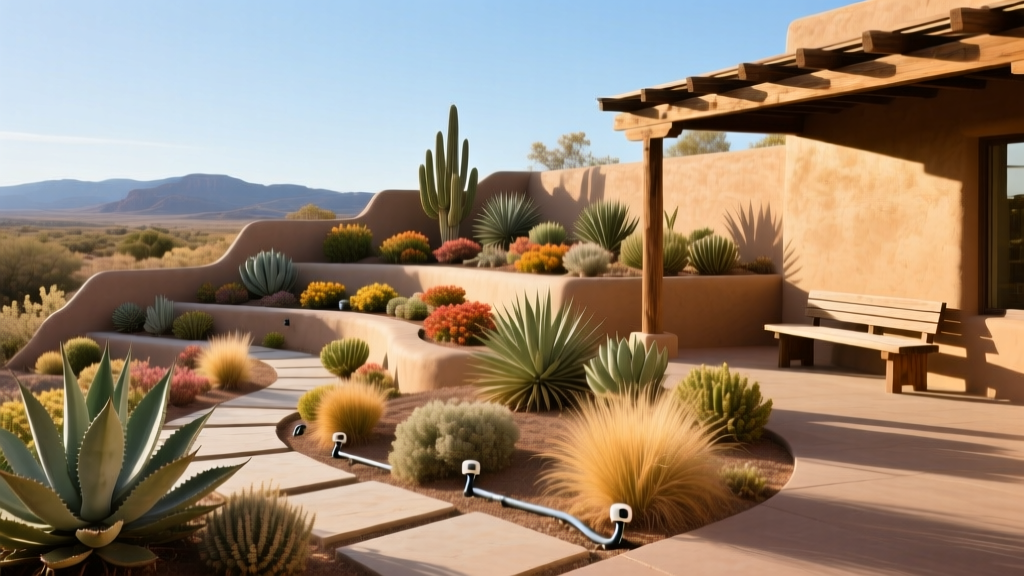
How to Design and Install a Drought-Tolerant Santa Fe Landscape
Designing an authentic Santa Fe landscape requires balancing Spanish colonial aesthetics with the harsh realities of high-desert horticulture. Sitting at roughly 7,000 feet in elevation, Santa Fe experiences intense UV radiation, drastic diurnal temperature shifts, and an average annual rainfall of just 14 inches. A successful project in this environment abandons traditional turf-heavy templates in favor of permeable hardscapes, xerophytic natives, and precision irrigation.
This guide details the exact materials, soil amendments, and installation sequences required to build a resilient, low-water Santa Fe yard that thrives in USDA Hardiness Zone 6b.
Understanding the High-Desert Microclimate and Soil Profile
Before breaking ground, you must address the native soil. Santa Fe soils are predominantly heavy clay or caliche (calcium carbonate crust), which severely restricts drainage and root penetration. Planting xeric natives directly into unamended caliche is the primary cause of root rot in high-desert landscapes.
Site Assessment Checklist:
- Percolation Test: Dig a 12-inch test hole. Fill with water; it must drain within 2 hours. If it pools, you have caliche and must fracture the hardpan.
- pH Testing: High-desert soils typically register between 7.5 and 8.5 (alkaline). Avoid acid-loving plants; select alkaline-tolerant natives.
- Solar Mapping: Identify south-facing walls that create thermal mass microclimates, which can push Zone 6b into Zone 7a, allowing for more tender agaves.
Step 1: Excavation and Hardscape Foundation
The backbone of any Santa Fe landscape is its hardscape, which should cover 40% to 60% of the total yard area to reduce water demand and provide usable living space. The standard material palette includes irregular New Mexico flagstone and 3/8-inch minus decomposed granite (DG).
Flagstone Patio Installation Specs
Do not lay flagstone directly on dirt. As of 2026, the industry standard for high-traffic desert patios requires a compacted aggregate base to prevent frost heave during freezing winter nights.
- Excavate the patio footprint to a depth of 6 inches.
- Install 4 inches of 3/4-inch minus road base. Compact using a vibratory plate compactor in 2-inch lifts.
- Spread a 1-inch layer of coarse masonry sand. Screed to a 1/8-inch-per-foot slope away from the home's foundation.
- Set the flagstone (minimum 1.5 inches thick) leaving 2-to-3-inch joints.
- Fill joints with 3/8-inch minus DG or a polymeric sand formulated for wide joints.
Material Cost Breakdown (2026 Estimates)
| Material | Application | Cost per Sq. Ft. (Installed) |
|---|---|---|
| New Mexico Flagstone (1.5"+) | Primary Patios, Steppers | $14.00 - $19.00 |
| 3/8" Minus Decomposed Granite | Pathways, Mulch Replacement | $3.50 - $5.50 |
| Crushed Basalt (3/4") | Dry Creek Beds, Drainage | $2.50 - $4.00 |
Step 2: Hydrozoning and Native Flora Selection
A core principle of xeriscaping is hydrozoning—grouping plants with identical water requirements on the same irrigation valve. The Colorado State University Extension emphasizes that mixing high-water and low-water plants in the same bed is the most common cause of xeriscape failure.
Zone 1: Oasis Zone (Near Patio/Entrances)
These areas receive supplemental water and benefit from the shade of structures. Use plants that provide lush texture without requiring daily soaking.
- Desert Willow (Chilopsis linearis): Plant 15 feet from foundations. Requires deep watering bi-weekly in summer once established.
- Autumn Sage (Salvia greggii): Space 18 inches apart. Blooms heavily from May to October. Prune to 6 inches in early March.
Zone 2: Transition Zone (Mid-Yard)
Plants here survive on rainfall plus minimal supplemental irrigation during severe drought.
- Beaked Yucca (Yucca rostrata): Requires excellent drainage. Plant on 12-inch berms. Water monthly during the first summer only.
- Desert Spoon (Dasylirion wheeleri): Space 4 feet apart to accommodate mature 5-foot rosette spread.
Zone 3: Native Zone (Perimeter)
Zero supplemental water once established. Relies entirely on natural precipitation.
- Blue Grama Grass (Bouteloua gracilis): Plant plugs 12 inches on center for a native meadow effect. Mow once annually in late winter.
- Rocky Mountain Penstemon (Penstemon strictus): Direct sow seeds in late fall for spring germination.
Step 3: Subsurface Drip Irrigation Matrix
Overhead spraying is highly inefficient in Santa Fe due to high winds and low humidity, which cause rapid evaporation. Subsurface drip irrigation delivers water directly to the root zone. The City of Santa Fe Water Conservation Division strongly mandates drip systems for all new landscape installations to comply with municipal water restrictions.
For garden beds, use inline drip tubing such as Rain Bird XFS Dripline, which features copper-infused emitters that prevent root intrusion. Configure the system based on plant maturity:
Irrigation Configuration Specs:
- Tubing Spacing: 12-inch grid for groundcovers; 18-inch grid for shrubs.
- Emitter Flow Rate: 0.9 Gallons Per Hour (GPH) for clay soils to allow lateral capillary spread without pooling.
- Flush Valve Installation: Install a manual flush valve at the end of every lateral run to clear mineral deposits (calcium carbonate) common in Santa Fe municipal water.
Step 4: Integrating Corten Steel and Adobe Accents
To achieve the contemporary Santa Fe aesthetic, integrate weathering steel (Corten) and adobe elements. Corten steel develops a protective rust patina that contrasts beautifully with the silver-blue foliage of native agaves and the tan tones of decomposed granite.
For raised planter beds or retaining walls under 3 feet, specify 3/16-inch (11-gauge) Corten steel sheets. Thinner gauges (1/8-inch) will warp under the hydrostatic pressure of wet soil during the July monsoon season. Anchor the steel using 24-inch steel T-posts driven every 4 feet along the backside of the wall, welded or bolted to the sheeting.
If incorporating traditional adobe walls, cap them with a Portland cement-based stucco or a traditional tierra blanca (white earth) lime wash to protect the mud bricks from melting during heavy summer downpours.
Critical Failure Points to Avoid
Warning: The Weed Fabric Mistake
Never install woven or non-woven weed barrier fabric beneath decomposed granite or crushed rock. In high-desert environments, wind-blown dust and organic matter settle on top of the fabric, creating a shallow soil layer where weeds thrive. More importantly, fabric destroys the permeability of the DG, causing rainwater to sheet off the surface and erode your hardscape edges. Instead, apply a 3-inch layer of DG directly over the compacted base and use a pre-emergent herbicide like prodiamine in early spring.
By prioritizing deep soil preparation, precise hydrozoning, and subsurface irrigation, your Santa Fe landscape will mature into a resilient, architecturally striking environment that requires a fraction of the water and maintenance of traditional yard designs.

