
Landscaping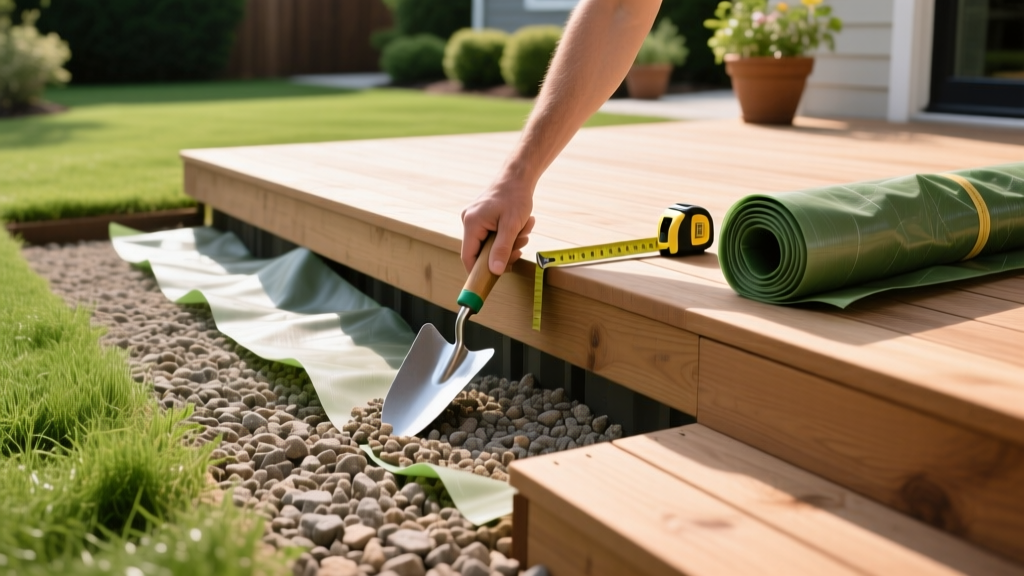
Installing Gravel Under Deck: Step-by-Step Drainage & Weed Guide
The Hidden Threat Beneath Your Deck
The space beneath an elevated deck is highly susceptible to moisture accumulation, soil erosion, and aggressive weed growth. Left untreated, this micro-environment generates constant humidity that wicks into wooden joists, accelerating rot and inviting carpenter ants and termites. Installing a proper gravel under deck system is not merely an aesthetic upgrade; it is a critical structural defense mechanism. A correctly engineered gravel bed manages hydrostatic pressure, accelerates surface runoff, and creates a physical barrier against organic growth.
This guide details the exact materials, measurements, and installation protocols required to build a high-performance drainage bed beneath your deck, moving beyond generic advice to provide contractor-grade specifications.
Why Angular Crushed Stone Beats Pea Gravel Every Time
The most common mistake homeowners make when planning a gravel under deck project is selecting smooth, round stones like pea gravel or river rock based on visual appeal. For subsurface drainage and structural stability, angular crushed stone is the only viable option.
| Material Type | Shape & Texture | Drainage Rate | Weed Suppression | 2026 Avg. Cost (Per Ton) |
|---|---|---|---|---|
| #57 Crushed Stone | Angular, fractured faces | Excellent (High void ratio) | High (Locks together) | $65 - $95 |
| Pea Gravel | Smooth, rounded | Moderate (Shifts and compacts) | Low (Migrates easily) | $45 - $70 |
| Crusher Run (Dense Grade) | Angular with stone dust | Poor (Compacts into solid mass) | Very High | $40 - $60 |
For optimal deck drainage, specify 3/4-inch #57 crushed angular gravel. The fractured faces of the stones interlock when tamped, creating a stable, permeable matrix that resists displacement from heavy rain or foot traffic. Smooth pea gravel rolls and shifts, eventually exposing the underlying weed barrier and creating low spots where water pools.
Geotextile Fabrics: Woven vs. Non-Woven Under Decks
Placing gravel directly on bare soil guarantees failure. Over time, the gravel will sink into the earth, and soil will migrate upward, clogging the drainage voids. A geotextile fabric separator is mandatory. However, not all landscape fabrics perform equally in high-moisture, low-UV environments.
The Woven Polypropylene Standard
According to research from the University of Minnesota Extension, woven geotextile fabrics are superior for permanent hardscape and gravel installations. Woven fabrics (typically rated between 3.2 oz and 4.8 oz per square yard) feature high tensile strength and precise water flow rates (permittivity). They allow water to pass through vertically while blocking soil particles and weed rhizomes.
Avoid non-woven (felt-like) fabrics under decks. While excellent for French drains where lateral water movement is required, non-woven fabrics are prone to clogging with fine silt over time when exposed to surface runoff, effectively turning into an impermeable plastic sheet that traps water against your deck joists.
Critical Warning: Never Use 6-Mil Black Plastic Sheeting
Polyethylene plastic sheeting is completely impermeable. Laying plastic under a deck creates a bathtub effect. Water will pool on top of the plastic, breeding mosquitoes, and the trapped humidity will evaporate upward, directly rotting your deck joists and rim boards from the bottom up.
Polyethylene plastic sheeting is completely impermeable. Laying plastic under a deck creates a bathtub effect. Water will pool on top of the plastic, breeding mosquitoes, and the trapped humidity will evaporate upward, directly rotting your deck joists and rim boards from the bottom up.
Material Calculator: Tonnage and Cubic Yards
Accurate material estimation prevents project delays and excessive delivery fees. Gravel is sold by the ton, but calculated by volume (cubic yards).
The Formula:
(Length in feet × Width in feet × Depth in feet) ÷ 27 = Cubic Yards
Cubic Yards × 1.4 = Estimated Tons (for #57 Crushed Stone)
(Length in feet × Width in feet × Depth in feet) ÷ 27 = Cubic Yards
Cubic Yards × 1.4 = Estimated Tons (for #57 Crushed Stone)
Real-World Example: For a 12-foot by 16-foot deck, requiring a 3-inch (0.25 feet) gravel depth:
12 × 16 = 192 sq ft.
192 × 0.25 = 48 cubic feet.
48 ÷ 27 = 1.77 cubic yards.
1.77 × 1.4 = 2.48 tons.
Order 3 tons to account for subgrade irregularities and compaction.
Step-by-Step Installation Guide
Proper execution requires attention to grading and edge containment. Follow this sequence to ensure long-term stability.
- Excavation and Subgrade Compaction: Remove existing topsoil, organic matter, and large roots to a depth of 4 inches below the bottom of your deck joists. Use a hand tamper or a plate compactor to firm the exposed subsoil. This prevents future settling that causes gravel depressions.
- Establish the Drainage Slope: The subgrade must slope away from the house foundation. The industry standard is a minimum drop of 1/4 inch per linear foot. Use a string line and line level to verify the pitch before laying fabric.
- Deploy the Woven Geotextile: Roll out 3.2 oz woven polypropylene fabric. Overlap all seams by a minimum of 12 inches. Do not pull the fabric drum-tight; leave slight slack to accommodate the weight of the gravel without tearing. Secure the perimeter with 10-inch galvanized landscape staples every 3 feet.
- Install Edge Containment: To prevent the gravel from migrating into adjacent lawn beds, install heavy-duty aluminum or steel landscape edging along the perimeter, anchoring it through the fabric into the soil with steel spikes.
- Spread and Level the #57 Stone: Dump the gravel in manageable piles and spread it with a steel landscape rake to a uniform 3-inch depth. Keep the gravel at least 2 inches below the bottom of the wooden joists to ensure adequate air circulation and prevent splash-back during heavy rains.
Protecting Deck Posts from Moisture Wicking
Even with a perfect gravel bed, wooden posts embedded in or resting near the ground are vulnerable. The Penn State Extension notes that moisture wicking from soil and gravel interfaces is a primary cause of structural post decay.
If your deck rests on concrete piers, ensure the concrete extends at least 2 inches above the finished gravel grade. If using wooden posts, they must be pressure-treated to UC4B (Ground Contact) standards at a minimum. For maximum longevity, install composite post sleeves or wrap the bottom 6 inches of the post in a self-adhering bituminous flashing membrane (such as Vycor Plus) before the gravel is laid, creating an impermeable moisture break at the most critical rot zone.
Long-Term Maintenance Protocol
A gravel under deck system is low-maintenance, but not zero-maintenance. To preserve the drainage capacity and weed-blocking integrity, implement the following annual checks:
- Debris Clearing: Use a leaf blower on a low setting to remove autumn leaves and pine needles from the gravel surface. Decaying organic matter on top of the fabric will eventually create a soil layer that supports weed seeds.
- Spring Raking: Rake the gravel lightly every spring to redistribute stones that may have shifted near the downspout discharge areas, maintaining a uniform 3-inch depth.
- Downspout Routing: Ensure all gutter downspouts discharge at least 4 feet away from the deck perimeter. Concentrated water flow from a roofline will wash out the gravel bed and undermine the geotextile fabric over time.
- Spot Treatment: If wind-blown weed seeds germinate in the top layer of gravel, pull them immediately. Avoid using broad-spectrum chemical herbicides under decks, as the runoff can accumulate in the soil below and harm nearby foundational plantings.
Expert Insight: The success of a subsurface gravel bed relies entirely on the separation layer. If the geotextile fabric tears during installation or degrades due to UV exposure before the gravel is laid, the entire system's lifespan is compromised. Inspect every square foot of fabric for punctures before the first wheelbarrow of stone is dumped.

