
Landscaping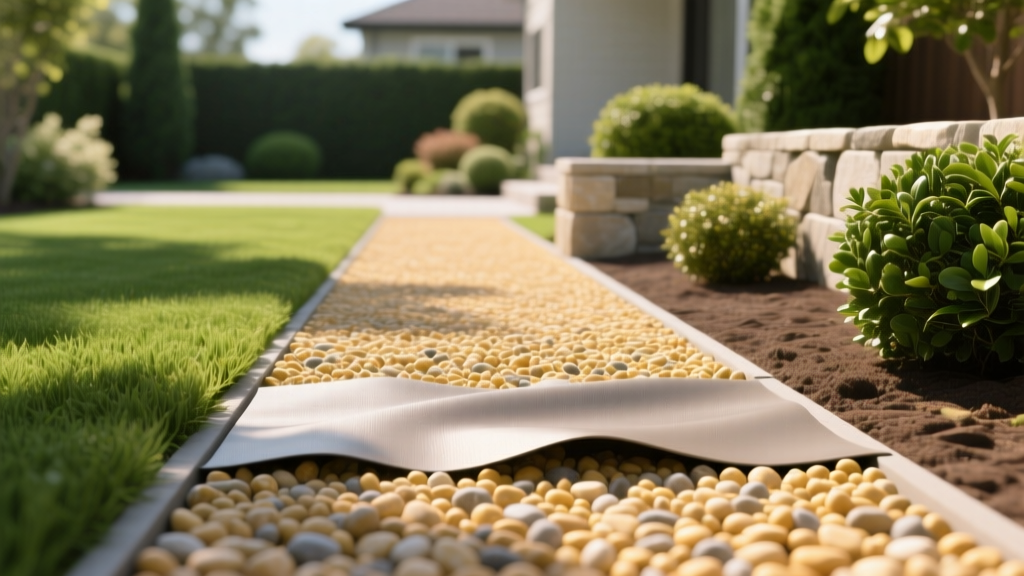
Choosing the Right Landscape Fabric for Pea Gravel Paths
The Physics of Pea Gravel: Why Standard Weed Barrier Fails
Pea gravel is a favorite among beginner landscapers for its affordability, natural aesthetic, and excellent drainage. However, its physical structure presents a unique engineering challenge. Unlike crushed angular gravel (such as decomposed granite or crushed limestone), which features jagged edges that lock together to form a semi-solid matrix, pea gravel consists of smooth, rounded stones. These stones act like thousands of tiny ball bearings. When subjected to foot traffic or rainfall, they shift, roll, and migrate laterally.
If you place pea gravel directly onto bare soil, the stones will quickly work their way down into the dirt, while soil pushes up into the gravel layer. Within a single season, your path will become a muddy, uneven mess. Furthermore, standard hardware-store "weed barriers"—typically thin, black, woven slit-film plastics—are entirely inadequate for this application. According to Penn State Extension, these cheap plastics degrade under UV exposure, tear easily under the shifting friction of round stones, and eventually clog with fine silt, destroying soil drainage.
To stabilize pea gravel, you must use a professional-grade geotextile fabric specifically engineered to separate aggregate from subgrade soil while maintaining high water permeability.
Woven vs. Non-Woven Geotextiles: Comparison Matrix
Selecting the correct fabric category is the most critical decision in your project. Geotextiles generally fall into two categories: woven and non-woven. Here is how they perform specifically under pea gravel:
| Feature | Woven Slit-Film (Standard Weed Barrier) | Non-Woven Needle-Punched (Geotextile) |
|---|---|---|
| Material Structure | Woven plastic tapes with microscopic slits | Random synthetic fibers bonded like felt |
| Tensile Strength | High (resists stretching) | Moderate to High (depending on weight) |
| Permeability | Low to Moderate (slits clog with silt rapidly) | High (water passes through the 3D matrix) |
| Separation Ability | Poor (sharp stones can puncture slits) | Excellent (distributes point-loads evenly) |
| Best Use Case | Temporary weed suppression under mulch | Aggregate separation, drainage, French drains |
| Verdict for Pea Gravel | AVOID - Will fail within 1-2 years | REQUIRED - Lasts 20+ years underground |
For pea gravel pathways, patios, and drainage beds, a non-woven, needle-punched geotextile is the only viable choice. Its felt-like structure prevents the round stones from puncturing the fabric while allowing water to drain vertically, preventing puddling on the surface.
Exact Specifications to Buy
When shopping for non-woven landscape fabric for pea gravel, ignore marketing buzzwords and look for these exact technical specifications on the product datasheet:
- Weight: 3 oz to 6 oz per square yard (osy). A 4 oz fabric is the sweet spot for residential foot traffic; upgrade to 6 oz if you plan to drive a wheelbarrow or light cart over the path.
- Permeability (Flow Rate): Minimum of 100 gallons per minute per square foot (gpm/ft²). This ensures heavy rainstorms will not wash out your gravel edges.
- Material: 100% Polypropylene or Polyester. These materials are naturally rot-proof and resistant to soil chemicals.
- UV Stabilization: While the fabric will be buried, it must have UV treatment to prevent degradation during the weeks it sits exposed on your job site before the gravel is delivered.
Pro Tip: The University of Missouri Extension notes that many commercial-grade fabrics are sold in rolls of 300 feet or more. For beginner projects, look for brands like Mutual Industries or Flarmor that sell smaller 50-foot or 100-foot cuts of 4 oz non-woven geotextile to avoid wasting material.
Professional Installation Protocol for Beginners
Even the most expensive geotextile will fail if installed incorrectly. Follow this precise sequence to ensure a permanent subgrade separation.
- Excavate the Subgrade: Dig your path or patio area to a depth of 4 to 5 inches. This allows for a 2.5-inch layer of pea gravel, sitting slightly above the surrounding soil grade to encourage surface runoff.
- Compact the Soil: Do not skip this step. Rent a vibratory plate compactor (available at most home improvement rental centers for about $50/day). Make at least three passes over the bare soil to achieve 90% compaction. If your native soil is heavy clay, lay down a 1-inch base of coarse sand before compacting to create a stable foundation.
- Roll and Overlap the Fabric: Unroll the non-woven geotextile over the compacted subgrade. Where two rolls meet, overlap them by a minimum of 6 inches. Never butt the edges together; shifting gravel will find the seam and push dirt through.
- Secure with Heavy-Duty Staples: Use 11-gauge steel landscape staples (minimum 6 inches long). Place a staple every 3 feet along all overlapping seams, and every 9 feet in the center "field" of the fabric.
Warning: Never use the flimsy, plastic-capped garden stakes sold in the lawn care aisle. They will snap under the tension of the fabric and fail to hold the overlap secure against the lateral pressure of shifting pea gravel.
- Install Edge Restraints: Pea gravel *must* be contained. Install rigid steel, aluminum, or heavy-duty plastic landscape edging along the perimeter, securing it with 18-inch steel spikes. The fabric should run up the inside of the edging slightly before being trimmed.
- Spread the Gravel: Dump the pea gravel onto the fabric. Use a steel landscape rake to spread it to an even depth of 2.5 inches. Do not use a mechanical plate compactor on pea gravel; it will simply push the stones out of the boundaries. Hand-tamping or simply walking on it is sufficient to settle the stones into the fabric matrix.
Troubleshooting Common Subgrade Failures
Symptom: Gravel Sinking into Mud After Rain
Cause: You likely used a woven slit-film fabric instead of a non-woven geotextile, or your subgrade was not properly compacted before laying the fabric. The woven slits clogged with clay particles, causing water to pool on top of the fabric, turning the gravel bed into a soup. Fix: You must rake off the gravel, pull up the failed fabric, re-compact the subgrade, and reinstall a 4 oz non-woven needle-punched geotextile.
Symptom: Weeds Pushing Through the Fabric
Cause: Weeds are rarely growing from the soil below a properly installed geotextile. Instead, wind-blown topsoil, decaying leaves, and organic debris have accumulated *on top* of the gravel, creating a shallow seedbed. The weed roots are growing down into the gravel, not through the fabric. Fix: Use a leaf blower to clear organic debris from the gravel bed twice a year. For existing weeds, apply a targeted glyphosate or horticultural vinegar treatment directly to the foliage; do not pull them, as pulling can disturb the gravel matrix.
Frequently Asked Questions
Can I use a thicker layer of pea gravel instead of fabric?
No. Adding more than 3 inches of pea gravel actually makes the path less stable. Because the stones are round, a deep layer of pea gravel creates a "fluid" effect where your feet sink deeply into the stones, making walking difficult and causing the gravel to spill over your edge restraints. Fabric solves the vertical sinking problem; depth does not.
Should I put sand under the landscape fabric?
Only if your native soil is highly expansive clay that swells significantly when wet. In that case, a 1-inch layer of coarse, angular builder's sand (not play sand) can act as a buffer. However, for standard loam or sandy soils, the non-woven fabric should be placed directly against the compacted native subgrade for maximum friction and stability.
Will the fabric stop all weeds forever?
No landscape fabric stops 100% of weeds indefinitely. As noted by turf and weed scientists, fabric is primarily a soil-separation and aggregate-stabilization tool. Its secondary benefit is suppressing subgrade weeds. Expect to do minor surface-level weed maintenance annually, but the fabric will permanently prevent your expensive pea gravel from disappearing into the dirt below.

