
Landscaping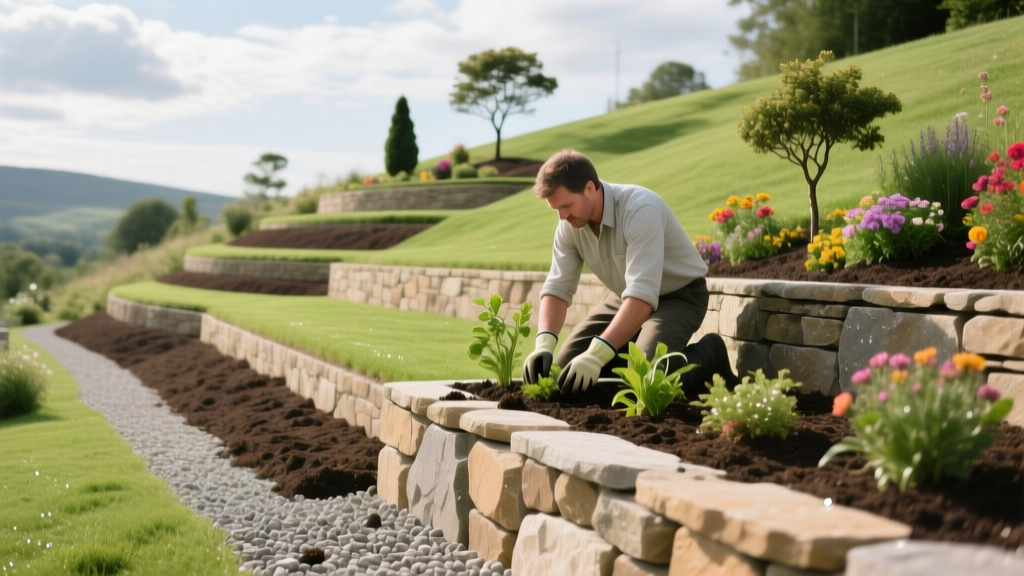
Beginner Guide: How to Landscape for Hills With Terracing & Walls
Understanding Your Slope: The Math Behind the Hill
When you landscape for hills, gravity and water are your primary adversaries. Before purchasing materials or digging trenches, you must calculate your slope's ratio, expressed as 'rise over run.' A 3:1 slope means the ground drops 1 vertical foot for every 3 horizontal feet. According to the USGS Water Science School, water velocity doubles as slope steepness increases, exponentially raising the kinetic energy available to strip topsoil and expose shallow roots.
⚠️ The 3:1 Rule of Thumb: You can safely plant and maintain a slope up to a 3:1 ratio using deep-rooted groundcovers and erosion control blankets. Any slope steeper than 3:1 (such as a 2:1 or 1:1) requires structural intervention like terracing, retaining walls, or engineered swales to prevent catastrophic soil failure.
Core Strategies to Landscape for Hills
Transforming a steep, unusable incline into functional outdoor space relies on two primary techniques: breaking the slope into flat planes (terracing) or safely channeling water away from vulnerable soil (dry creek beds and swales).
1. Terracing and Retaining Walls
Terracing converts a single steep slope into a series of level 'steps.' This eliminates runoff velocity, allowing water to percolate into the soil rather than washing it away. Retaining walls hold back the soil at the edge of each terrace. For beginner DIYers, segmental concrete retaining wall blocks are the optimal choice. They feature built-in interlocking lips or pins that naturally create the required 'batter'—the backward lean that gives the wall its structural strength.
2. Swales and Dry Creek Beds
If terracing is beyond your budget, a dry creek bed is a highly effective alternative. This involves digging a shallow, meandering trench down the hill's natural drainage path, lining it with non-woven geotextile fabric, and filling it with varying sizes of river rock (from 2-inch base gravel to 6-inch decorative boulders). This armors the soil against water scouring while creating a striking visual feature.
Material & Cost Comparison Matrix
Choosing the right structural material dictates your budget, timeline, and the wall's lifespan. Below are the 2026 market averages for residential hillside retaining materials.
| Material Type | Est. Cost (Per Sq. Ft. Face) | DIY Difficulty | Lifespan & Notes |
|---|---|---|---|
| Treated Timber (6x6) | $18 - $28 | Moderate | 15-20 years. Requires deadmen anchors. Prone to eventual rot. |
| Segmental Concrete Blocks | $22 - $38 | Easy/Moderate | 50+ years. Interlocking design. Best for DIY terracing. |
| Natural Cut Stone | $45 - $85 | Expert | 100+ years. Requires mortar or precise gravity-set engineering. |
| Gabion Wire Baskets | $25 - $40 | Moderate | 50+ years. Excellent permeability. Filled with local rubble or stone. |
The Silent Wall Killer: Hydrostatic Pressure
The USDA Natural Resources Conservation Service notes that saturated soil expands and exerts massive lateral pressure against retaining structures. Over 90% of DIY retaining wall failures are not caused by poor stacking, but by trapped water. When you landscape for hills, drainage is non-negotiable.
💡 Pro Drainage Specification: Do not use cheap woven landscape fabric behind your wall; it clogs with silt within two years. Instead, use non-woven geotextile drainage fabric (minimum 4 oz/sq yd weight) to separate the native clay soil from a 12-inch column of 3/4-inch washed clear gravel placed directly behind the wall blocks. Bury a 4-inch SDR 35 perforated PVC pipe at the base of the gravel, sloped at 1/8 inch per foot to daylight the water at the wall's ends.
Best Plants for Slope Stabilization
Once your terraces are built or your gentle slopes are prepped, selecting the right vegetation is critical. Turfgrass is a poor choice for hills; its shallow 2-inch root system offers minimal soil binding, and mowing on an incline is a severe safety hazard. Opt for deep-rooted, drought-tolerant perennials and shrubs.
Deep-Rooted Groundcovers (For 3:1 Slopes)
- Creeping Juniper (Juniperus horizontalis 'Blue Rug'): Roots penetrate up to 30 inches deep. Highly drought-tolerant once established and provides dense, year-evergreen soil armoring.
- Allegheny Spurge (Pachysandra procumbens): A native alternative to the invasive Japanese Pachysandra. Thrives in the shaded understory of hillside trees and forms a dense, weed-choking mat.
- Bearberry (Arctostaphylos uva-ursi): Excellent for sandy, well-draining hillside soils in colder hardiness zones (Zones 2-6).
Structural Shrubs (For Terrace Edges)
- Weeping Forsythia (Forsythia suspensa): The cascading branches physically drape over retaining walls, softening the hardscape while its deep taproots anchor the soil behind the wall.
- Rugosa Rose (Rosa rugosa): Salt-tolerant, heavily thorned, and possesses a massive, spreading root system ideal for coastal or sandy hillside stabilization.
Step-by-Step: Building Your First Segmental Terrace
Follow this sequence for a structurally sound, beginner-friendly concrete block retaining wall up to 3 feet in height. (Note: Walls exceeding 3-4 feet often require a licensed engineer and geogrid reinforcement, depending on local municipal codes).
- Call 811: Always have underground utilities marked before excavating a hillside.
- Excavate the Trench: Dig a trench twice as wide as your wall block and deep enough to bury 10% of the total wall height, plus 4 inches for a compacted base.
- Lay the Base: Fill the trench with 3/4-inch crushed angular gravel (never use round pea gravel, which rolls). Compact it with a mechanical plate compactor to create a rigid, frost-heave-resistant foundation.
- Set the Base Course: Lay the first row of blocks directly on the compacted gravel. Use a 4-foot level to ensure perfect side-to-side and front-to-back leveling. This first row must be partially buried in the soil to prevent the wall from kicking out at the base.
- Stack and Backfill: Stack subsequent rows, ensuring vertical joints are staggered (like bricks). As you build up, backfill the 12-inch void behind the wall with washed clear gravel and compact it in 8-inch lifts.
- Cap the Wall: Adhere the final capstone blocks using a high-strength polyurethane construction adhesive (e.g., Loctite PL Landscape Block) to prevent them from shifting or blowing off in high winds.
Common Beginner Mistakes to Avoid
When learning how to landscape for hills, avoiding critical errors saves thousands of dollars in future repairs:
- Ignoring the 'Batter': Retaining walls must lean backward into the hill. A standard rule is a 1-inch setback for every 12 inches of wall height. A perfectly vertical wall will eventually topple forward under soil pressure.
- Using Topsoil for Backfill: Never backfill directly behind a retaining wall with native clay or topsoil. It retains water, turns to mud, and creates immense hydrostatic pressure. Always use free-draining washed gravel.
- Planting Trees Too Close: Do not plant large trees within 10 feet of the top of a retaining wall. As the trunk caliper expands and roots thicken, they will exert lateral force capable of cracking concrete blocks and pushing timber walls outward.

