
Landscaping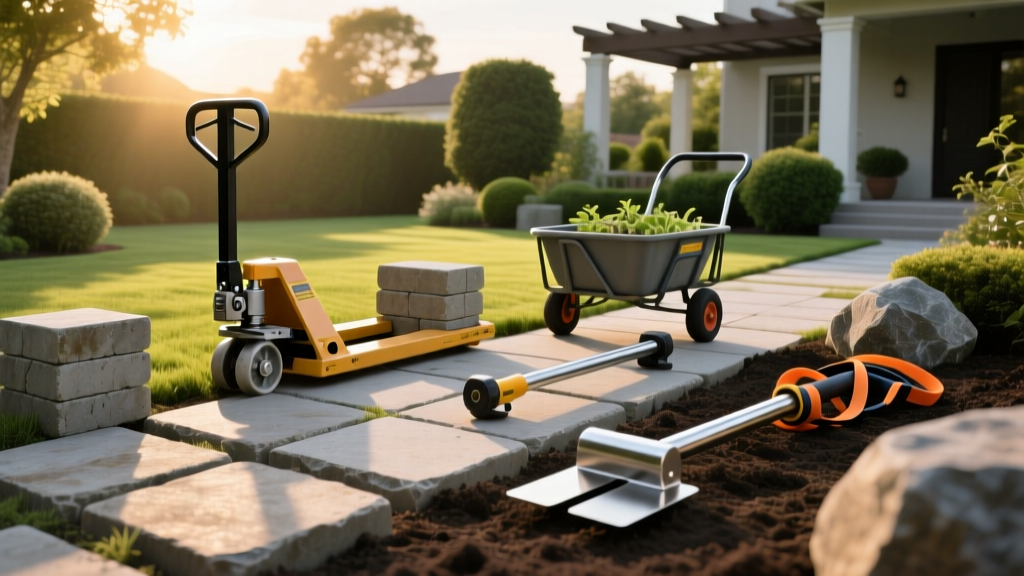
Best Landscape Helper Tools for Moving Heavy Pavers and Rocks
The Biomechanics of Hardscaping: Why You Need Mechanical Aid
Building a patio, installing a retaining wall, or regrading a yard involves moving thousands of pounds of dense material. A standard concrete retaining wall block weighs between 50 and 80 pounds. According to biomechanical data referenced by the National Institute for Occupational Safety and Health (NIOSH), lifting an 80-pound object from ground level generates up to 800 pounds of compressive and shear force on the L4-L5 spinal discs. Relying on manual lifting for a project requiring 200 blocks is a direct path to severe lumbar injury.
In landscaping, a 'landscape helper' is not just an extra pair of hands; it refers to the specialized mechanical aids, heavy-duty carts, and leverage tools designed to eliminate manual load-bearing. Selecting the correct landscape helper equipment depends entirely on your terrain slope, material density, and the specific hardscape elements you are installing.
Warning: The Occupational Safety and Health Administration (OSHA) strictly advises against repetitive manual lifting of materials exceeding 50 pounds without mechanical assistance. Always use leverage tools for natural stone and masonry.
Top 3 Landscape Helper Tools for Hardscape Materials
1. Heavy-Duty Poly Dump Carts (For Pavers and Base Gravel)
Standard wheelbarrows concentrate weight on a single front wheel and require immense upper-body stabilization. A four-wheel poly dump cart acts as a superior landscape helper for bulk transport. The Gorilla Carts GOR1400-COM is the industry benchmark for residential hardscaping. It features a 10-cubic-foot poly bed, a 1,400-pound weight capacity, and 16-inch pneumatic tires that prevent sinking in soft topsoil. The quick-release dump mechanism allows you to deposit 5/8-inch crushed gravel base directly onto your subgrade without shoveling. Expect to invest between $160 and $190 for a cart of this caliber.
2. Mechanical Rock Lifters and Grabbers (For Boulders and Capstones)
Moving natural limestone or granite boulders weighing 100 to 300 pounds requires a mechanical rock grabber. Tools like the Talon Rock Lifter or generic 4-prong chain grabbers utilize a scissor-action leverage principle. As you pull the handle upward, the steel prongs bite into the rock's irregularities, tightening the grip. This allows a single operator to drag or pivot 250-pound boulders into garden beds or water features. These tools typically cost $120 to $180 and require a minimum rock diameter of 8 inches to engage the prongs properly.
3. Vacuum and Suction Slab Lifters (For Flagstone and Retaining Wall Caps)
Flat, heavy materials like bluestone patio slabs or concrete retaining wall capstones are notoriously difficult to grip. Suction slab lifters, such as the Kraft Tool 8-Inch Aluminum Lifter, use high-friction rubber pads and a cam-action lever to clamp onto smooth or slightly textured surfaces. Priced around $45 to $60, these lifters support up to 110 pounds per unit. For heavier 2-inch-thick bluestone slabs weighing 150+ pounds, use two lifters simultaneously—one in each hand—to maintain a level center of gravity during transport.
Equipment Comparison Matrix
| Tool Category | Specific Model Example | Max Capacity | Best Application | Avg Cost |
|---|---|---|---|---|
| Poly Dump Cart | Gorilla Carts GOR1400-COM | 1,400 lbs | Bulk gravel, mulch, stacked pavers | $169 |
| Rock Grabber | Talon 4-Prong Lifter | 300 lbs | Irregular boulders, large river rock | $145 |
| Slab Lifter | Kraft Tool 8' Aluminum | 110 lbs | Flagstone, wall caps, smooth pavers | $55 |
| Paver Carrier | Kraft Tool Paver Grabber | 80 lbs | Standard 6x9 concrete wall blocks | $75 |
Terrain Decision Framework: Choosing the Right Cart
Not all landscape helper carts perform equally across different yard topographies. Use this framework to select the correct wheel and axle configuration for your specific site conditions:
- Flat Terrain (0-3% Slope): Standard 16-inch pneumatic (air-filled) tires are optimal. They provide maximum shock absorption and protect delicate lawn grass from deep rutting. Maintain tire pressure at 22-25 PSI to increase the contact patch on soft soil.
- Moderate Slopes (4-8% Grade): Upgrade to a cart with a lower center of gravity and a wider wheelbase (minimum 26 inches between outer wheels). Carts with 14-inch semi-pneumatic (foam-filled) tires prevent the cart from tipping laterally when loaded with 1,000+ pounds of uneven stone.
- Steep or Uneven Terrain (9%+ Grade): Abandon wheeled carts for inclined transport. Use a specialized track-barrow (like the Muck-Truck Max) or rely on mechanical rock grabbers and manual pivot techniques to move materials down slopes safely without risking a runaway load.
Step-by-Step: Moving 80lb Retaining Wall Blocks Without Strain
When installing a segmental retaining wall, you will likely move hundreds of blocks. Follow this mechanical leverage protocol to preserve your joints:
- Stage the Pallet: Have your supplier deliver the pallet as close to the build site as possible. Use a pallet jack or a heavy-duty pry bar to elevate one side of the pallet by 4 inches, sliding a wooden 4x4 block underneath to raise the working height.
- Engage the Paver Grabber: Slide the teeth of a scissor-action paver grabber (such as the Block Carrier by Kraft Tool) under the top layer of blocks. Squeeze the handles to lock the cam mechanism against the concrete.
- Lift with the Legs: Keep your arms straight and use your quadriceps and glutes to stand up. The tool transfers the load's center of gravity directly in front of your shins, preventing lower-back rounding.
- Transport and Release: Walk to the wall base. To release the block, simply push the handles downward to disengage the cam. Never twist your torso while holding an 80-pound block; pivot your feet instead.
'The most common mistake beginners make with dump carts is overloading the front third of the bed. Always distribute crushed stone and pavers evenly over the rear axle to maintain steering control and prevent the front caster wheels from lifting off the ground.' — Master Hardscape Installer Guideline
Equipment Maintenance for Longevity
Landscape helper tools endure extreme abrasion from silica dust, wet clay, and UV exposure. Implement these specific maintenance routines to prevent mid-project failures:
- Axle Lubrication: Dump cart axles seize when fine masonry sand infiltrates the bearing housing. Apply a lithium-based marine grease (e.g., Lucas Oil Red 'N' Tacky) to the axle zerk fittings every 20 hours of use.
- Cam Mechanism Cleaning: Slab lifters and paver grabbers rely on friction. If the rubber pads or steel teeth become coated in wet clay or stone dust, they will slip under load. Scrub the gripping surfaces with a stiff wire brush and isopropyl alcohol before every use.
- Poly Bed Protection: While high-density polyethylene (HDPE) beds resist cracking, dropping sharp granite boulders from a height can cause stress fractures. Always line the bottom of your dump cart with a 1/2-inch thick rubber stall mat when transporting jagged natural stone.

