
Landscaping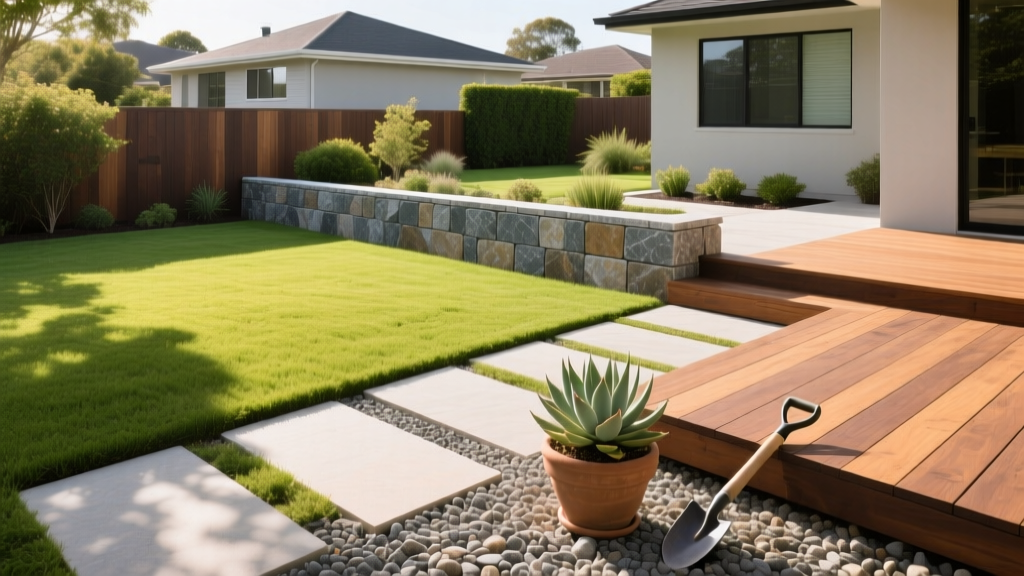
The True Landscaping Meaning: Hardscape vs Softscape Explained
When homeowners search for the landscaping meaning, they often encounter overly simplistic dictionary definitions focused on planting flowers or mowing grass. In professional exterior design, landscaping is the comprehensive manipulation of outdoor spaces to achieve functional, ecological, and aesthetic goals. It is the intersection of horticulture, civil engineering, and spatial architecture.
Understanding the true landscaping meaning requires breaking down your property into two distinct but interdependent categories: softscape (the living, botanical elements) and hardscape (the non-living, structural elements). Mastering the balance between these two domains is the difference between a yard that merely looks nice and an engineered outdoor living space that increases property value by 10% to 15%.
The Core Landscaping Meaning: Art Meets Engineering
The American Society of Landscape Architects (ASLA) defines landscape architecture as the analysis, planning, design, management, and stewardship of the natural and built environment. For residential properties, this translates to managing water runoff, mitigating soil erosion, creating microclimates, and establishing functional traffic flow.
'Landscaping is not simply about placing plants in the ground; it is the strategic organization of outdoor space to solve environmental challenges while enhancing human usability.' — National Association of Landscape Professionals (NALP) Design Guidelines.
If your yard suffers from standing water after a rainstorm, or if your patio heaves every winter due to frost, the root cause is a failure to apply the correct landscaping meaning to your site's topography and soil composition.
Softscape: The Living, Breathing Elements
Softscape encompasses all biological and horticultural components of your yard. However, professional softscaping goes far beyond buying flats of annuals from a hardware store. It requires an understanding of soil science, mature plant morphology, and regional hardiness zones.
Turfgrass and Groundcover Specifications
Selecting turf requires matching the grass cultivar to your soil's pH and your yard's sun exposure. For high-traffic southern lawns, TifTuf Bermuda offers superior drought tolerance, requiring up to 38% less water than older cultivars like Tifway 419. In northern climates, a mix of KBG (Kentucky Bluegrass) and fine fescue provides a dense canopy that naturally chokes out broadleaf weeds.
Before laying sod, you must address soil compaction. According to Penn State Extension, soil bulk density exceeding 1.4 g/cm³ severely restricts root penetration and water infiltration. If your soil is heavily compacted clay, you must perform deep-tine core aeration or incorporate 2 to 3 inches of coarse compost before installation.
Tree and Shrub Caliper Standards
When purchasing trees, ignore the height of the canopy and focus on the trunk caliper (the diameter of the trunk measured 6 inches above the soil line). A 2.5-inch to 3-inch caliper shade tree (such as a Red Maple or Live Oak) typically costs between $600 and $1,200 installed, but it establishes faster and resists windthrow far better than a spindly 10-foot sapling.
The 70/30 Rule of Landscape Balance: A well-designed residential property typically allocates roughly 70% of the budget and spatial volume to softscape (lawns, beds, trees) and 30% to hardscape (patios, walkways, walls). Inverting this ratio creates a sterile, heat-island effect, while exceeding 80% softscape leaves you with no functional space for outdoor living.
Hardscape: The Structural Backbone
Hardscape refers to the inanimate, structural features that define the geometry of your landscape. This includes retaining walls, patios, pergolas, driveways, and drainage swales. Hardscape dictates how water moves across your property and how humans navigate the space.
The most common failure in hardscaping is inadequate base preparation. A patio is only as stable as the sub-base beneath it. For freeze-thaw climates, installers must excavate to a depth of 12 to 16 inches, lay a non-woven geotextile fabric, and compact DOT Class II road base in 2-inch lifts using a vibratory plate compactor to achieve 95% Proctor density.
Hardscape Material Comparison Matrix
| Material | Avg. Installed Cost (per sq. ft.) | Lifespan | Maintenance Requirements | Best Application |
|---|---|---|---|---|
| Natural Bluestone Flagging | $35 - $50 | 50+ years | Annual sealing, joint sand replenishment | Premium patios, formal walkways |
| Permeable Concrete Pavers | $22 - $35 | 30-40 years | Vacuum sweeping, joint stone top-ups | Driveways, eco-friendly patios |
| Stamped Concrete | $15 - $25 | 20-25 years | Resealing every 2-3 years | Large patios, pool decks |
| Decomposed Granite (DG) | $6 - $10 | 5-10 years | Raking, weed control, periodic topping | Informal paths, xeriscaping |
Applying the Landscaping Meaning to Your Yard Layout
Translating the landscaping meaning into a physical layout requires a systematic approach to site analysis. Follow this decision framework to plan your yard:
- Map the Microclimates: Track sun exposure across your yard over a full day. South-facing walls create heat sinks ideal for Mediterranean plants, while north-facing corners retain moisture and require shade-tolerant species like Hostas or Ferns.
- Identify Hydrology and Drainage: Observe water flow during a heavy rain. If water pools near your foundation, you must install a French drain or grade the hardscape with a minimum 2% slope (1/4 inch drop per foot) away from the house.
- Establish the Circulation Flow: Lay out walkways based on natural desire lines (the paths people naturally take). A primary walkway should be at least 48 inches wide to accommodate two people walking side-by-side, while secondary garden paths can be 24 to 30 inches wide.
- Layer the Softscape: Design plant beds using the canopy-to-root layering method. Start with overstory shade trees (30+ feet tall), move to understory ornamental trees (15-25 feet), add structural shrubs (4-8 feet), and finish with herbaceous perennials and groundcovers.
Budgeting for a Complete Landscape Transformation
Understanding the landscaping meaning also means understanding the financial investment required to execute it properly. In 2026, a comprehensive landscape renovation for a standard 5,000-square-foot suburban backyard typically ranges from $25,000 to $65,000, depending on material grades and site accessibility.
- Site Prep and Demolition: $2,500 - $5,000 (Includes removing old concrete, grading, and hauling debris).
- Hardscape Installation: $12,000 - $35,000 (A 400 sq. ft. paver patio with a built-in fire feature and seating wall).
- Softscape and Planting: $5,000 - $15,000 (Includes soil amendment, 3 large caliper trees, 50 shrubs, and 2,000 sq. ft. of premium sod).
- Irrigation and Lighting: $4,000 - $8,000 (A smart Wi-Fi enabled irrigation system with drip zones, plus low-voltage LED uplighting).
To maximize ROI, the EPA WaterSense program recommends integrating soil moisture sensors and weather-based smart controllers into your irrigation design, which can reduce outdoor water use by up to 50% compared to traditional timers.
Frequently Asked Questions
Is landscaping considered a capital improvement?
Yes, if the landscaping adds permanent structural value to the property, such as installing retaining walls, in-ground irrigation systems, or large shade trees. Routine maintenance like mowing, weeding, and seasonal flower planting is considered an operating expense, not a capital improvement.
What is the difference between landscaping and landscape architecture?
Landscaping generally refers to the physical installation and maintenance of yard elements (planting, laying sod, building small patios). Landscape architecture is a licensed profession focused on large-scale environmental planning, complex grading, commercial site development, and ecological restoration.
How deep should landscape fabric be installed under gravel?
Landscape fabric does not go 'deep' into the ground; it is laid directly on top of the compacted soil sub-grade, beneath the gravel or mulch. For gravel driveways or paths, excavate 6 to 8 inches, compact the native soil, lay a heavy-duty woven geotextile fabric, and then add 4 to 6 inches of crushed angular gravel. Never use non-woven fabric under gravel, as it will tear under the friction of the stone.

