
Landscaping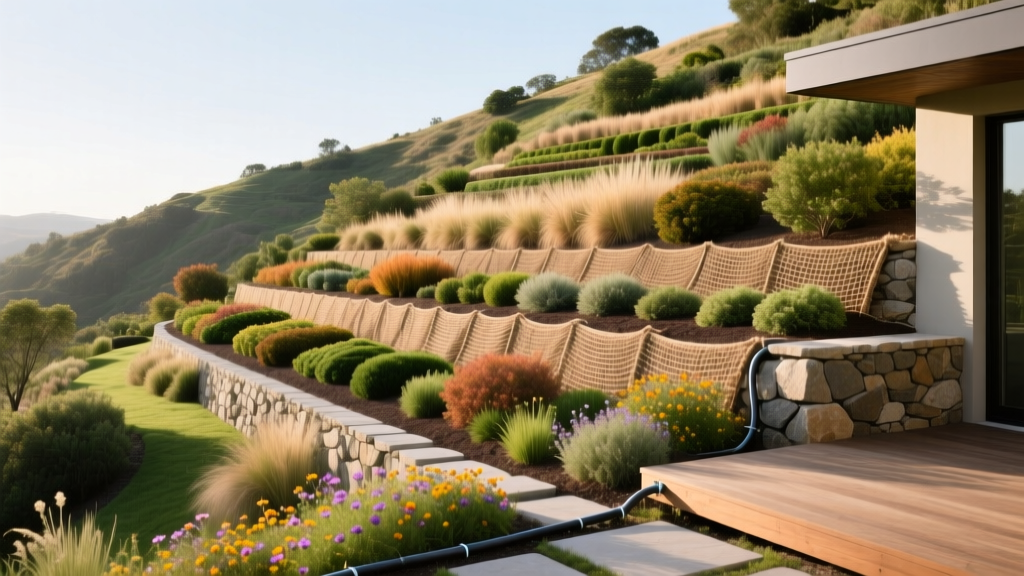
Landscaping on Hillside Slopes: Erosion Control and Design Guide
Assessing Your Slope Gradient and Soil Percolation
Landscaping on hillside properties presents a dual challenge: managing severe water runoff while creating usable, aesthetically pleasing outdoor space. Unchecked slopes lose topsoil at rates up to 10 times faster than flat terrain, leading to structural foundation issues and nutrient-depleted garden beds. Before purchasing materials or planting, you must quantify the exact gradient and drainage capacity of your site.
To calculate your slope ratio, measure the "rise" (vertical height) and the "run" (horizontal distance). A slope is generally expressed as a ratio, such as 3:1, meaning three feet of horizontal distance for every one foot of vertical drop. According to the USDA Natural Resources Conservation Service, slopes steeper than 3:1 (a 33% grade) are highly susceptible to sheet and rill erosion and typically require structural intervention like terracing or retaining walls rather than planting alone.
Pro Tip: The Percolation Test
Hillside soils are often heavily compacted clay or fast-draining shale. Dig a 12-inch deep hole, fill it with water, and let it drain. Refill it and measure the drop after one hour. If water drops less than 1 inch per hour, your soil is clay-heavy and will cause surface runoff on slopes, necessitating French drains. If it drops more than 4 inches, you have sandy soil that requires drought-tolerant, deep-rooted plantings to hold the matrix together.
Hillside soils are often heavily compacted clay or fast-draining shale. Dig a 12-inch deep hole, fill it with water, and let it drain. Refill it and measure the drop after one hour. If water drops less than 1 inch per hour, your soil is clay-heavy and will cause surface runoff on slopes, necessitating French drains. If it drops more than 4 inches, you have sandy soil that requires drought-tolerant, deep-rooted plantings to hold the matrix together.
Core Strategies for Landscaping on Hillside Terrains
Terracing and Retaining Wall Materials
Terracing breaks a single, steep slope into a series of level, manageable plateaus. This slows water velocity, allowing it to percolate into the soil rather than stripping topsoil. The material you choose dictates the cost, lifespan, and maximum height of your terraces.
| Material | Avg. Cost (Installed) | Max Height (Unreinforced) | Lifespan |
|---|---|---|---|
| Treated Timber (6x6) | $15 - $25 / sq. ft. | 3 to 4 feet | 15 - 20 years |
| Segmental Concrete Block | $20 - $35 / sq. ft. | 4 feet (higher with geogrid) | 50+ years |
| Natural Cut Stone | $35 - $60 / sq. ft. | 3 feet | 100+ years |
Deep-Rooted Erosion Control Plantings
When landscaping on hillside areas with gradients between 4:1 and 3:1, structural walls may be unnecessary if you utilize deep-rooted native vegetation. Standard turfgrass roots only reach 2 to 4 inches deep, offering negligible slope stabilization. Instead, select species that act as biological soil nails.
- Switchgrass (Panicum virgatum): A prairie native with fibrous roots that can plunge up to 10 feet deep into the soil profile, anchoring the slope against deep-seated landslides.
- Creeping Juniper (Juniperus horizontalis): Forms a dense, evergreen mat that intercepts raindrop impact, preventing the surface crust from breaking apart during heavy downpours.
- Crownvetch (Securigera varia): A fast-spreading legume that fixes its own nitrogen and thrives in poor, disturbed hillside soils. (Check local invasive species lists before planting, as it can be aggressive in some regions).
For a comprehensive database of native root depths and hardiness zones, consult the USDA Plants Database to ensure your selections match your specific microclimate.
Step-by-Step: Building a Segmental Retaining Wall on a Slope
Segmental concrete blocks are the industry standard for DIY and professional hillside terracing due to their flexibility and dry-stacked installation. Follow these exact parameters to prevent wall bulging and catastrophic failure.
- Excavate the Trench: Dig a trench that is twice the width of your block's depth and deep enough to bury the first course of blocks completely, plus 6 inches for a gravel base. Burying the first course prevents the wall from sliding forward under the lateral pressure of the slope.
- Prepare the Base: Fill the trench with 6 inches of angular 3/4-inch crushed stone. Never use round pea gravel; it rolls under pressure and will not lock into place. Compact the base using a mechanical plate compactor, not a hand tamper, to achieve a 95% Proctor density.
- Lay the First Course: Place the base blocks and check for level side-to-side and front-to-back. This foundational course dictates the alignment of the entire wall.
- Establish the Batter: Hillside retaining walls must lean into the slope (the "batter"). Most segmental blocks feature a built-in setback pin or lip that automatically creates a 1/4-inch to 1/2-inch backward lean per course. Never stack blocks perfectly plumb on a hillside.
- Install Geogrid Reinforcement: For any wall exceeding 3 feet in height, lay synthetic geogrid mesh every two courses (approximately every 16 inches). Extend the geogrid back into the slope soil at a distance equal to 60% of the wall's total height to tie the wall face to the earth mass.
Warning: The Landscape Fabric Mistake
Do not place woven landscape fabric between the slope soil and your wall's gravel backfill. While it seems logical to keep dirt out of the gravel, fabric clogs with fine silt over time, turning your drainage system into a dam. Instead, use clear, washed 3/4-inch crushed stone directly against the native soil, or use a specialized non-woven geotextile filter fabric designed specifically for high-flow subsurface drainage.
Do not place woven landscape fabric between the slope soil and your wall's gravel backfill. While it seems logical to keep dirt out of the gravel, fabric clogs with fine silt over time, turning your drainage system into a dam. Instead, use clear, washed 3/4-inch crushed stone directly against the native soil, or use a specialized non-woven geotextile filter fabric designed specifically for high-flow subsurface drainage.
Irrigation and Drainage Solutions for Steep Grades
Water management is the most critical component of landscaping on hillside properties. Overhead sprinklers are highly inefficient on slopes; water hits the ground and runs off before it can infiltrate the root zone, causing erosion and wasting municipal water.
Instead, install a pressure-compensating (PC) drip irrigation system. Standard drip emitters output water faster at the bottom of a hill due to gravity-induced pressure spikes, while emitters at the top starve. PC emitters contain internal diaphragms that regulate water flow to a uniform rate (e.g., 1.0 gallon per hour) regardless of elevation changes or pressure fluctuations up to 50 PSI.
For subsurface drainage behind retaining walls, install a 4-inch perforated PVC pipe wrapped in a non-woven geotextile sleeve. Place this pipe directly behind the base of the retaining wall, resting on the native soil or compacted base gravel, not suspended halfway up the wall. This intercepts groundwater before it builds up hydrostatic pressure against the lowest, most vulnerable point of the wall.
Common Hillside Landscaping Mistakes to Avoid
- Mulching with loose materials on steep grades: Wood chips and bark mulch will wash away in the first heavy rain if applied to slopes steeper than 5:1. Use heavier materials like shredded hardwood bark (which knits together), river rock (for non-planting drainage swales), or erosion control blankets (jute or coir netting) pinned directly over newly seeded slopes.
- Ignoring the "Slip Circle": When planting trees on a hillside, avoid species with shallow, lateral root plates (like Norway Maples or Leyland Cypress). In saturated soils, these trees can pull entire sections of the hillside down with them. Opt for deep-taprooted trees like Oaks or Pines.
- Failing to cap retaining walls: Water entering the top of a retaining wall's hollow cores or backfill from above will freeze, expand, and crack the system. Always install solid capstone blocks with a bead of polyurethane concrete adhesive to seal the top course.
Frequently Asked Questions
Do I need a permit to build a retaining wall on my hillside?
In most municipalities, retaining walls under 3 to 4 feet in height (measured from the bottom of the base gravel to the top of the wall) do not require a structural engineering permit. However, if your wall supports a surcharge load—such as a driveway, patio, or pool located near the top of the slope—engineering and permits are almost always required regardless of height.
What is the cheapest way to landscape a steep slope?
The most cost-effective approach is biological stabilization using erosion control blankets (costing $0.50 to $1.50 per square foot) pinned over the soil, followed by hydroseeding with a deep-rooted native meadow mix. This avoids the $20+ per square foot cost of structural terracing while effectively halting topsoil loss within a single growing season.
Can I use old railroad ties for hillside terracing?
While cheap and readily available, creosote-treated railroad ties are heavily discouraged for residential landscaping. The EPA restricts the use of creosote-treated wood in residential settings due to the leaching of toxic polycyclic aromatic hydrocarbons (PAHs) into the soil, which can contaminate vegetable gardens and groundwater. Opt for modern ground-contact rated pressure-treated timber or segmental concrete instead.

