
Landscaping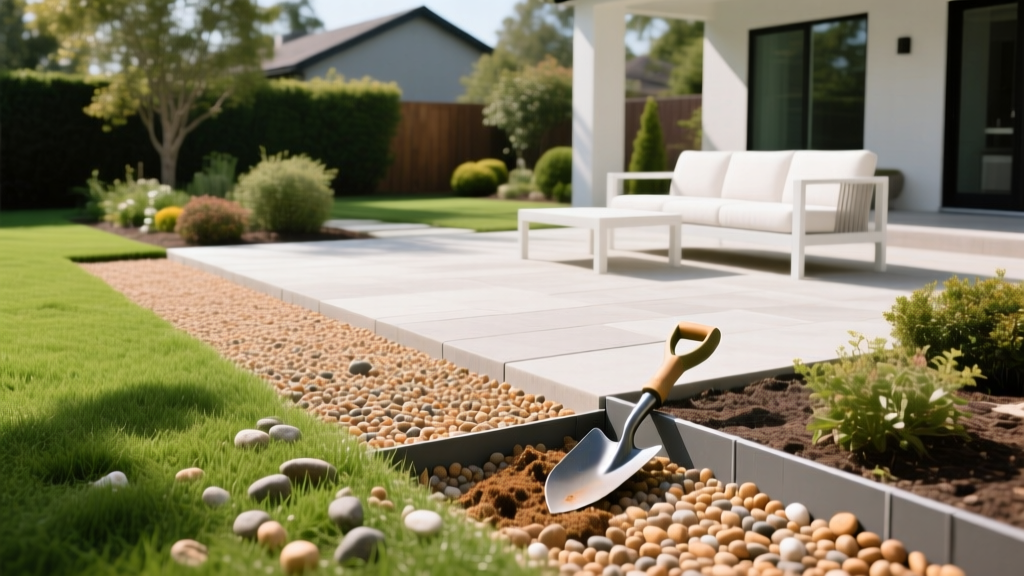
Why Your Menards Pea Gravel Keeps Spreading (And How to Fix It)
The Physics of Pea Gravel Migration: Why It Fails
Pea gravel—typically 3/8-inch rounded river stone—is a staple in the Menards landscaping aisle for pathways, patios, and drainage beds. However, its rounded geometry is its fatal flaw. Unlike angular aggregates (such as crushed limestone or decomposed granite) that mechanically interlock to form a semi-solid surface, rounded pea gravel stones act like thousands of tiny ball bearings. Under foot traffic, they roll, displace, and migrate.
When homeowners simply dump bagged pea gravel from Menards directly onto topsoil or bare dirt, three predictable failures occur within the first six months: the stones sink into the subgrade, weeds penetrate the gaps, and the aggregate scatters onto adjacent turf. Solving these issues requires moving beyond surface-level top-ups and addressing the structural base.
Symptom Diagnostic Matrix
Before purchasing more aggregate, identify the specific failure mode of your current installation. Use this diagnostic table to pinpoint the root cause and select the correct materials from the Menards hardscape department.
| Symptom | Root Cause | Menards Aisle Solution |
|---|---|---|
| Gravel sinking into mud | Missing sub-base or poor soil compaction | 3/4-inch minus crushed limestone (Bulk or bagged base rock) |
| Stones scattering onto lawn | Inadequate, flexible, or shallow edging | 5-inch heavy-duty aluminum or steel landscape edging |
| Weeds pushing through | Degraded woven slit-film fabric or organic debris buildup | 4 oz non-woven geotextile fabric & pre-emergent granular herbicide |
| Puddling after rain | Clogged fabric pores or impermeable clay subgrade | Perforated corrugated drain pipe & washed drainage rock |
| Surface feels spongy/uneven | Organic topsoil left under the aggregate | Excavate to mineral subsoil; use a mechanical plate compactor |
The Ultimate Fix: Grid Stabilization Systems
The only way to make rounded pea gravel function as a stable, walkable surface is to confine it. Gravel stabilization grids (often made of high-density polyethylene or HDPE) feature a honeycomb structure that locks the stones in place, preventing lateral migration while maintaining permeability. According to the EPA Green Infrastructure Guidelines, confined aggregate systems significantly reduce surface runoff and prevent the "rutting" effect common in loose stone paths.
Step-by-Step Grid Installation
- Excavate the Subgrade: Dig down 6 to 8 inches below your desired finished grade. Remove all organic topsoil, exposing the mineral subsoil.
- Install the Base Layer: Lay down 4 inches of 3/4-inch minus crushed limestone. This angular rock will interlock when compacted. Use a mechanical plate compactor (available for rent at most Menards tool rental desks) to achieve a 95% Proctor density.
- Lay Geotextile Fabric: Roll out a 4 oz to 6 oz non-woven polypropylene geotextile fabric over the compacted base. Do not use the cheap woven black plastic; it traps water and degrades under UV exposure.
- Snap and Secure the Grids: Connect the HDPE gravel grid panels using their integrated interlocking pins. Anchor the perimeter with 10-inch landscape spikes driven through the grid nodes.
- Fill with Pea Gravel: Pour 3/8-inch washed pea gravel over the grids, overfilling by about 1/2 inch. Sweep the gravel into the cells. The stones will settle slightly, leaving a flush, confined surface.
Containment: Selecting the Right Edging
Even with a stabilized base, perimeter containment is non-negotiable. If the edges are not rigidly defined, the border stones will inevitably spill into the grass or mulch beds. Menards carries several edging profiles, but they are not created equal.
Pro Tip: Always install edging before pouring your final layer of pea gravel. The top of the edging should sit exactly 1/2 inch above the finished gravel level to prevent stones from rolling over the lip.
- Aluminum Edging (Best for Curves): Typically sold in 8-foot lengths. Aluminum is rust-proof, bends smoothly around radii, and provides a clean, nearly invisible profile. Stake every 12 inches.
- Steel Edging (Best for Straight Lines): Heavier and more rigid than aluminum. Ideal for long, geometric pathways. It will develop a patina (rust) over time unless you purchase the galvanized or powder-coated variants.
- Heavy-Duty Plastic/Poly (Budget Option): Avoid the thin, roll-out plastic edging for pea gravel. It warps in the sun and flexes under pressure, allowing stones to escape. Only use thick, rigid poly edging with a reinforced top lip if budget constraints rule out metal.
The Landscape Fabric Myth & Weed Control
A common mistake is relying entirely on landscape fabric to stop weeds. Research from the University of Minnesota Extension highlights that landscape fabric is not a permanent solution for weed control. Over time, wind-blown soil, decaying leaves, and organic matter accumulate on top of the fabric, creating a perfect seedbed for weeds whose roots will then penetrate the fabric, making them nearly impossible to pull.
Warning: Never install a "double layer" of fabric or place plastic sheeting beneath your gravel. This creates an impermeable barrier that traps water, turns your subgrade into mud, and kills the roots of adjacent trees and shrubs by suffocating the soil.
The Correct Weed Strategy: Use the non-woven geotextile fabric strictly as a separation layer to keep your base rock from mixing with the clay subsoil. For weed prevention, apply a granular pre-emergent herbicide (such as Prodiamine or Pendimethalin, available in the Menards garden center) to the surface of the pea gravel in early spring before soil temperatures reach 55°F.
2026 Cost Breakdown: 100 Sq. Ft. Stabilized Patio
Below is an estimated material cost breakdown for sourcing a properly engineered, grid-stabilized pea gravel patio from Menards. Prices reflect early 2026 regional averages and may vary by local quarry fees and store location.
| Material | Quantity Needed | Est. Unit Cost | Total Cost |
|---|---|---|---|
| 3/4" Minus Crushed Limestone (Base) | 1.5 Tons (Bagged/Bulk) | $45.00 / Ton | $67.50 |
| 4 oz Non-Woven Geotextile Fabric | 120 Sq. Ft. Roll | $65.00 / Roll | $65.00 |
| HDPE Gravel Stabilization Grids | 100 Sq. Ft. Kit | $2.85 / Sq. Ft. | $285.00 |
| 3/8" Washed Pea Gravel | 1.5 Tons (approx. 60 bags) | $5.50 / 0.5 Cu Ft Bag | $330.00 |
| Aluminum Edging & Stakes | 40 Linear Feet | $3.50 / Lin. Ft. | $140.00 |
| Total Estimated Materials | $887.50 |
Frequently Asked Questions
Can I use Menards pea gravel for a driveway?
No. Even with stabilization grids, 3/8-inch rounded pea gravel lacks the shear strength required for vehicle tires. The turning friction of tires will displace the stones, tearing the grid cells. For driveways, use 3/4-inch angular crushed gravel or opt for permeable pavers.
How deep should the pea gravel layer be?
When using a stabilization grid, the gravel should be filled exactly to the top of the grid cells, usually 1 to 1.5 inches deep. If laying gravel without a grid (not recommended for high-traffic areas), a depth of 2.5 to 3 inches is standard, but expect migration.
Will the steel edging rust and stain my concrete?
Uncoated steel edging will develop a surface rust (patina). If your pea gravel path borders a concrete patio or driveway, rainwater running off the rusted steel can leave permanent orange iron-oxide stains on the concrete. Use galvanized steel or aluminum edging near concrete surfaces to prevent this.

