
Landscaping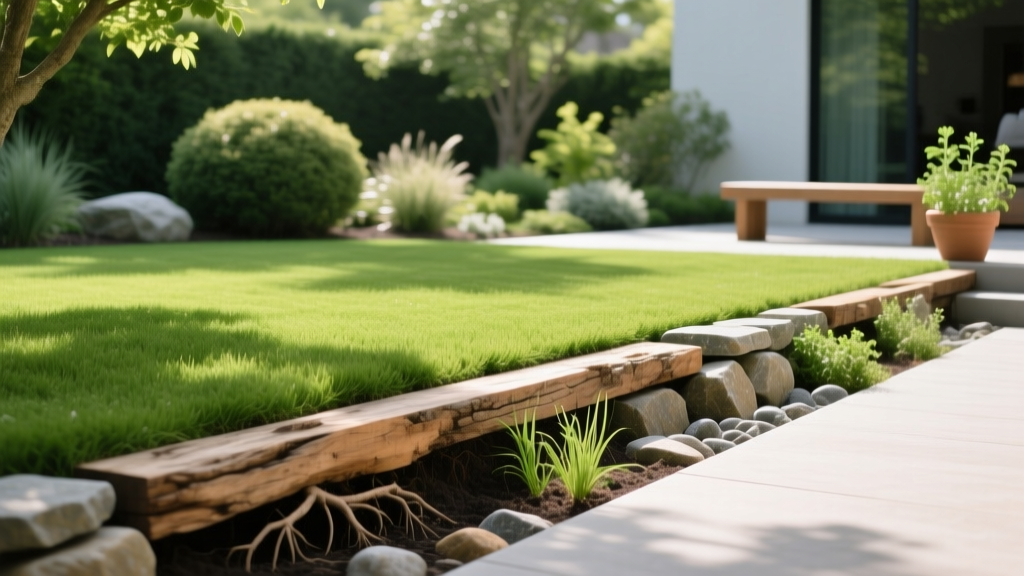
How Natural Landscape Edging Stops Weeds Without Chemicals
Turfgrass invasion and weed encroachment are the primary reasons homeowners resort to synthetic herbicides like glyphosate or sethoxydim along garden borders. However, chemical controls disrupt soil microbiology, risk damaging ornamental root systems through soil leaching, and require continuous reapplication. Implementing natural landscape edging provides a permanent, organic solution by addressing the mechanical and biological vectors of weed spread, entirely eliminating the need for toxic border sprays.
The Biology of Turfgrass Invasion
To design an effective chemical-free barrier, you must understand how invasive grasses operate. Aggressive species like Bermudagrass (Cynodon dactylon) and Quackgrass (Elymus repens) spread primarily through rhizomes—subterranean stems that grow horizontally beneath the soil surface. According to the University of California Statewide IPM Program, Bermudagrass rhizomes can penetrate up to 6 inches deep into the soil, easily bypassing shallow plastic edging or surface-level mulch barriers.
Above ground, grasses like Kentucky Bluegrass spread via stolons (runners). An effective natural landscape edging system must block both vectors: a subterranean physical barrier to halt rhizomes, and a surface-level architectural or biological barrier to block stolons and wind-blown weed seeds.
Material Comparison Matrix for Organic Edging
Not all edging materials are created equal. Thin, flexible plastics degrade under UV exposure and buckle under frost heave, creating gaps where weeds exploit. Below is a comparison of premium, long-lasting materials suitable for organic landscape management, reflecting 2026 material and installation costs.
| Material | Subterranean Depth | Lifespan | Cost (Per Linear Ft.) | Best Application |
|---|---|---|---|---|
| 14-Gauge Cor-Ten Steel | 6 to 8 inches | 40+ years | $8.50 - $12.00 | Modern straight lines, heavy rhizome blocking |
| Basalt / Granite Cobble | 4 to 6 inches (set in mortar) | Lifetime | $14.00 - $22.00 | Curved borders, high-traffic lawn boundaries |
| Woven Willow / Hazel | 3 to 4 inches | 5 - 8 years | $6.00 - $9.00 | Raised beds, cottage gardens, temporary borders |
| Thick-Cut Cedar Bole | 4 to 6 inches | 10 - 15 years | $7.50 - $11.00 | Woodland gardens, naturalistic curved beds |
The 'English Edge' Trenching Method
If you prefer to avoid hardscape materials entirely, the 'English Edge' (or Victorian trench) is a highly effective, zero-material natural landscape edging technique. It relies on a physical void that stolons and rhizomes cannot cross. To maintain this edge organically, precision is mandatory.
Step-by-Step Installation
- Mark the Boundary: Use a garden hose to lay out a smooth, continuous curve. Avoid sharp, tight radii which make mowing difficult and create weak points for grass invasion.
- Cut the Vertical Face: Using a 12-gauge half-moon edger (such as the Bully Tools 12-Gauge Half-Moon Edger), cut a perfectly vertical line on the garden bed side of the hose. This cut must be exactly 6 inches deep to sever deep rhizomes.
- Cut the Angled Face: On the lawn side, cut a 45-degree angle sloping down to meet the bottom of the vertical cut. This creates a V-shaped trench.
- Extract the Wedge: Remove the soil wedge. Do not leave loose soil in the trench, as wind-blown weed seeds will germinate in the dirt pocket.
- Mulch the Bed Side: Apply a 3-inch layer of coarse arborist wood chips right up to the vertical cut. Research from the University of Minnesota Extension confirms that coarse wood chips suppress weed seed germination by blocking light and creating a physical barrier, without the need for synthetic landscape fabrics.
Warning: The Landscape Fabric Myth
Never install woven polypropylene landscape fabric beneath your mulch as a weed barrier. Within 24 months, organic matter accumulates on top of the fabric, allowing weeds to root into the fabric mesh. Furthermore, the fabric blocks water infiltration and gas exchange, suffocating the soil microbiome and ornamental roots. True organic weed control relies on deep, coarse mulch and solid physical edging, not semi-permeable plastics.
Living Natural Landscape Edging (Biological Barriers)
For a fully integrated organic approach, replace inert materials with 'living edges'—dense, clumping perennial plants that form a biological wall. These plants outcompete invasive grasses for water, light, and soil nutrients, effectively choking out weeds before they can establish.
Top Species for Biological Weed Suppression
- Liriope muscari (Big Blue Lilyturf): Forms a dense, impenetrable root mat. Plant at 12-inch on-center intervals along the border. It thrives in both deep shade and full sun, requiring zero chemical maintenance once established.
- Carex pensylvanica (Pennsylvania Sedge): A native alternative that spreads via rhizomes but stays tightly contained. Excellent for dry, shady borders where turfgrass struggles and invasive weeds typically take over.
- Ophiopogon japonicus (Mondo Grass): The dwarf variety ('Nana') grows only 3 inches tall, creating a tight, dark green ribbon that visually separates lawn and bed while physically blocking surface stolons.
'The most sustainable edge is one that maintains itself. By utilizing deep-rooted, clumping perennials as a living border, you transition from fighting nature with chemicals to leveraging plant competition for natural weed suppression.'
Organic Maintenance Protocol
Even the best natural landscape edging requires seasonal maintenance. When grass stolons attempt to bridge the gap, avoid the temptation to use a string trimmer, which scatters seeds and damages the bark of nearby ornamentals. Instead, use a manual rotary edger or a sharp hori-hori knife to sever the runners weekly during peak spring growth.
If wind-blown weeds (like dandelion or thistle) germinate in the trench or hardscape gaps, utilize thermal weed control. A propane-powered flamer applies 2,000°F heat directly to the weed's crown, boiling the plant's cellular water and killing it instantly without leaving any chemical residue in the soil. This method is highly effective for maintaining pristine, chemical-free borders throughout the growing season.

