
Landscaping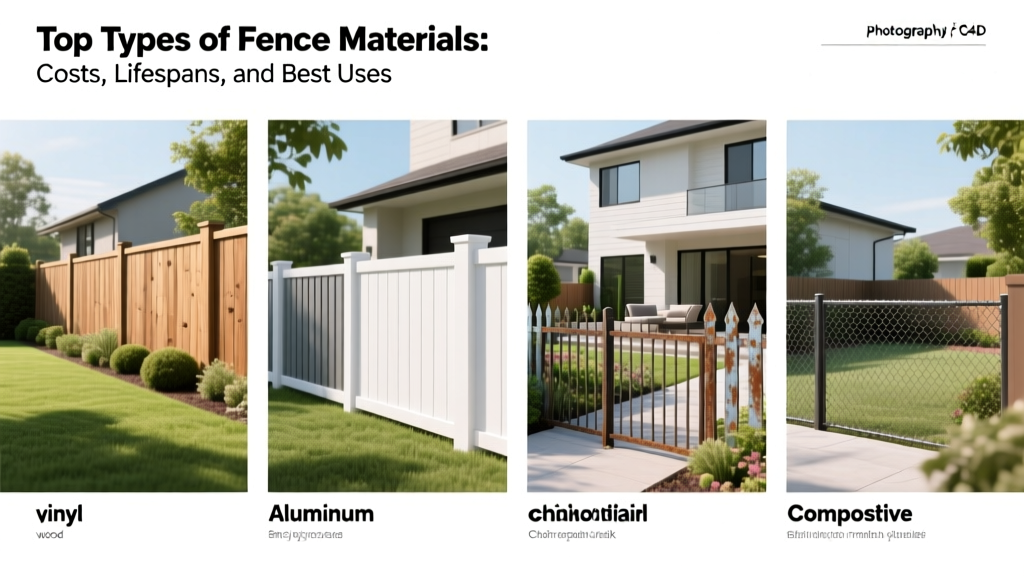
Top Types of Fence Materials: Costs, Lifespans, and Best Uses
Choosing the right fencing for your property requires balancing privacy, security, budget, and long-term maintenance. The market offers a wide array of options, but the wrong material choice can lead to premature rot, structural failure, or thousands of dollars in unexpected upkeep. This guide breaks down the primary types of fence materials available to homeowners, detailing exact cost ranges, structural vulnerabilities, and the specific grading standards you need to look for when purchasing.
The Fence Selection Framework: Matching Material to Purpose
Before evaluating specific materials, define your primary objective. Different materials excel in different scenarios, and over-engineering for the wrong use case wastes budget.
Decision Matrix: What is your primary goal?
- Maximum Privacy & Sound Dampening: Masonry, 6-foot Cedar, or solid-board Composite.
- Pet & Child Containment (Open Sightlines): Powder-coated Aluminum or Chain Link.
- Zero-Maintenance & High Wind Resistance: Vinyl (with internal aluminum reinforcement) or spaced-picket Metal.
- Strict Budget (Under $20/linear ft): Pressure-treated Pine or Chain Link.
Wood Fences: The Classic Privacy Standard
Wood remains the most popular choice for residential privacy fences due to its natural aesthetic and customizable height. However, not all wood is created equal, and understanding treatment standards is critical for longevity.
Western Red Cedar and Redwood
These species contain natural tannins and oils that resist decay and insect damage without chemical treatments. For fencing, always specify Clear or Select Tight Knot (STK) grades. Construction-grade cedar has large, loose knots that will eventually fall out, leaving holes in your privacy fence. Expect to pay between $25 and $45 per linear foot installed. While the boards resist rot, the posts do not; cedar posts buried in soil will typically rot at the ground line within 10 to 12 years unless set in gravel or elevated on metal post anchors.
Pressure-Treated Pine
Pine is the most economical wood option ($15 to $28 per linear foot), but it requires chemical treatment to survive ground contact. According to the American Wood Protection Association (AWPA), you must verify the Use Category tag on the lumber. Posts must be rated UC4A (Ground Contact) or UC4B (Heavy Duty Ground Contact). Using UC3B (Above Ground) rated pine for fence posts is a common contractor shortcut that guarantees rot within five years. Modern treatments use Micronized Copper Azole (MCA) rather than the older, highly toxic Chromated Copper Arsenate (CCA).
Warning: The Concrete Collar Mistake
Never pour concrete so that it slopes upward against a wooden fence post. This creates a "collar" that traps rainwater and accelerates rot. The correct installation method is to pour a 4-inch gravel base for drainage, set the post, fill with concrete to 2 inches above grade, and slope the concrete away from the wood to shed water.
Vinyl and Composite Fences: Low-Maintenance Alternatives
Vinyl (PVC) and composite (wood-plastic blend) fences eliminate the need for staining or sealing, but they carry higher upfront costs ($30 to $55 per linear foot) and specific failure modes related to temperature and UV exposure.
Vinyl (PVC) Fencing
High-quality vinyl fences are manufactured from virgin PVC resin blended with titanium dioxide (TiO2) to prevent UV degradation and chalking. Cheaper alternatives use high levels of calcium carbonate fillers, which make the panels brittle and prone to shattering in freezing temperatures or upon impact (like a stray baseball). When buying vinyl, look for co-extruded profiles where the outer layer is heavily pigmented with UV inhibitors and the inner layer provides structural rigidity. For windy regions, ensure the hollow posts are reinforced with internal aluminum or steel inserts.
Composite Fencing
Composite fencing, made from recycled wood fibers and high-density polyethylene (HDPE), offers a more realistic wood-grain texture than vinyl. However, composite boards are significantly heavier and more susceptible to thermal expansion. Installers must leave precise 1/8-inch expansion gaps between boards; failing to do so will cause the panels to buckle and warp during peak summer heat.
Metal Fences: Security, Durability, and Open Sightlines
Metal fences provide exceptional longevity and security but offer zero privacy. The American Fence Association notes that metal fencing is the preferred choice for perimeter security and pool enclosures due to its compliance with safety climb-resistance codes.
- Aluminum ($25 - $45/linear ft): Lightweight, rust-proof, and ideal for pool enclosures or sloped terrain (panels can be racked to follow the grade). Ensure the powder-coat finish is at least 1.0 mil thick if you live in a coastal area to prevent salt-spray oxidation.
- Wrought Iron ($40 - $80/linear ft): Unmatched for security and ornate aesthetics. True wrought iron is rare today; most "iron" fences are actually galvanized steel. The primary failure point is the weld joints. If the galvanized coating is burned off during welding and not properly treated with a zinc-rich primer, rust will bloom at the joints within two years.
- Chain Link ($12 - $22/linear ft): The most cost-effective and durable option for pet containment. Upgrade from standard 11.5-gauge wire to 9-gauge for added rigidity, and opt for vinyl-coated mesh (black or green) to blend into the landscape.
Masonry, Brick, and Stone Fences: The Ultimate Investment
Masonry fences ($60 to $150+ per linear foot) offer total privacy, complete sound blocking, and a lifespan exceeding 100 years. These structures are built using Concrete Masonry Units (CMUs) that are then faced with brick, natural stone, or stucco.
Because masonry fences act as solid wind barriers, they experience massive lateral wind loads. The International Code Council (ICC) requires masonry walls to be engineered with deep concrete footings that extend below the local frost line to prevent frost heave from cracking the mortar joints. Additionally, masonry walls must include "weep holes" at the base every 32 inches to allow hydrostatic pressure and trapped water to escape, preventing the wall from bowing or collapsing during freeze-thaw cycles.
Comprehensive Cost and Lifespan Matrix
The table below summarizes the critical data points for comparing the most common types of fence materials in the current market.
| Material | Avg. Installed Cost (per linear ft) | Expected Lifespan | Maintenance Level | Primary Vulnerability |
|---|---|---|---|---|
| Pressure-Treated Pine | $15 - $28 | 15 - 20 years | High (Annual sealing) | Post rot, warping, splitting |
| Western Red Cedar | $25 - $45 | 20 - 30 years | Medium (Staining every 3 yrs) | Ground-line post decay |
| Vinyl (PVC) | $30 - $55 | 30 - 50+ years | Low (Power washing) | Brittleness in extreme cold |
| Aluminum | $25 - $45 | 50+ years | None | Bending under heavy impact |
| Galvanized Steel / Iron | $40 - $80 | 40 - 60 years | Medium (Rust treatment) | Rust at weld joints |
| Masonry / Stone | $60 - $150+ | 100+ years | Low (Mortar repointing) | Hydrostatic pressure, frost heave |
Hidden Costs and Permitting Requirements
When budgeting for a new fence, the material and labor are only part of the equation. Homeowners frequently overlook the following mandatory expenses:
- Utility Locates (811): Calling 811 to mark underground utilities is free, but if you hit an unmarked line because you skipped this step, you are liable for repairs. If your property has private underground lines (like a septic system or invisible dog fence), you will need to hire a private utility locator ($150 - $300).
- Permits and HOA Approvals: Most municipalities require a zoning permit for fences over 6 feet tall, and corner-lot properties have strict "sight triangle" restrictions (usually limiting fences to 3 feet tall within 25 feet of an intersection) to maintain driver visibility. Permit fees typically range from $50 to $150.
- Rock Excavation: Standard installation quotes assume normal soil. If contractors hit bedrock or heavy clay requiring a rock saw or jackhammer, expect "hard dig" surcharges of $15 to $30 per post hole.
Frequently Asked Questions
Does a fence add value to a home?
A well-maintained privacy fence typically yields a 50% to 65% return on investment at resale, primarily by increasing the property's appeal to families with pets or young children. Masonry and high-end composite fences rarely recoup their full costs but significantly boost curb appeal.
Which side of the fence faces the neighbor?
By standard convention (and often by local ordinance), the "finished" or "good" side of a wood or vinyl fence must face outward toward the neighbor and the street. The structural side with the exposed rails and posts faces your yard.
How deep should fence posts be set?
A general rule of thumb is that one-third of the post's total length should be underground. For a 6-foot-tall fence, you need 9-foot posts set in 3-foot-deep holes. In northern climates, the bottom of the hole must extend at least 6 inches below the local frost line to prevent winter freezing from pushing the posts upward.

