
Landscaping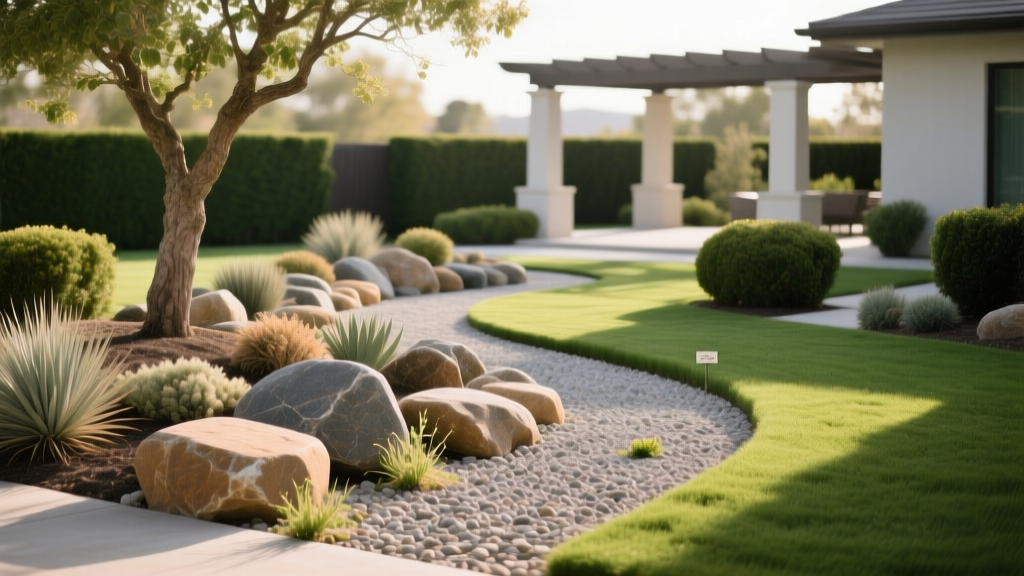
Fixing Common Problems Seen in Pictures of River Rock Landscaping
The Reality Behind Perfect Pictures of River Rock Landscaping
Homeowners frequently browse pictures of river rock landscaping on social media, seeing pristine, weed-free dry creek beds and elegant stone borders. However, replicating these highly curated images without understanding subsurface engineering leads to three major real-world failures: severe washouts during heavy rain, aggressive weed breakthroughs, and accidental foundation flooding. A successful river rock installation relies entirely on what is hidden beneath the stones. This guide diagnoses the most common structural failures in DIY river rock projects and provides exact material specifications, grading frameworks, and containment solutions to ensure your landscape survives beyond the first spring thaw.
⚠️ Warning: The "Sinking Rock" Syndrome
If you place river rock directly onto bare topsoil without a compacted base or geotextile separator, the stones will migrate downward into the dirt within 12 to 18 months. This creates a muddy, compacted layer that suffocates soil biology and ruins the aesthetic of the rock bed. Always use a mechanical separator.
Problem 1: Rocks Washing Away During Heavy Rain
The most frequent discrepancy between online inspiration and reality is rock migration. When rain hits a slope greater than 4%, the kinetic energy of the water easily displaces standard 1-inch to 3-inch river rock, scattering it across your lawn or clogging your storm drains.
Diagnosis: Inadequate Containment and Sizing
Washouts occur when the rock mass is too light for the water velocity, or when the perimeter lacks deep-set physical barriers. Using flexible plastic edging staked only at the seams will inevitably bow and fail under the lateral pressure of shifting stone and hydrostatic soil pressure.
The Solution: Rigid Edging and Gravel Grids
For slopes between 4% and 8%, upgrade your containment to 8-inch mill finish aluminum or 16-gauge galvanized steel edging. For slopes exceeding 8%, you must install a permeable gravel stabilization grid (such as TRUEGRID Pro Lite) beneath the rock to lock the stones into individual cells, preventing lateral migration entirely.
| Material | Cost per Linear Ft (2026) | Lifespan | Best Application |
|---|---|---|---|
| 8" Aluminum (Pro-Lite) | $3.50 - $4.10 | 20+ years | Curved beds, moderate slopes |
| 16-ga Steel (Colmet) | $4.50 - $5.20 | 30+ years | Straight lines, high lateral pressure |
| 4" HDPE Plastic (Dimex) | $1.80 - $2.30 | 5-8 years | Flat borders, low-budget temporary |
Problem 2: The Inevitable Weed Invasion
Many homeowners attempt to replicate the clean lines seen in pictures of river rock landscaping by laying down 6-mil black plastic sheeting beneath the stones. This is a critical error. Black plastic is impermeable; it traps moisture in the soil, creates anaerobic conditions, and eventually tears under the weight of the rocks, allowing weeds to penetrate through the rips.
Diagnosis: Incorrect Geotextile Selection
According to research published by Penn State Extension, landscape fabrics must allow water infiltration while blocking sunlight. Furthermore, organic debris (leaves, grass clippings) that accumulates on top of the river rock will decompose into a soil layer, creating a medium for wind-blown weed seeds to germinate above the fabric.
The Solution: Woven Polypropylene and Maintenance Protocols
Specify a 3.2 oz to 4.4 oz woven polypropylene geotextile fabric (such as US Fabrics 4.4 oz Woven). Woven slit-film fabrics provide a water flow rate of roughly 12 gallons per square foot per minute, ensuring proper drainage while maintaining a high puncture resistance (typically >200 lbs).
Pro-Tip for Surface Weeds: To prevent seeds from germinating in the crevices between the rocks, use a backpack blower on the rock beds bi-weekly during autumn to remove organic debris before it decomposes into topsoil.
Problem 3: Water Pooling Near the Foundation
River rock beds placed directly against a home's foundation without proper grading act as a sponge, holding water against the concrete and accelerating basement moisture intrusion and foundation settling.
Step-by-Step Grading & Drainage Framework
To diagnose and fix foundation-adjacent rock beds, follow this exact grading sequence recommended by drainage experts at Texas A&M AgriLife Extension:
- Excavate the Trench: Dig the rock bed area to a depth of 6 inches, sloping away from the foundation at a minimum grade of 1/4 inch per foot (2% slope).
- Compact the Subgrade: Use a hand tamper or plate compactor to firm the native soil. Soft subgrades will settle over time, creating depressions that pool water.
- Install a French Drain (If Necessary): If your soil is heavy clay, lay a 4-inch perforated PVC pipe wrapped in non-woven geotextile at the lowest point of the trench, routing it to a daylight exit or dry well.
- Deploy the Woven Fabric: Roll out your 3.2 oz woven fabric, overlapping seams by a minimum of 12 inches. Secure with 6-inch galvanized landscape pins every 3 feet.
- Apply the Rock: Distribute the river rock to the calculated depth, ensuring the final surface maintains the 2% slope away from the structure.
Sizing Guide: Matching Rock Diameter to Application
Selecting the wrong stone size is a primary reason DIY projects fail to match professional pictures of river rock landscaping. Smaller rocks are easier to walk on but wash away easily; larger rocks stay put but are difficult to navigate and trap more debris.
| Rock Size | Primary Use Case | Required Depth | Avg. Cost (2026) |
|---|---|---|---|
| 3/4" - 1" Washed | Walkways, patio surrounds, small borders | 2.5 inches | $160 - $190 / ton |
| 1" - 3" Medium | Standard dry creek beds, foundation beds | 3.0 inches | $170 - $210 / ton |
| 3" - 5" Large Cobble | High-flow drainage, steep erosion control | 4.0 inches | $190 - $250 / ton |
🧮 Exact Tonnage Calculation Formula
Do not guess your material order. Use this formula to calculate exactly how much river rock you need:
(Length in ft × Width in ft × Depth in inches) ÷ 12 = Cubic Feet
Cubic Feet ÷ 27 = Cubic Yards
Cubic Yards × 1.35 = Tons of River Rock
Always add 10% to your final tonnage to account for compaction and irregular trench edges.
Expert Troubleshooting FAQ
Q: My existing river rock bed is completely overrun with crabgrass and nutsedge. Can I just spray it?A: Spraying post-emergent herbicides like Glyphosate or Fusilade will kill the active weeds, but it will not address the root cause. Nutsedge, in particular, has sharp rhizomes that easily puncture standard landscape fabrics. You must rake the rock aside, remove the existing compromised fabric, lay down a heavy-duty 4.4 oz woven geotextile, and replace the rock. Spot-treating will only provide a 4-week reprieve.
Q: Will river rock change the pH of my soil and harm nearby trees?A: True river rock (granite, basalt, or quartz) is largely inert and will not significantly alter soil pH. However, limestone-based decorative gravels (often mislabeled as river rock at big-box stores) will slowly leach calcium carbonate, raising soil alkalinity. Always verify the stone composition with your quarry supplier before installing near acid-loving shrubs like azaleas or hydrangeas.
By diagnosing the structural weaknesses that separate professional installations from amateur attempts, you can build a river rock landscape that is both visually striking and structurally permanent. Focus your budget on subsurface containment and high-grade geotextiles, and the surface aesthetics will naturally follow.

