
Landscaping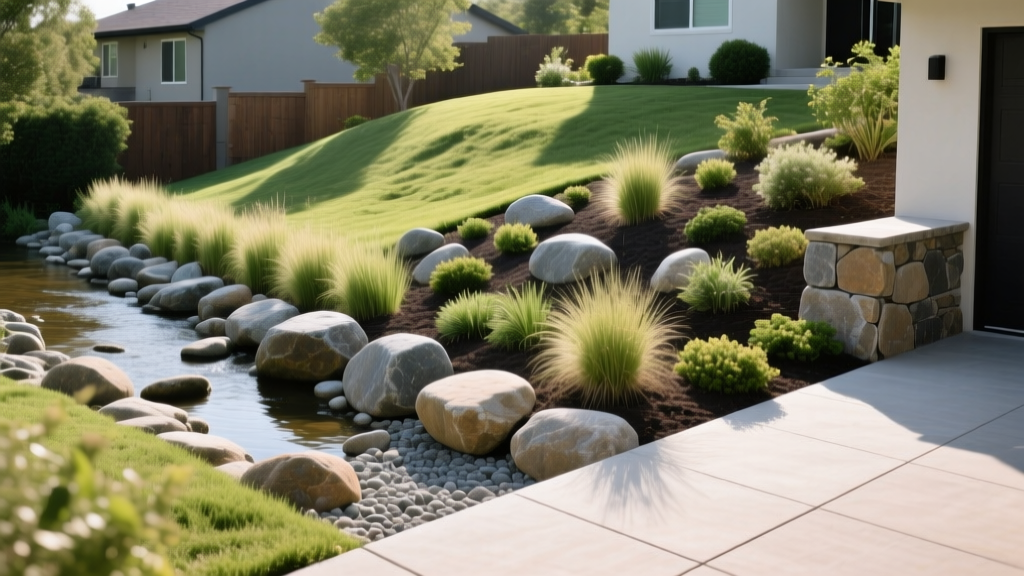
Landscaping With River Rock: How to Fix Weeds, Sinking, and Washouts
The 4 Fatal Flaws of River Rock Installations
River rock is a staple of modern hardscaping, prized for its natural aesthetics, superior drainage, and permanence. However, homeowners frequently encounter severe degradation within three to five years of installation. When landscaping with river rock fails, it is rarely the stone itself that is the problem; the failure almost always originates in the subgrade preparation, fabric selection, or hydraulic miscalculation. Below is a diagnostic framework for the four most common river rock failures and the precise engineering solutions required to fix them.
Flaw 1: Subgrade Subsidence (The "Sinking" Effect)
The Diagnosis: If your river rock beds are constantly losing volume, disappearing into the soil, or developing uneven, muddy depressions after heavy rains, you are experiencing subgrade subsidence. This occurs when heavy stones (river rock weighs approximately 2,800 lbs per cubic yard) are laid directly over uncompacted topsoil or loose organic matter. The soil compresses under the weight and hydraulic pressure, swallowing the rock.
The Solution: You must create a rigid load-bearing base. Excavate the bed to a depth of 4 inches. Remove all organic topsoil and replace it with a 2-inch layer of 3/4-inch crushed angular gravel (such as #57 stone). Angular gravel locks together when compacted, unlike round river rock which rolls. Rent a vibratory plate compactor and achieve a minimum 95% Proctor density before laying your separation fabric and decorative river rock.
⚠️ Critical Warning: Never use black polyethylene plastic sheeting as a base layer. Plastic traps moisture, creates anaerobic soil conditions, destroys soil microbiology, and becomes brittle and shattered within two seasons, leading to catastrophic weed breaches.
Flaw 2: The Dual-Vector Weed Problem
The Diagnosis: Weeds in river rock beds come from two distinct vectors. Vector A consists of subterranean weeds pushing up through inadequate barriers. Vector B consists of windblown seeds germinating in the organic debris (dust, pollen, decomposing leaves) that accumulates on top of the rocks. According to the University of Minnesota Extension, landscape fabrics degrade over time and do not stop Vector B weeds, which root directly into the stone layer.
The Solution: Address both vectors systematically. For Vector A, upgrade to a commercial-grade woven geotextile. For Vector B, implement a strict maintenance protocol using a backpack leaf blower on a low setting every two weeks during autumn to remove organic matter before it decomposes into "soil" between the rocks. Apply a granular pre-emergent herbicide, such as Prodiamine 65 WDG, at a rate of 1.1 lbs per 1,000 square feet in early spring (when soil temperatures hit 55°F) to create a chemical barrier on the rock surface.
| Fabric Type | Weight/Spec | Best Use Case | Failure Risk |
|---|---|---|---|
| Non-Woven (Spunbond) | 4 oz to 6 oz | French drains, underdrainage, stabilization | High weed penetration if stretched |
| Woven (Slit Tape) | 3 oz to 4 oz | Surface river rock beds, high traffic paths | Low (Industry standard for weed block) |
| Polyethylene Plastic | 2 mil to 6 mil | None (Do not use in landscaping) | Catastrophic (Traps water, tears easily) |
Flaw 3: Hydraulic Washouts on Slopes
The Diagnosis: If your river rock is migrating into your lawn, pooling against your foundation, or clogging your storm drains after heavy rain, you have a hydraulic velocity problem. Standard 3/4-inch to 1-inch river rock has a low friction coefficient and will easily wash away on slopes exceeding a 5% grade during high-volume precipitation events. The USDA Natural Resources Conservation Service emphasizes that rock armoring must be sized specifically to the expected water velocity to prevent erosion.
The Solution: Scale your rock size to your slope gradient. For flat surfaces (0-3% grade), 3/4-inch to 1.5-inch river rock is perfectly stable. For moderate slopes (4-8% grade), you must upgrade to 2-inch to 4-inch river cobble. For steep grades (9%+), utilize 6-inch+ boulders or install a subsurface French drain wrapped in non-woven fabric to intercept water before it reaches the surface rock layer. Additionally, install rigid aluminum or heavy-duty steel landscape edging (minimum 4-inch depth) at the terminal ends of the slope to act as a physical retaining dam.
Flaw 4: Thermal Mass and Root Baking
The Diagnosis: Are the shrubs and trees bordering your river rock beds showing scorched leaves, stunted growth, or sudden dieback in mid-summer? River rock possesses immense thermal mass. Under direct July and August sun, surface rock temperatures can exceed 140°F, and the soil temperature just two inches beneath the rock can sustain 105°F to 115°F. This literally bakes the fine feeder roots of adjacent plantings.
The Solution: Establish a strict 18-inch "no-rock buffer zone" around the root flares of all trees and delicate shrubs. Replace the rock in this immediate zone with shredded hardwood mulch, which insulates the soil and retains moisture. When selecting plants to integrate directly into river rock beds, choose high-heat, drought-tolerant species such as Muhlenbergia capillaris (Pink Muhly Grass), Lantana camara, or Sedum spurium. Avoid shallow-rooted acid-lovers like Azaleas or Hydrangeas near stone beds.
Step-by-Step Remediation Protocol for Failed Beds
If your existing river rock landscape is failing, follow this precise sequence to rehabilitate it without starting from scratch:
- Extract and Clean: Use a heavy-duty landscape rake to pull the existing river rock onto a tarp. Use a leaf blower and a stiff push broom to remove all accumulated dirt, decomposed leaves, and weed roots from the stone.
- Strip the Old Barrier: Remove and discard any degraded plastic or torn landscape fabric currently in the bed.
- Regrade and Compact: Rake the exposed soil to ensure a 2% slope away from your home's foundation. Tamp the soil firmly using a hand tamper or plate compactor.
- Deploy Woven Geotextile: Roll out commercial-grade woven geotextile fabric. Overlap all seams by a minimum of 6 inches and secure with 6-inch landscape staples every 3 linear feet.
- Redistribute Rock: Shovel the cleaned river rock back onto the fabric. Maintain a uniform depth of 2 to 2.5 inches. Deeper than 3 inches creates a "sponge effect" that traps excess water and promotes anaerobic bacterial growth.
💡 Tonnage Calculator Tip: To calculate exactly how much replacement rock you need, use this formula: (Length in feet × Width in feet × Depth in inches) ÷ 12 = Cubic Feet. Divide Cubic Feet by 27 to get Cubic Yards. Multiply Cubic Yards by 1.4 (the standard tonnage multiplier for river rock) to determine the exact tons to order from your local quarry.
Long-Term Maintenance for Permanent Curb Appeal
Landscaping with river rock is often marketed as "maintenance-free," but as a hardscape professional, I can confirm it is actually "low-maintenance." To preserve the pristine look of your stone beds through 2026 and beyond, integrate an annual application of a stone-safe algaecide/mildew remover if your yard is heavily shaded, as algae will turn light-colored river rock green and slippery. By diagnosing the root causes of sinking, weeds, and washouts, and applying these structural corrections, your river rock installations will remain stable, clean, and visually striking for decades.

