
Landscaping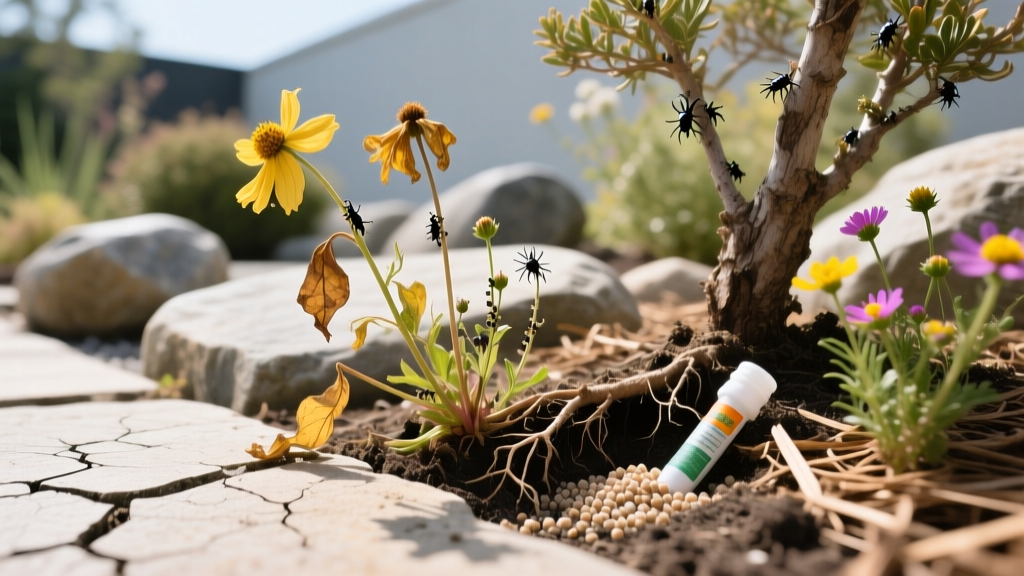
Rock Garden Flowers Dying? Diagnose and Fix Common Issues
The Hidden Mechanics of Rock Garden Failures
Rock gardens are frequently misunderstood as low-maintenance dumping grounds for succulents and alpine species. In reality, rock garden flowers have strict physiological requirements that mimic high-altitude or arid environments. When these plants fail, the cause is rarely a lack of water; it is almost always a structural or chemical flaw in the garden's microclimate. Diagnosing why your rock garden flowers are dying requires looking past the surface symptoms and analyzing the soil matrix, rock chemistry, and thermal dynamics of your landscape.
This guide breaks down the four most common failure modes in rock garden design and provides exact, actionable remediation protocols to save your plants and stabilize your landscape.
Symptom 1: Blackened Crowns and Sudden Wilting (The Drainage Failure)
The Diagnosis
If your alpine plants or creeping sedums are suddenly wilting, and the base of the stem feels mushy or blackened, you are dealing with Phytophthora or Pythium crown rot. This occurs when heavy clay soil is trapped beneath or between large landscaping boulders. The rocks create a 'perched water table,' preventing gravity from pulling moisture down through the soil profile. The roots suffocate, and fungal pathogens rapidly consume the stressed tissue.
The Solution: The 50/30/20 Grit Protocol
You cannot fix this by simply watering less. You must physically alter the soil's macroporosity. Excavate the planting pockets to a depth of 12 inches and replace the native soil with a precise 50/30/20 mix:
- 50% Loam or Topsoil: Provides the base mineral structure and cation exchange capacity (CEC) for nutrient retention.
- 30% Horticultural Pumice or Expanded Shale (3-6mm particle size): This is non-negotiable. Do not use perlite. Perlite crushes under the weight of rocks over time, losing its aeration benefits, and it floats to the surface during heavy rains. Pumice and expanded shale maintain permanent structural integrity, ensuring continuous oxygen flow to the roots.
- 20% Composted Pine Bark (fine grade): Adds slight acidity and organic matter without retaining excessive moisture like peat moss does.
Pro Tip: When replanting, ensure the root crown of the plant sits exactly 0.5 inches above the surrounding soil grade, and slope the soil away from the stem at a 5-degree angle to shed water instantly.
Symptom 2: Yellowing Foliage and Veinal Chlorosis (The pH Trap)
The Diagnosis
When the leaves of your rock garden flowers turn pale yellow but the veins remain green (interveinal chlorosis), the plant is suffering from iron deficiency. However, the soil likely contains plenty of iron. The culprit is the rock itself. If you built your garden using limestone, tufa, or sandstone with high calcium carbonate content, the rocks are actively leaching alkalinity into the soil, buffering the pH to 7.5 or higher. At this pH, iron becomes chemically locked up and insoluble.
The Solution: Fe-EDDHA Application and Plant Swaps
According to soil chemistry guidelines from the Royal Horticultural Society (RHS), applying standard iron supplements will not work in alkaline conditions. Most commercial iron chelates use Fe-EDTA, which breaks down and becomes useless at a pH above 7.0.
To fix this immediately, you must apply Fe-EDDHA (often sold as 'red iron' because of its dark red powder color). Fe-EDDHA remains stable and bioavailable in soils with a pH up to 9.0. Apply it as a soil drench at a rate of 1 teaspoon per gallon of water every 14 days until the foliage regreens. Long-term, transition your planting palette to alkaline-tolerant species like Dianthus deltoides (Maiden Pink) and Aubrieta deltoidea, which thrive in the calcium-rich environment limestone provides.
Symptom 3: Crispy Leaf Margins and Bleached Blooms (Thermal Scorch)
The Diagnosis
If your plants are showing scorched, crispy leaf edges and faded, bleached flowers despite adequate soil moisture, they are suffering from thermal scorch. This is a microclimate issue caused by the albedo (reflectivity) of your chosen hardscape. Dark rocks like basalt, slate, and dark river rock absorb up to 90% of solar radiation. On a 85°F summer day, the surface temperature of dark basalt can exceed 140°F, radiating intense heat upward and literally cooking the lower canopy of your rock garden flowers.
The Solution: Albedo Modification and Strategic Shading
Replacing all your rocks is expensive and disruptive. Instead, mitigate the thermal mass through strategic planting and surface modification:
- Top-Dress with High-Albedo Gravel: Apply a 1-inch layer of light-colored decomposed granite or crushed limestone gravel (3/8-inch size) over the dark rocks and soil. This reflects solar radiation and drops the ambient surface temperature by 15°F to 20°F.
- Deploy Thermal Buffers: Plant heat-tolerant, dense groundcovers like Sedum spurium 'Dragon's Blood' or Thymus serpyllum (Creeping Thyme) on the south and west-facing sides of large boulders. Their foliage will act as a living insulator, shading the dark rock from direct afternoon sun.
Troubleshooting Matrix: Matching Plants to Rock Microclimates
Success in rock gardening relies on matching the plant's evolutionary adaptations to your specific hardscape. Use this matrix to diagnose planting errors and select the right species for your existing conditions, referencing data supported by the Alpine Garden Society.
| Plant Species | Ideal Rock Type | Target Soil pH | Sun Exposure | Primary Failure Risk if Mismatched |
|---|---|---|---|---|
| Sempervivum tectorum | Granite, Basalt | 6.0 - 7.0 | Full Sun (6+ hrs) | Crown rot in shaded, damp pockets |
| Dianthus deltoides | Limestone, Tufa | 7.0 - 8.0 | Full Sun | Iron chlorosis in acidic, peaty soils |
| Phlox subulata | Sandstone, Mixed | 6.5 - 7.5 | Full to Part Sun | Powdery mildew in poor air circulation |
| Campanula carpatica | Limestone | 7.0 - 7.8 | Part Shade (4 hrs) | Thermal scorch and bleaching in full sun |
| Sedum spurium | Any (High Albedo) | 6.0 - 7.5 | Full Sun | Etiolation (stretching) in deep shade |
Symptom 4: Uprooted Plants in Early Spring (Frost Heave)
The Diagnosis
If you find your shallow-rooted alpines literally pushed out of the ground in early spring, with their roots exposed to the air, you are experiencing frost heave. This occurs in USDA Zones 4 through 6 when soil moisture freezes and forms 'ice lenses' beneath the plant. The expanding ice pushes the plant upward. When the soil thaws, the plant does not settle back down, leaving the roots exposed to drying winds.
Critical Warning: Never use wood chips, shredded bark, or straw to mulch a rock garden. Organic mulches act like a sponge, holding moisture directly against the plant crown and guaranteeing winter rot. They also exacerbate frost heave by insulating the surface, allowing the soil below to freeze at a different rate than the surface.
The Solution: Thermal Mass and Inorganic Mulching
To prevent ice lensing, you must manage the soil's thermal mass and surface moisture. In late November, before the ground freezes solid, water your rock garden deeply. Wet soil has a higher thermal mass than dry soil and freezes more slowly, reducing the violent expansion of ice lenses. Immediately after watering, apply a 1.5-inch layer of 3/8-inch crushed gravel (not rounded pea gravel, which rolls away). The sharp edges of crushed gravel lock together, creating a stable, inorganic mulch that insulates the frost line, prevents moisture from pooling at the crown, and physically holds the plant in place during freeze-thaw cycles.
Advanced Remediation for Established Gardens
If your rock garden is already fully constructed and you cannot excavate the soil without dismantling the hardscape, use 'vertical aeration and top-dressing.' Use a 1-inch diameter soil auger attached to a heavy-duty drill to bore 8-inch deep holes in the empty spaces between your plants. Fill these holes with pure 3-6mm pumice. This creates vertical drainage chimneys that intercept perched water and route it deeper into the subsoil, instantly improving aeration and saving your established rock garden flowers from suffocation without destroying your landscape design. For more structural inspiration, review the hardscape layouts at the United States National Arboretum rock garden collections.

