
Landscaping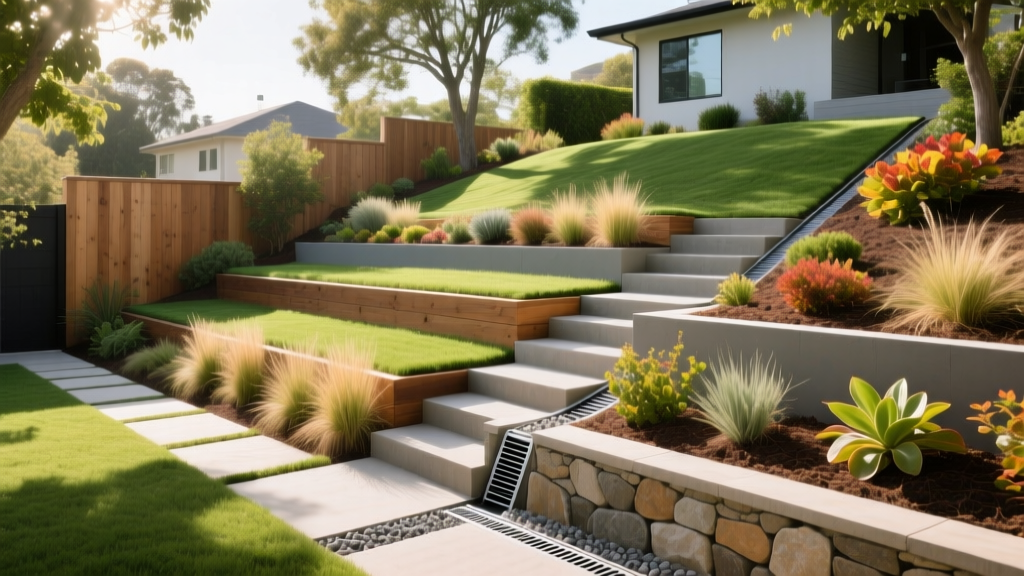
Small Sloped Backyard Ideas: Solving Erosion and Drainage Problems
The Diagnostic Phase: Assessing Your Slope Severity
Before selecting from various small sloped backyard ideas, you must quantify the exact grade and soil composition of your yard. A slope's severity dictates whether you need biological stabilization (plants) or structural intervention (retaining walls). Measure the "rise" (vertical height) and "run" (horizontal distance). Divide the rise by the run and multiply by 100 to get the percentage grade.
Slope Severity Diagnostic Framework:
- Under 15% Grade (Gentle): Suitable for standard turfgrass, shallow-rooted groundcovers, and basic surface grading.
- 15% to 33% Grade (Moderate): Mowing becomes hazardous. Sod will slide before rooting. Requires deep-rooted native plantings, erosion control blankets, or low-profile terracing.
- Over 33% Grade (Steep / 3:1 Ratio): High risk of severe topsoil washout. Turfgrass will fail. Mandates structural retaining walls, switchback hardscaping, or aggressive terracing.
Next, perform a percolation test. Dig a 12-inch deep hole, fill it with water, and measure how long it takes to drain. If water remains after 4 hours, you have heavy clay soil, which exacerbates surface runoff and necessitates subsurface drainage solutions alongside any slope stabilization.
Problem 1: Topsoil Erosion and Root Exposure
The Diagnosis: You notice bare patches of dirt, exposed tree roots, and sediment accumulating on your lower patio or driveway after heavy rains. This indicates that surface water velocity is exceeding the soil's shear strength.
The Structural Fix: Modular Terracing
For slopes exceeding 33%, terracing breaks a single steep drop into multiple level platforms. According to guidelines published by the University of Minnesota Extension, retaining walls under 3 feet (36 inches) in height generally do not require engineered permits, making them ideal for DIY small yard terracing.
Use modular, lip-and-groove concrete blocks like the Allan Block Classic or Versa-Lok Standard. These units weigh roughly 70 lbs each and interlock without mortar. Critical Installation Specs:
- Base Trench: Excavate a trench 6 inches deep and 24 inches wide. Fill with 3/4-inch minus crushed gravel and compact it with a mechanical plate compactor to achieve a 95% Proctor density.
- Backfill: Never backfill a retaining wall with native clay soil. Use 3/4-inch clear crushed stone (no fines) for the first 12 inches directly behind the block to prevent hydrostatic pressure buildup.
- Geogrid: For walls approaching 36 inches, integrate a biaxial polypropylene geogrid (like Tensar BX1200) between the block courses, extending it back into the soil at least 60% of the wall's height.
The Biological Fix: Fibrous Root Matrices
If terracing is beyond your budget, deploy plants with dense, fibrous root systems that bind soil particles together. Avoid taproot plants on slopes, as they do not hold the topsoil matrix.
- For Full Sun: Juniperus horizontalis 'Wiltonii' (Blue Rug Juniper). Roots spread laterally up to 8 feet, creating a dense, drought-tolerant mat.
- For Deep Shade: Pachysandra terminalis (Japanese Spurge). Forms a thick, 10-inch tall canopy that intercepts raindrop impact, reducing soil detachment.
Problem 2: Aggressive Runoff and Foundation Pooling
The Diagnosis: Water rushes down the slope during storms, pooling against your home's foundation or flooding a lower-level basement. Surface grading alone cannot handle the volume of water moving through a small, sloped backyard.
Integrating French Drains with Dry Creek Beds
To intercept subsurface water, install a French drain across the slope's contour line, just above the problem area. The EPA Green Infrastructure guidelines emphasize intercepting runoff before it gains destructive velocity.
Material Specifications for Sloped French Drains:
- Pipe: Use 4-inch SDR 35 rigid perforated PVC, not flexible corrugated black pipe. Corrugated pipe sags under soil weight and its ridges trap sediment, leading to clogs within 3 to 5 years.
- Wrap: Wrap the pipe and gravel in a 4 oz to 6 oz non-woven polypropylene geotextile fabric. Woven fabrics act like sieves and clog rapidly with clay silt.
- Gravel: Use washed 3/4-inch drain rock. "Washed" is the operative word; unwashed gravel contains stone dust that turns into concrete-like sludge when wet.
Daylight the PVC pipe into a decorative dry creek bed at the bottom of the slope. Line the creek bed with a heavy-duty EPDM rubber liner (45-mil thickness) beneath river rocks to prevent the discharged water from simply eroding a new trench at the base of your yard.
Problem 3: Unusable "Dead" Space on Steep Grades
The Diagnosis: You have a 40% grade slope that is impossible to mow safely and too steep to walk on, rendering 30% of your property's square footage entirely useless.
Switchback Pathways and Stabilized Decomposed Granite
Transform dead space into navigable terrain using switchback pathways. By zig-zagging the path across the slope's contour, you reduce the effective walking grade to a manageable 10% to 15%.
For the pathway surface, avoid loose mulch or standard gravel, which will wash down the hill. Use Decomposed Granite (DG) stabilized with a liquid polymer binder like TechniSoil Gator Stone Bond. Application Protocol:
- Excavate the path 4 inches deep and install aluminum landscape edging on the downhill side to act as a micro-retaining wall.
- Lay a 2-inch base of 3/4-inch crushed road base and compact.
- Apply a 1.5-inch layer of 3/8-inch minus DG.
- Spray the TechniSoil binder at a rate of 1 gallon per 40 square feet. The binder cross-links the DG particles, creating a porous but erosion-resistant surface that can withstand slopes up to 15% without washing out.
Cost and Material Comparison Matrix (2026 Estimates)
When budgeting small sloped backyard ideas, factor in both material costs and the required labor intensity. The table below outlines average 2026 pricing for residential-scale projects.
| Solution Type | Primary Materials | Avg. Cost (Per Sq. Ft.) | DIY Viability |
|---|---|---|---|
| Biological (Groundcovers) | Plugs, Jute Erosion Netting | $1.50 - $3.00 | High (Weekend Project) |
| Stabilized DG Pathways | DG, Polymer Binder, Edging | $4.00 - $6.50 | Moderate (Requires Compactor) |
| Subsurface French Drain | SDR 35 PVC, Washed Rock, Fabric | $20.00 - $35.00 (Per Linear Ft) | Moderate (Heavy Trenching) |
| Modular Retaining Wall | Concrete Blocks, Base Gravel, Geogrid | $18.00 - $28.00 | Low (Blocks weigh 70+ lbs) |
Critical Failure Modes to Avoid
Even well-designed slope solutions will fail if these common engineering mistakes are made during installation:
- Burying the Wall Toe: Never build a retaining wall so that the bottom course is buried below the final grade on the downhill side. Water will pool against the face, freeze, and spall the concrete. The base course must sit on compacted gravel slightly above the lower grade.
- Using Landscape Fabric for Drainage: Standard black, woven weed-barrier fabric is designed to block sunlight, not manage water flow. It will clog with silt in a single season, causing your French drain to back up and blow out the side of the slope. Always use non-woven geotextile.
- Ignoring the "Kick-Out" for Drainage Pipes: A French drain is useless if the daylighted exit point is flat or slopes backward. The pipe exit must have a minimum 1% downward pitch (1/8 inch drop per foot) and be fitted with a grated cap to prevent rodents from nesting inside the PVC.

