
Landscaping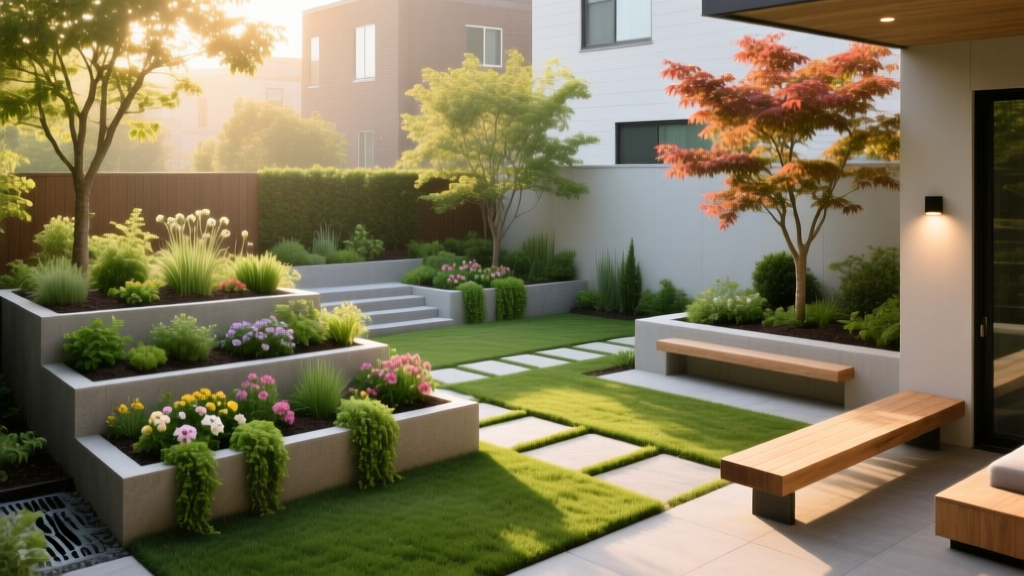
Landscape Ideas for Small Yards: Solving Common Site Problems
Diagnosing Your Small Yard's Micro-Conditions
Small yards (under 2,000 square feet) act as magnifying glasses for site flaws. A minor 5% grading error in a sprawling suburban lot goes unnoticed; in a 25-foot-wide townhouse backyard, it sends stormwater straight into your basement. When researching landscape ideas for small yards, most guides focus on aesthetic illusions—mirrors, vertical gardens, and painted fences. But aesthetics fail if the underlying site conditions are broken. This guide bypasses cosmetic tricks to solve the four most destructive micro-condition problems in compact spaces, providing exact material specifications and 2026 pricing to help you execute a functional transformation.
Problem 1: The "Bowling Alley" Effect (Narrow & Long Yards)
Narrow side yards and rectangular townhouse lots create a "bowling alley" visual. This layout draws the eye straight to the back fence, making the space feel claustrophobic and highlighting its lack of width. The goal is to force the eye to track laterally, breaking the linear sightline.
The Staggered Hardscape Solution
Avoid laying standard 12x12 concrete pavers in a straight running bond. Instead, use large-format 24x24-inch porcelain pavers (such as the MSI Bayou series, averaging $14–$18 per square foot in 2026). Lay them in a staggered grid with 4-inch gaps. Fill the gaps with 3/4" Mexican beach pebbles or dark basalt gravel. The large scale of the pavers tricks the brain into perceiving a wider space, while the contrasting gravel joints interrupt the forward momentum of the eye. For a 400-square-foot patio, expect to spend roughly $6,200 on materials, plus $2,500 for base preparation and labor.
Problem 2: The Sunken Sponge (Poor Drainage in Compact Spaces)
Small yards often suffer from severe soil compaction left behind by builders, turning the lawn into an impenetrable sponge. Traditional French drains require massive trenching and gravity slopes that eat up precious square footage and often lack a viable daylight exit point in zero-lot-line properties.
Crucial Material Warning: Never use round pea gravel for subsurface drainage in small yards. The smooth, round stones migrate and compact over time, crushing the drainage pipe and clogging the system. Always specify 3/4-inch angular crushed granite or limestone. The jagged edges mechanically lock together while maintaining permanent void space for water flow.
Point-Source Dry Well Installation
Instead of trenching, install point-source dry wells. The NDS 12-inch Flo-Well system ($72–$85 per unit) can be buried vertically in a 2-foot square footprint. Connect your downspouts directly to the Flo-Well via 4-inch corrugated pipe. Dig a pit 24 inches deep, place the unit, and surround it with 2 cubic feet of the angular crushed stone wrapped in non-woven geotextile fabric (to prevent soil infiltration). A single 12-inch Flo-Well can hold up to 48 gallons of water, handling the immediate surge from a 1,000-square-foot roof footprint during heavy downpours without sacrificing surface yard space.
Problem 3: The Wind Tunnel & Privacy Void (Townhouse Setbacks)
Building codes often mandate 5-foot side setbacks between homes. Erecting a solid 6-foot wood fence in these tight gaps creates an aerodynamic nightmare. Solid fences force wind up and over, creating a negative pressure zone on the leeward side that causes wind to swirl violently downward, toppling patio umbrellas and stunting plant growth.
Permeable Living Screens
To maintain privacy without creating a wind tunnel, use a semi-permeable living screen that filters wind rather than blocking it entirely. Fargesia rufa (clumping bamboo) is the ideal candidate. Unlike invasive running bamboo, it stays tightly contained. According to the NC State Extension plant database, it thrives in partial shade, tolerates cold down to -5°F, and reaches a manageable 8 feet tall.
Plant them in 30-inch Corten steel trough planters. The rusted steel provides a modern aesthetic, while the trough restricts root spread and elevates the canopy, giving you a 6-foot privacy screen immediately without waiting years for in-ground plantings to mature. Space the planters 18 inches apart to allow 20% wind permeability.
| Feature | Solid 6ft Wood Fence | Corten Trough + Fargesia rufa |
|---|---|---|
| Wind Aerodynamics | Creates severe leeward turbulence | Filters wind, reducing velocity by 40% |
| Installation Cost (per 20 linear ft) | $1,800 - $2,500 | $2,200 - $2,800 (including plants) |
| HOA / Code Compliance | Often restricted in front/side setbacks | Classified as landscaping, usually exempt |
Problem 4: The Deep Shade Trap (Zero Sunlight Zones)
Yards boxed in by two-story homes or mature oaks receive less than 3 hours of direct sunlight. Homeowners repeatedly attempt to grow Fescue or Bermuda grass in these zones, resulting in thin, diseased turf that turns to mud when walked on. Furthermore, pouring a traditional concrete patio over the root zone of a mature shade tree will suffocate the roots and kill the tree within five years.
Permeable Interlocking Concrete Pavers (PICP)
Abandon the lawn in deep shade zones. Install permeable interlocking concrete pavers, such as Belgard's Aqua Roc series. These pavers are laid with wide, gravel-filled joints that allow rainwater and oxygen to infiltrate the subsurface. This protects the critical root zones of mature canopy trees while providing a solid, mud-free surface for outdoor furniture. The EPA's permeable pavement research confirms these systems reduce stormwater runoff volume by up to 80% compared to traditional concrete slabs. Expect to pay $22–$28 per square foot for professional PICP installation, which includes the deep aggregate base required for structural integrity and water storage.
Budgeting Your Small Yard Transformation
Small yard landscaping carries a unique cost premium. Because mini-excavators and skid steers often cannot fit through standard side gates, excavation and material transport must be done manually via wheelbarrow. This increases labor costs by 20% to 30% compared to large, open lots.
| Project Component | Material Cost | Manual Labor Cost |
|---|---|---|
| Staggered Porcelain Patio (300 sq ft) | $4,800 | $3,200 |
| NDS Flo-Well Drainage (2 units) | $250 | $600 |
| Corten Troughs & Clumping Bamboo | $2,400 | $450 |
| Total Estimated Investment | $7,450 | $4,250 |
Site-Condition Summary
Successful small yard design requires prioritizing subsurface mechanics and aerodynamics over surface decoration. By utilizing large-format staggered pavers to break linear sightlines, deploying point-source dry wells with angular aggregate for drainage, and selecting permeable living screens to manage wind flow, you can convert a problematic compact lot into a highly functional, structurally sound outdoor living space.

