
Landscaping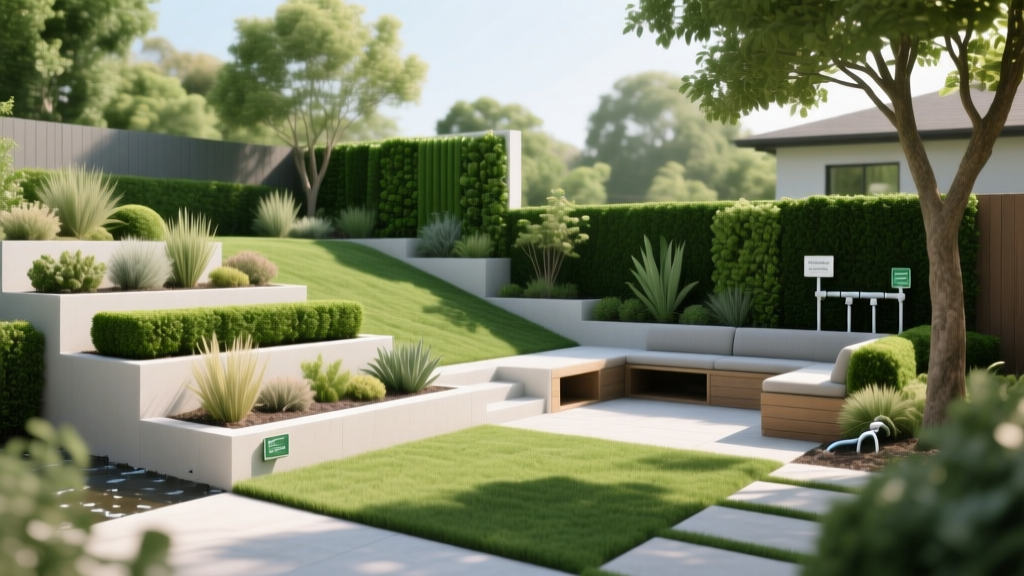
Small Yard Landscaping Designs to Solve Common Site Problems
The Amplification Effect in Small Yards
In properties under 2,500 square feet, site defects do not just exist; they amplify. A 2% negative grade in a sprawling suburban lawn creates a minor puddle. In a small urban or townhouse yard, that same grading error funnels thousands of gallons of runoff directly into your basement. Similarly, a solid 6-foot privacy fence in a large yard provides seclusion; in a 30-foot-wide yard, it creates a claustrophobic wind tunnel and blocks crucial sunlight.
Effective small yard landscaping designs must function as site-condition problem solvers. Rather than masking flaws with superficial decorative elements, these designs utilize structural hardscaping, targeted hydrology, and microclimate-specific planting to neutralize physical limitations. Below are engineered solutions for the four most pervasive small-yard site conditions, complete with 2026 material specifications and cost frameworks.
1. The Narrow Side Yard: Solving Drainage and Claustrophobia
Side yards (typically 5 to 10 feet wide) act as natural gutters. When roof downspouts discharge into these narrow corridors, the soil quickly becomes waterlogged, killing turf and creating mosquito breeding grounds. Traditional solid concrete walkways exacerbate the issue by increasing surface runoff velocity.
The Permeable Paver and French Drain Matrix
Replace solid pathways with permeable interlocking concrete pavers (PICP), such as the Belgard Aqua Roc series. These systems allow water to infiltrate directly through the joints into a crushed stone reservoir base, reducing surface runoff by up to 80%. According to the EPA's Green Infrastructure guidelines, permeable pavements significantly reduce the burden on municipal stormwater systems while recharging local groundwater.
Installation Specs for Side Yard PICP:
- Base Layer: 12 inches of open-graded crushed stone (ASTM No. 2 or 3) for water storage.
- Bedding Layer: 2 inches of ASTM No. 8 or No. 9 crushed stone (never use sand, which clogs joints).
- Joint Fill: ASTM No. 8 or 9 stone, swept flush with the paver surface.
- Cost (2026): $18 to $26 per square foot, fully installed.
For the remaining soil borders, install a 4-inch corrugated slotted pipe wrapped in non-woven geotextile fabric. Trench the pipe at a 1% slope toward the front yard or a dry well, backfilling with 3/4-inch washed gravel. This captures subsurface lateral flow before it reaches the foundation.
2. Privacy Without the 'Boxed-In' Feeling
When neighboring properties sit less than 15 feet away, privacy is mandatory. However, standard solid wood stockade fences reflect sound, block cross-breezes, and visually shrink the yard. The solution lies in semi-permeable screening that manipulates sightlines without eliminating light or airflow.
Horizontal Slatted Screens and Clumping Bamboo
Construct horizontal slatted screens using 1x2-inch Western Red Cedar or Ipe boards, spaced with 1/2-inch gaps. This specific spacing breaks the line of sight from a standing adult's eye level (approximately 5.5 feet) while allowing 30% light penetration and reducing wind load by 40% compared to solid panels. Mount the frames on black powder-coated steel posts to minimize visual bulk.
| Material / Method | Cost per Linear Ft (Installed) | Wind Load Impact | Space Footprint |
|---|---|---|---|
| Solid Vinyl Fence (6ft) | $65 - $85 | High (Creates wind tunnels) | 4-6 inches |
| Cedar Slatted Screen (1/2" gaps) | $90 - $120 | Low (Air passes through) | 3-4 inches |
| Corten Steel Planter + Trellis | $140 - $180 | Moderate | 18-24 inches |
| Clumping Bamboo (*Fargesia murielae*) | $45 - $70 (Planting) | Low (Stems flex) | 24-36 inches |
Expert Note: Avoid running bamboo (*Phyllostachys*). Even with rhizome barriers, the hydrostatic pressure in small, confined yard beds often causes the barrier to buckle within 3 to 5 years. Stick strictly to clumping varieties like *Fargesia murielae* (hardy to Zone 5) or *Fargesia robusta* (Zone 7+).
3. Heavy Shade and Root Competition Under Mature Trees
Small yards often feature one or two mature canopy trees that dominate the space. The dual problem is severe shade (preventing turf growth) and aggressive surface roots (making traditional concrete patios or digging impossible without harming the tree).
Helical Pile Decking and Shade-Tolerant Groundcovers
Do not pour concrete footings or trench near the critical root zone (the area under the drip line). Instead, build an elevated composite deck using helical piles (e.g., Techno Metal Post). These 2 7/8-inch diameter steel shafts are mechanically screwed 5 to 7 feet into the ground using specialized hydraulic equipment, bypassing large roots without severing them and requiring zero concrete curing.
- Site Scan: Use ground-penetrating radar (GPR) or manual air-spade trenching to map roots larger than 2 inches in diameter.
- Pile Installation: Screw helical piles to a depth of 5-7 feet, attaching adjustable U-head brackets to accommodate uneven root topography.
- Framing: Use 2x8 pressure-treated joists spaced 12 inches on-center, elevated at least 18 inches above the soil to allow air and water flow to the root zone.
- Decking: Install grooved composite boards (like Trex Transcend) using hidden fasteners to eliminate surface screws that could snag or warp.
For the bare soil patches beneath the deck or around the tree base where foot traffic is minimal, abandon grass entirely. Plant Carex pensylvanica (Pennsylvania Sedge) or Pachysandra terminalis. These species thrive in dry shade and require zero mowing, eliminating the need to run lawnmowers near vulnerable tree trunks.
4. The 'Bowl Effect': Managing Severe Grading Issues
Many small yards are graded improperly, sloping toward the home or featuring a central depression that traps water. Regrading the entire yard is often impossible due to property line constraints and neighbor disputes.
Engineered Rain Gardens and Dry Creek Beds
Instead of fighting the water, capture it. Construct a rain garden at the lowest elevation point of the yard. According to research from the University of Minnesota Extension, a properly engineered rain garden can absorb 30% more water than a conventional lawn of the same size.
"The critical failure point in small-yard rain gardens is the soil mix. Native clay holds water too long, creating a swamp. You must excavate 18 to 24 inches of native soil and replace it with a bioretention mix: 30% coarse sand, 30% topsoil, and 40% leaf compost. This ensures a drawdown time of under 24 hours, which is mandatory to prevent mosquito breeding."
Line the edges of the rain garden with river rock (3-5 inch diameter) to dissipate the energy of incoming runoff, preventing soil erosion. Plant deep-rooted, moisture-tolerant natives such as Asclepias incarnata (Swamp Milkweed) and Iris versicolor (Blue Flag Iris), which act as biological pumps, drawing gallons of water through their root systems daily.
Material and Budget Decision Framework
When allocating a budget for small yard landscaping designs, prioritize structural problem-solving over aesthetic ornamentation. Use the matrix below to determine where to invest capital based on your specific site condition.
| Site Problem | Primary Investment Area | Expected 2026 Cost Range | ROI / Value Add |
|---|---|---|---|
| Basement Water Intrusion | Subsurface drainage & grading | $4,500 - $8,000 | Prevents $20k+ structural damage |
| Lack of Usable Space | Helical pile decking | $12,000 - $22,000 | Adds functional outdoor living sq ft |
| Neighbor Proximity / Noise | Acoustic fencing & plant buffers | $3,000 - $6,500 | Increases daily enjoyment & privacy |
| Muddy / Unusable Turf | Permeable hardscaping | $6,000 - $12,000 | Eliminates mud, reduces maintenance |
By treating your small yard as a complex system of hydrology, microclimates, and spatial geometry, you can transform severe site limitations into highly functional, architecturally striking outdoor spaces. Focus your budget on subsurface infrastructure and structural screening first; the aesthetic planting layers will thrive once the foundational site conditions are resolved.

