
Landscaping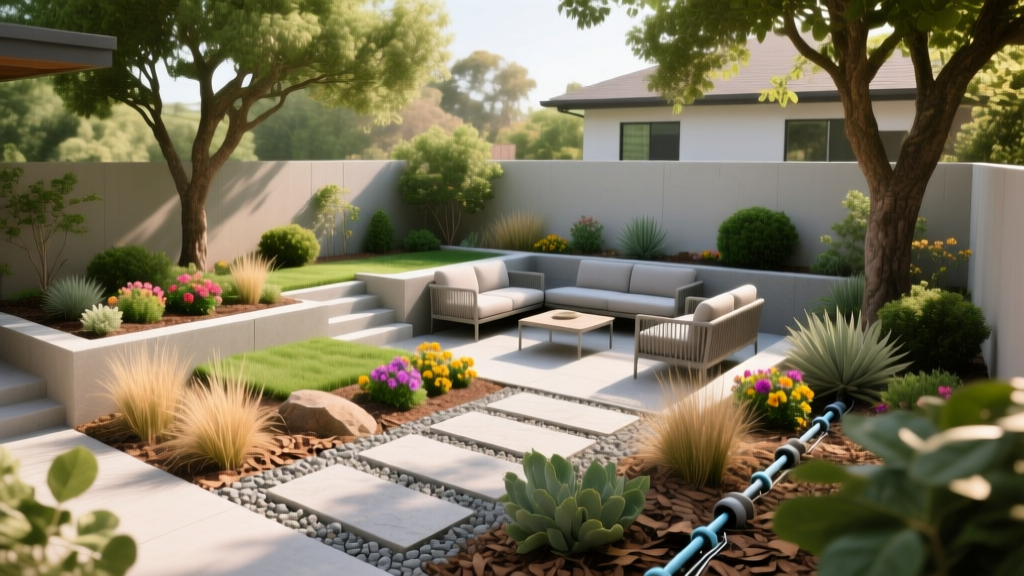
Small Yard Landscaping Ideas to Solve Common Site Problems
Small yards magnify site flaws. A minor drainage issue becomes a localized swamp; a lack of privacy feels oppressive when the neighbor's patio is ten feet away; and mature trees cast shade that turns turf into bare mud. Standard landscaping advice often assumes ample square footage, leaving homeowners with compact lots struggling to adapt. Effective small yard landscaping ideas must function as site-condition problem solvers, prioritizing spatial efficiency, hydrological management, and vertical utilization.
This guide bypasses generic aesthetic tips and focuses on structural and horticultural solutions for the four most common micro-climate and topographical challenges found in compact residential lots.
The Narrow Side Yard: Channeling Flow and Light
Side yards are typically 3 to 5 feet wide, heavily shaded by the primary structure, and subjected to roof runoff. Paving them entirely with concrete creates heat islands and exacerbates stormwater runoff, while planting traditional turf guarantees a muddy, high-traffic failure zone.
The Stepping Stone and Creeping Groundcover Matrix
Instead of a continuous walkway or solid planting bed, use an alternating hardscape-softscape grid. This reduces material costs, maintains permeability, and breaks up the "bowling alley" visual effect.
- Hardscape: Use 18x18-inch brushed concrete pavers or natural bluestone treads. Space them exactly 4 to 6 inches apart to accommodate human stride mechanics while leaving room for plant growth.
- Softscape: Plant Thymus serpyllum 'Elfin' (Elfin Creeping Thyme) in the gaps. It tolerates light foot traffic, requires only 2 inches of soil depth, and thrives in the partial shade typical of side yards.
- Base Preparation: Excavate 4 inches of native soil. Lay down a non-woven geotextile fabric (such as Mirafi 140N) to prevent weed intrusion, followed by 3 inches of compacted 3/4-inch crushed gravel. Set the pavers directly on the gravel base without mortar to ensure water permeability.
Pro Tip: To manage roof runoff in this narrow corridor, grade the gravel base with a 2% slope (1/4 inch per foot) directing water toward the rear yard or a designated dry well, preventing foundation pooling.
The Shade-Trap Corner: Managing Moisture and Root Competition
Compact yards often feature a corner dominated by a mature tree (like an Oak or Maple). The soil here suffers from "dry shade"—the tree canopy intercepts rainfall, and its extensive feeder roots aggressively outcompete smaller plants for moisture. Tilling this soil to plant a garden destroys the tree's critical root zone.
Dry Creek Beds and Epiphytic Layering
According to the University of Minnesota Extension, gardening under established trees requires avoiding deep soil disturbance. The solution is to build up and manage surface water visually and functionally.
- Construct a Dry Creek Bed: Map the natural water flow from the tree's drip line. Excavate a shallow trench (4 inches deep, 12 to 18 inches wide). Line it with permeable landscape fabric and fill it with 3/4-inch to 1.5-inch smooth river rock. This captures surface runoff without suffocating tree roots.
- Deploy Shade-Tolerant Groundcovers: Avoid planting directly against the tree trunk. Instead, plant plugs of Pachysandra terminalis or Asarum canadense (Wild Ginger) in the undisturbed soil pockets between major surface roots.
- Vertical Interest: Hang fern baskets (like Nephrolepis exaltata) from the lower, structural branches of the tree using heavy-duty arborist straps (never nails or screws, which introduce pathogens).
The Privacy-Deficient Patio: Vertical Screening Without Bulk
In a small yard, a traditional 6-foot wooden privacy fence consumes valuable square footage, casts heavy shadows, and creates a claustrophobic "box" effect. Modern small yard landscaping ideas favor living screens and permeable architectural elements that provide privacy while maintaining airflow and light penetration.
Corten Steel Troughs and Clumping Bamboo
Weathering steel (Corten) planters provide an industrial-modern aesthetic and develop a protective rust patina that eliminates the need for painting. More importantly, they allow you to position privacy screens exactly where needed without permanent hardscape alterations.
| Plant Species | Mature Width | Growth Rate | Root Behavior | Best Application |
|---|---|---|---|---|
| Fargesia rufa (Clumping Bamboo) | 3-4 feet | Fast (1-2 ft/yr) | Non-invasive clumper | Tight corners, patio edges |
| Thuja occidentalis 'Emerald Green' | 3-4 feet | Moderate (6-9 in/yr) | Compact, fibrous | Perimeter hedging |
| Trachelospermum jasminoides (Star Jasmine) | 1-2 feet (when trellised) | Fast (1-2 ft/yr) | Moderate spread | Vertical trellis screens |
Implementation Specs: Purchase 48-inch long, 16-inch wide, and 16-inch deep Corten steel troughs (typically $350-$500 each). Ensure they have at least four 1/2-inch drainage holes. Fill with a 50/50 mix of high-quality potting soil and pine bark fines to ensure drainage. Plant two Fargesia rufa divisions per trough. This creates an instant 6-to-8-foot living wall that occupies only 16 inches of lateral yard space.
The Steep Micro-Slope: Terracing with Modular Retaining
Many small urban lots feature a 3-to-5-foot elevation drop from the back door to the property line. Left alone, this slope erodes during heavy rains, rendering the space unusable. Building a traditional poured concrete retaining wall requires heavy machinery access that small yards rarely permit.
Segmental Retaining Wall Blocks
Segmental retaining wall (SRW) blocks, such as the Belgard Weston Stone or Pavestone systems, are engineered for modular, machine-free installation. They utilize a lip-and-groove system or fiberglass pins for structural alignment.
Critical Engineering Requirement: For any SRW wall exceeding 24 inches in height, you must incorporate geogrid reinforcement. Excavate 6 inches of compacted 3/4-inch crushed angular gravel for the base. Lay the geogrid fabric every two courses, extending it back into the retained soil by a distance equal to 60% of the wall's total height to anchor the structure against hydrostatic pressure.
Once the terraced levels are established, stabilize the exposed soil on the upper tier with slope-tolerant groundcovers. The NC State Extension Plant Database recommends Juniperus horizontalis 'Wiltonii' (Blue Rug Juniper) for its aggressive, soil-binding root system and extreme drought tolerance once established.
Budget & Material Decision Matrix
Small yards require a higher percentage of hardscaping to remain functional, which can inflate budgets. Use the matrix below to balance upfront costs with long-term site-condition benefits.
| Material | Avg. Cost (Installed) | Permeability | Site-Condition Benefit |
|---|---|---|---|
| Permeable Interlocking Pavers | $14 - $18 / sq ft | High | Eliminates standing water; reduces runoff |
| Natural Flagstone (Mortar Set) | $18 - $25 / sq ft | None | High durability; requires separate drainage |
| Decomposed Granite (DG) w/ Stabilizer | $6 - $9 / sq ft | Moderate | Low cost; excellent for informal pathways |
| Composite Decking (e.g., Trex) | $12 - $16 / sq ft | High (Underneath) | Solves uneven terrain without grading |
Final Sizing and Proportion Rules
When executing these small yard landscaping ideas, adhere to the 3-to-1 scaling rule. For every 3 feet of horizontal distance, limit vertical structures (fences, planters, retaining walls) to 1 foot of height to prevent the space from feeling canyon-like. By treating your small yard's physical limitations as design parameters rather than obstacles, you engineer a landscape that is both highly functional and visually expansive.

