
Landscaping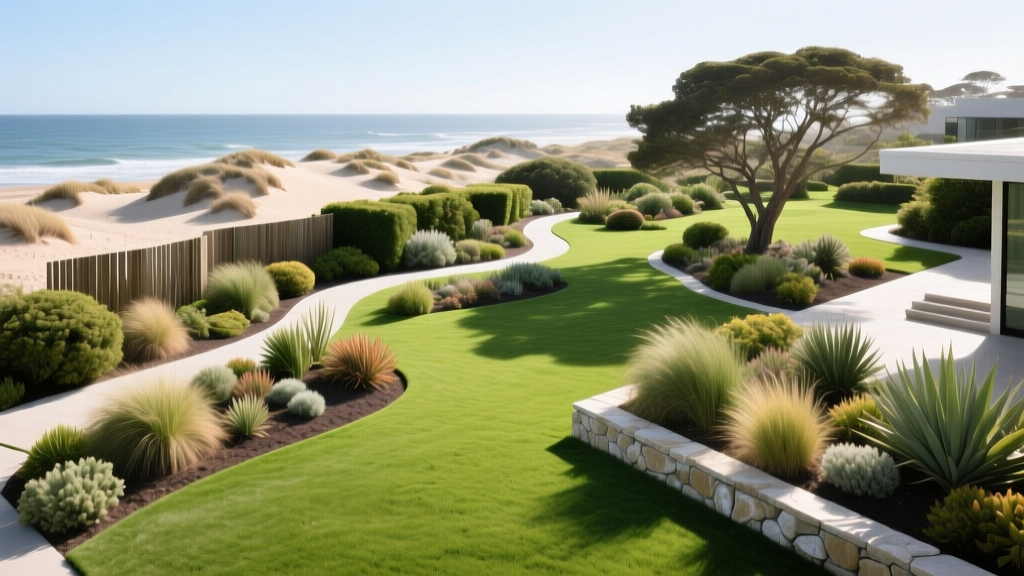
Troubleshooting Beachy Landscaping: Diagnosing Salt, Sand, and Wind Damage
Beachy landscaping offers a serene, resort-like aesthetic, but coastal and simulated coastal environments present harsh physiological and structural challenges. High salinity, rapid soil drainage, and relentless UV exposure routinely turn lush seaside designs into brittle, brown wastelands. Whether you are managing a literal oceanfront property or designing a simulated coastal retreat inland, the environmental stressors remain aggressive. This diagnostic guide identifies the exact failure modes in coastal-style yards and provides engineered, long-term solutions to keep your oasis thriving.
Symptom 1: Marginal Leaf Burn and White Crust (Salt Spray Toxicity)
The most immediate visual failure in beachy landscaping is foliar necrosis. When leaves develop brown, crispy margins or a faint white powdery crust, the root cause is sodium chloride accumulation. Salt spray acts as a desiccant, pulling moisture directly out of leaf tissue through osmotic stress, while chloride ions disrupt photosynthesis.
Diagnosis & Verification
Do not confuse salt burn with underwatering. Salt burn specifically targets the oldest leaves first and concentrates on the side of the plant facing the prevailing wind. To verify, wipe the foliage with a damp white cloth; if a distinct salty residue remains, you have an aerosolized salt problem.
Engineered Solutions
- Foliar Flushing Protocol: Install an overhead micro-sprinkler system calibrated to deliver exactly 0.1 inches of fresh water every morning at dawn. This washes salt crystals off the stomata before the sun bakes them into the tissue.
- Halophytic Plant Swaps: Replace susceptible ornamentals with true halophytes (salt-tolerant plants). Juniperus conferta (Shore Juniper) features thick, waxy cuticles that repel salt, while Muhlenbergia capillaris (Pink Muhly Grass) sheds salt-laden foliage naturally in autumn.
- Permeable Windbreaks: Plant a frontline hedge of Spartina patens (Saltmeadow Cordgrass) to physically intercept and filter airborne salt before it reaches your primary design elements.
Warning: Never apply anti-desiccant sprays (like Wilt-Pruf) to solve salt burn. These polymer coatings trap salt crystals against the leaf surface and block the stomata, accelerating cellular death in coastal environments.
Symptom 2: Chronic Chlorosis and Hydrophobic Soil (Sand Substrate Failure)
Sandy soils, the foundation of most natural beach environments, have a notoriously low Cation Exchange Capacity (CEC)—often below 5 meq/100g. This means the soil physically cannot hold onto positively charged nutrients like calcium, magnesium, and potassium. Furthermore, heavily trafficked beach sand becomes hydrophobic, repelling water and causing fertilizers to leach directly into the water table.
Soil Amendment Matrix for Coastal Sands
To fix nutrient leaching and hydrophobicity, you must alter the physical structure of the sand. According to research from the North Carolina State University Plant Database, amending native coastal sand requires specific ratios of organic and synthetic conditioners.
| Amendment | Primary Function | Application Rate | Est. Cost (2026) |
|---|---|---|---|
| Horticultural Biochar | Raises CEC; provides permanent porous structure for nutrient retention. | 10% to 15% by soil volume (top 12 inches). | $45 - $65 per cu. ft. |
| Cross-linked Polyacrylamide Hydrogels | Absorbs up to 400x its weight in water; combats hydrophobic dry-outs. | 2 to 3 lbs per 1,000 sq. ft. (incorporated at root zone depth). | $80 - $120 per 50 lb bag. |
| Liquid Humic Acid (12% concentration) | Chelates micronutrients; stimulates root hair development in poor soils. | 6 oz per 1,000 sq. ft. applied monthly via fertigation. | $35 - $50 per gallon. |
Symptom 3: Stem Shearing and Root Plate Uprooting (Wind Load Exceedance)
Coastal winds do not just dry out plants; they exert massive mechanical shear forces. A common failure in beachy landscaping is the uprooting of newly installed palm trees or the snapping of ornamental grasses at the crown. This occurs when the wind load exceeds the root ball's anchoring capacity or the stem's tensile strength.
Diagnosis & Verification
If you notice soil mounding at the base of a tree trunk on the windward side, the root plate is failing. If ornamental grasses are snapping cleanly at the base rather than bending, they are suffering from mechanical fatigue caused by high-frequency wind vibration.
Structural Solutions
- The 50% Porosity Rule: Never install solid privacy fences as windbreaks. Solid walls create a vacuum effect on the leeward side, resulting in destructive wind turbulence that will rip plants out of the ground. Instead, use slatted timber screens or living hedges that maintain exactly 40% to 50% porosity. This filters and slows the wind without creating eddies.
- Deep-Root Anchoring: For palms and coastal trees over 10 feet tall, abandon standard staking. Use subterranean root ball anchoring systems (like the Duckbill Earth Anchor) driven 36 inches into the undisturbed subsoil, attached to the root ball via UV-stabilized polyester straps.
- Crown Thinning: Reduce the wind sail effect by selectively thinning the inner canopy of coastal trees by 15% to 20%, allowing wind to pass through the foliage rather than pushing against it.
'Effective coastal design relies on managing kinetic energy. You cannot stop the wind, but you can bleed off its momentum through permeable layers and flexible plant architectures.' — NOAA Coastal Management Guidelines
Hardscape and Hardware Corrosion: The Hidden Failure
Aesthetic failures in beachy landscaping often extend beyond plants. Rust streaks on retaining walls, seized pergola brackets, and pitted lighting fixtures are rampant. Standard galvanized steel and even 304-grade stainless steel will rapidly succumb to pitting corrosion in high-chloride environments.
Material Upgrade Specifications
- Fasteners and Brackets: Mandate 316-grade marine stainless steel for all structural connections. The addition of molybdenum in 316 steel specifically prevents chloride-induced pitting.
- Hardscape Sealers: Apply silane/siloxane penetrating sealers to natural stone and concrete pavers. Unlike acrylic film-forming sealers that peel and trap salt moisture, silanes penetrate up to 1/4 inch and react chemically with the masonry to create a hydrophobic barrier without altering the slip resistance.
- Lighting Fixtures: Avoid cast aluminum or brass in direct splash zones. Opt for solid bronze or non-metallic composite polycarbonate fixtures rated for IP68 submersion, ensuring internal gaskets are protected from salt ingress.
Coastal Plant Selection Decision Matrix
Selecting the right plant for the right microclimate is the ultimate preventative measure. Use this matrix to zone your beachy landscaping layout based on proximity to the salt and wind source.
| Zone | Distance from Source | Recommended Species | Salt Tolerance |
|---|---|---|---|
| Zone 1: Frontline | 0 - 50 feet | Uniola paniculata (Sea Oats), Scaevola taccada (Beach Cabbage) | Extreme (Direct Spray) |
| Zone 2: Mid-Yard | 50 - 150 feet | Agave americana, Yucca filamentosa, Pittosporum tobira | Moderate (Occasional Spray) |
| Zone 3: Protected | 150+ feet / Courtyards | Hydrangea macrophylla, Camellia japonica, Ferns | Low (Requires Full Shelter) |
Successful beachy landscaping requires a shift from traditional horticulture to coastal engineering. By diagnosing the specific physiological and mechanical stressors—salt toxicity, hydrophobic sand, and wind shear—and applying targeted material and biological solutions, you can maintain a vibrant, resilient coastal property that withstands the elements year after year.

