
Lawn Care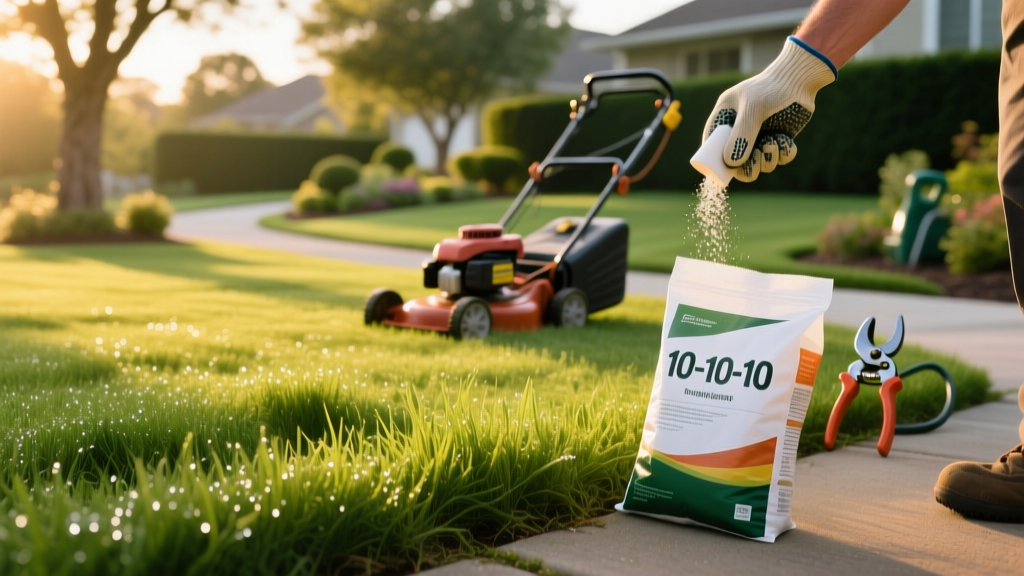
When to Use 10 10 10 Fertilizer for Lawns (And When to Avoid)
The Truth About Balanced NPK Ratios on Turfgrass
Walk into any garden center and you will find 10-10-10 fertilizer prominently displayed. Marketed as a "balanced" or "complete" fertilizer, it contains equal parts Nitrogen (N), Phosphorus (P2O5), and Potassium (K2O) by weight. While this 1:1:1 ratio is excellent for vegetable gardens and flowering beds, it is fundamentally misaligned with the nutritional requirements of established turfgrass.
Turfgrass requires high nitrogen for blade growth and color, moderate potassium for root strength and drought tolerance, and very little phosphorus once the root system is established. Applying 10 10 10 fertilizer for lawns that are already mature often results in severe phosphorus overloading, which triggers a cascade of soil health and environmental issues.
⚠️ Environmental Warning: Phosphorus Runoff
Excess phosphorus does not easily leach through soil; it binds to soil particles. When soil becomes saturated with phosphorus, surface runoff carries it into local waterways. According to the Environmental Protection Agency (EPA), phosphorus is the primary limiting nutrient in freshwater ecosystems, and its overapplication directly causes toxic algal blooms and aquatic dead zones. Many municipalities now legally restrict the use of phosphorus-containing fertilizers on established lawns.
When 10 10 10 Fertilizer for Lawns is the Right Choice
Despite the risks to established turf, there are specific, narrow scenarios where a balanced 10-10-10 formulation is the correct agronomic choice. You should only apply this ratio under the following conditions:
- New Lawn Establishment: When seeding or laying sod, grass requires a massive influx of phosphorus to stimulate early root development. A 10-10-10 or a dedicated starter fertilizer provides the necessary P boost that mature lawns do not need.
- Severe Soil Deficiencies: If a professional soil test reveals that your soil is critically deficient in both phosphorus and potassium (typically below 10 ppm for P and 100 ppm for K), a balanced fertilizer can help rebuild the soil's baseline nutrient profile.
- Overseeding Bare Patches: When repairing localized damage where the root system has been completely removed, treating the area as "new establishment" justifies a balanced NPK application.
The Soil Test Decision Matrix
Never guess your soil's nutrient levels. The University of Minnesota Extension strongly recommends soil testing every three years to dictate your fertilizer strategy. Use the matrix below to interpret your soil test results (using the Mehlich-3 or Bray P1 extraction methods) and select the correct NPK ratio.
| Soil Phosphorus (P) | Soil Potassium (K) | Recommended Fertilizer Ratio | Use 10-10-10? |
|---|---|---|---|
| Very Low (< 10 ppm) | Very Low (< 100 ppm) | 1:1:1 (10-10-10) or Starter (18-24-12) | YES |
| Low to Medium (11-25 ppm) | Medium (101-200 ppm) | High N, Low P, Mod K (e.g., 24-4-12) | NO |
| High (> 25 ppm) | High (> 200 ppm) | High N, Zero P (e.g., 32-0-4 or 29-0-3) | ABSOLUTELY NOT |
Application Rates, Math, and Cost Breakdown
The standard agronomic recommendation for cool-season and warm-season grasses is to apply 1 pound of actual Nitrogen per 1,000 square feet per application. Because 10-10-10 fertilizer is only 10% nitrogen by weight, the math dictates a heavy application rate.
The Application Math
- Calculate Product Needed: To get 1 lb of Nitrogen, divide 1 by 0.10 (the percentage of N). This equals 10 pounds of 10-10-10 product per 1,000 sq ft.
- Calculate Coverage: A standard 50-pound bag of triple-10 fertilizer will cover exactly 5,000 square feet at this rate.
- Spreader Calibration: On a standard Scotts EdgeGuard broadcast spreader, a setting of 5.5 to 6.0 typically delivers 10 lbs per 1,000 sq ft, but you must verify this by measuring out 10 lbs and testing it on a 1,000 sq ft marked area of your driveway.
The Hidden Cost of Balanced Fertilizer
Many homeowners assume 10-10-10 is a budget-friendly option because a 50 lb bag costs roughly $30 to $35 in 2026. However, when you calculate the cost per square foot of coverage, it is highly inefficient for established lawns.
- 10-10-10 ($35 / 50lb bag): Covers 5,000 sq ft. Cost = $7.00 per 1,000 sq ft.
- 32-0-4 High-Nitrogen Turf Fertilizer ($45 / 50lb bag): Requires only 3.1 lbs of product per 1,000 sq ft to deliver 1 lb of N. Covers 16,000 sq ft. Cost = $2.81 per 1,000 sq ft.
By using 10-10-10 on an established lawn, you are paying a 150% premium while simultaneously polluting your local watershed with unneeded phosphorus.
"Leaving grass clippings on the lawn returns up to 30% of the nitrogen and a significant portion of the phosphorus and potassium back to the soil. If you mulch-mow, your soil's P and K levels will naturally maintain themselves, rendering balanced fertilizers entirely redundant."
Better Alternatives for Established Lawns
If your soil test shows adequate phosphorus and potassium levels, abandon the 10-10-10 and switch to a turf-specific formulation. Here are the exact alternatives based on your lawn's current state:
- For Routine Maintenance (High N, Zero P): Look for formulations like Lesco Professional 32-0-4 or Scotts Turf Builder WinterGuard 32-0-10. These provide the nitrogen required for blade density without adding phosphorus.
- For Organic Slow-Release: Milorganite 6-2-0 is an excellent biosolid fertilizer. It provides slow-release nitrogen, contains iron for deep greening, and has a negligible phosphorus impact compared to synthetic balanced fertilizers.
- For New Seed/Sod (Starter): If you are establishing a new lawn and need phosphorus, use a dedicated starter fertilizer like Lesco Professional Starter 18-24-12. It provides a higher ratio of phosphorus specifically calibrated for root germination without the excessive bulk of a 1:1:1 ratio.
Frequently Asked Questions
Will 10-10-10 burn my lawn?
Yes, if overapplied. Because you must apply 10 lbs of product per 1,000 sq ft to meet nitrogen requirements, any overlap during spreading will deliver a massive dose of nitrogen salts, resulting in severe fertilizer burn (yellow/brown streaks). Always use a broadcast spreader with an edge guard and overlap your passes by exactly 50%.
Can I use 10-10-10 on St. Augustine or Bermuda grass?
Warm-season grasses like St. Augustine and Bermuda require high nitrogen during their active summer growth phase. Applying 10-10-10 will force you to apply excessive phosphorus to meet their high nitrogen demands. Stick to high-nitrogen, low-phosphorus formulations (like 28-0-3) for warm-season turf maintenance.

