
Lawn Care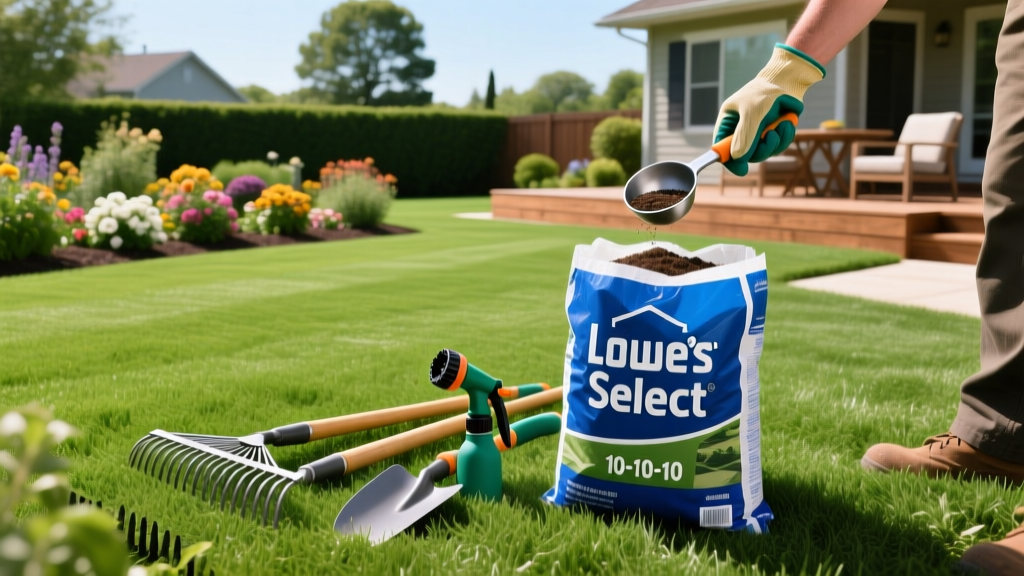
10-10-10 Fertilizer at Lowe's: Is It Right for Your Lawn?
The Reality of Using All-Purpose Fertilizer on Turf
If you are standing in the garden center looking for 10 10 10 fertilizer, Lowe's carries several all-purpose options that seem like a convenient, one-size-fits-all solution for your yard. A balanced 10-10-10 N-P-K (Nitrogen-Phosphorus-Potassium) ratio provides equal parts of the three primary macronutrients. While this formulation is excellent for vegetable gardens, perennial beds, and establishing new shrubs, applying it to an established lawn requires careful consideration—and in some jurisdictions, it may actually violate local environmental regulations.
Before you load a 40-pound bag of Vigoro or Sta-Green into your cart, you need to understand the mathematical reality of turfgrass nutrition, the hidden dangers of phosphorus runoff, and the exact spreader calibration required to prevent chemical burn. This guide breaks down the specific 10-10-10 products available at Lowe's and provides a definitive framework for deciding whether this fertilizer belongs on your lawn.
The N-P-K Breakdown: What 10-10-10 Actually Does
Every bag of fertilizer is labeled with three numbers representing the percentage by weight of Nitrogen (N), Phosphorus (P), and Potassium (K). In a 40-pound bag of 10-10-10 fertilizer, you are getting exactly 4 pounds of actual Nitrogen, 4 pounds of Phosphorus (expressed as P2O5), and 4 pounds of Potassium (expressed as K2O). The remaining 28 pounds consist of filler materials like limestone or sand that help distribute the nutrients evenly.
- Nitrogen (10%): Drives vertical blade growth and deep green coloration. Lawns typically require high nitrogen levels (2 to 4 lbs per 1,000 sq ft annually).
- Phosphorus (10%): Stimulates root development and seed germination. Crucial for new lawns, but largely unnecessary for established turfgrass unless a soil test confirms a deficiency.
- Potassium (10%): Enhances drought tolerance, disease resistance, and winter hardiness.
Brand Breakdown: 10-10-10 Options Available at Lowe's
Lowe's inventory fluctuates by region and season, but you will typically find 10-10-10 formulations under their house brands or general-purpose garden labels. Notably, premium turf-specific brands like Scotts Turf Builder rarely produce 10-10-10 lawn fertilizers, as turf science dictates a high-nitrogen, low-phosphorus ratio (such as 32-0-4) for established grass.
| Brand at Lowe's | Bag Size | Coverage Area | Est. Price (2026) | Best Use Case |
|---|---|---|---|---|
| Vigoro All-Purpose | 40 lbs | 4,000 sq ft | $24.98 | Garden beds, new lawn seeding |
| Sta-Green 10-10-10 | 40 lbs | 4,000 sq ft | $19.98 | Vegetable gardens, shrubs |
| Pennington All-Purpose | 40 lbs | 4,000 sq ft | $26.48 | Landscaping, general yard |
⚠️ Phosphorus Restriction Warning: Applying 10-10-10 to an established lawn at the standard rate of 1 lb of Nitrogen per 1,000 sq ft means you are simultaneously applying 1 lb of Phosphorus per 1,000 sq ft. According to the EPA's guidelines on nutrient pollution, excess phosphorus is a primary driver of toxic algae blooms in local waterways. Consequently, states like New York, New Jersey, Maryland, and Washington strictly prohibit the sale and application of phosphorus-containing fertilizers on established lawns unless a verified soil test proves a deficiency or you are establishing a new lawn from seed.
The Lawn Care Verdict: When to Use (and Avoid) 10-10-10
To determine if the 10-10-10 fertilizer at Lowe's is the right purchase for your specific scenario, use this decision matrix based on your lawn's current lifecycle stage.
When to BUY and Apply 10-10-10
- Seeding or Sodding a New Lawn: Phosphorus is critical for early root establishment. If you are laying down fresh sod or overseeding bare dirt, a balanced 10-10-10 starter application is highly beneficial.
- Soil Test Confirms Deficiency: If you have sent a soil sample to your local university extension and the results indicate low (P) and low (K) levels alongside a nitrogen deficit, 10-10-10 is mathematically appropriate.
- Maintaining Garden Beds: If your primary goal is fertilizing the flower beds, vegetable patches, and shrub borders adjacent to your lawn, this is the correct product.
When to AVOID 10-10-10 (Buy Turf-Specific Instead)
- Routine Maintenance on Established Lawns: Mature turfgrass extracts enough residual phosphorus from the soil to survive for years. Applying more leads to nutrient lockout and environmental harm.
- Summer Stress Periods: Pushing high-phosphorus growth during high heat can stress cool-season grasses like Tall Fescue or Kentucky Bluegrass.
- Living in a Phosphorus-Banned Municipality: You risk heavy municipal fines for violating local runoff ordinances.
Step-by-Step Application and Spreader Calibration
If your soil test justifies the use of 10-10-10 on your turf, precise application is mandatory. Granular all-purpose fertilizers often feature a salt-based carrier that will severely burn grass blades if overlapped. The target application rate for turf is 1 pound of actual Nitrogen per 1,000 square feet. Because the product is 10% Nitrogen, you must apply 10 pounds of product per 1,000 square feet.
Expert Insight: As noted by Penn State Extension's turfgrass management program, calibrating your spreader to the exact output rate prevents both under-fertilization and chemical burn.
The 50-Square-Foot Calibration Method
Do not blindly trust the settings printed on the bag, as spreader mechanisms wear down over time. Use this field-tested calibration method:
- Measure a Test Area: Mark off a 50-square-foot section of your driveway or a tarp (e.g., 5 feet wide by 10 feet long).
- Weigh the Product: Place exactly 0.5 pounds (8 ounces) of the 10-10-10 fertilizer into your rotary spreader. (Since 10 lbs covers 1,000 sq ft, 0.5 lbs covers 50 sq ft).
- Set the Dial: Start with a medium setting (e.g., 5.5 on a Scotts EdgeGuard Mini).
- Walk the Area: Walk at your normal, steady mowing pace over the 50-square-foot area.
- Evaluate: If you run out of product before finishing the 50 sq ft, your setting is too high (close the dial). If you have product left over, your setting is too low (open the dial). Adjust and repeat until the 0.5 lbs empties exactly at the end of the test zone.
Post-Application Watering Protocol
Once the 10-10-10 granules are on the lawn, they must be watered in immediately to activate the nutrients and wash the salts off the grass blades. Apply exactly 0.25 inches of water using your irrigation system or a hose-end sprinkler. To measure this, place three empty tuna cans in the sprinkler zone; when they collect a quarter-inch of water, shut the system off. Overwatering at this stage will push the water-soluble nitrogen past the root zone, wasting your investment.
Frequently Asked Questions
Can I use 10-10-10 fertilizer on my lawn in the fall?
For cool-season grasses, fall is the time for high-potassium, moderate-nitrogen winterizers (like a 10-0-20 or 24-0-10 formulation). Applying a high-phosphorus 10-10-10 in the fall is generally unnecessary for established lawns and may promote winter weed germination rather than turf root storage.
Why doesn't Lowe's carry Scotts 10-10-10 for lawns?
Scotts formulates their Turf Builder line specifically around the agronomic needs of mature grass, which requires heavy nitrogen and virtually zero phosphorus. Therefore, Scotts reserves 10-10-10 formulations for their garden and shrub product lines, leaving brands like Vigoro to fill the all-purpose gap on Lowe's shelves.
How long does it take to see results after applying?
Granular 10-10-10 fertilizers typically rely on soil moisture to break down the prills. You will notice a visible greening effect from the nitrogen within 7 to 14 days, provided soil temperatures are above 55°F and the product was properly watered in within 24 hours of application.

