
Lawn Care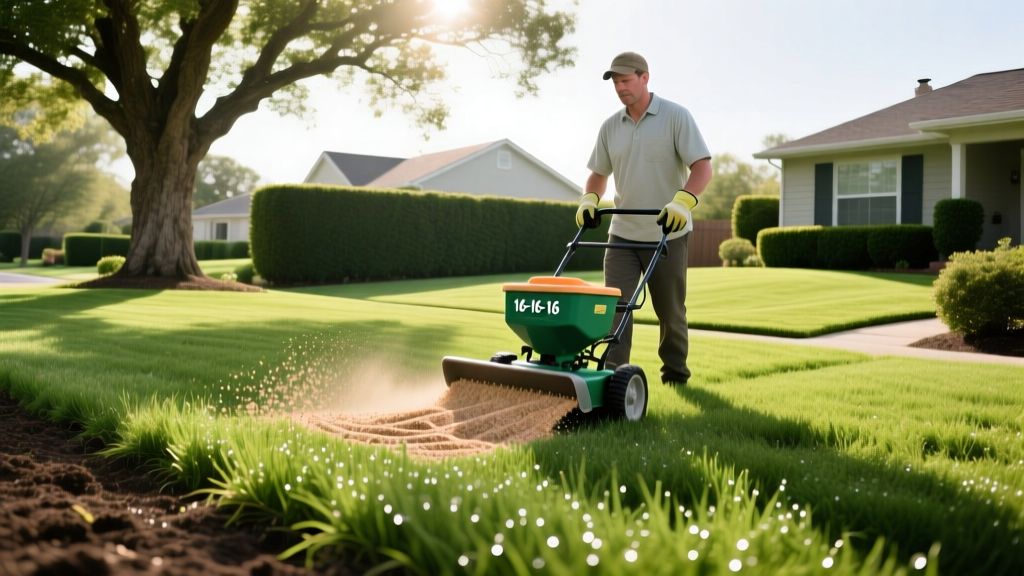
Is 16 16 16 Fertilizer Good for Lawns? Application Guide
The NPK Breakdown: What 16-16-16 Actually Means
A 16-16-16 fertilizer, commonly referred to as "Triple 16," is a balanced, equal-ratio synthetic fertilizer. The numbers represent the percentage by weight of the three primary macronutrients: 16% Nitrogen (N), 16% Phosphorus (P2O5), and 16% Potassium (K2O). In a standard 50-pound bag, this translates to exactly 8 pounds of nitrogen, 8 pounds of phosphorus, and 8 pounds of potassium, with the remaining 26 pounds consisting of inert carrier materials like limestone or sand.
The Golden Rule of Lawn Nutrition: Established turfgrass typically thrives on a 3:1:2 or 4:1:2 NPK ratio (e.g., 32-0-4 or 24-4-8). Applying a 1:1:1 ratio like 16-16-16 to a mature lawn often results in massive phosphorus over-application.
The Verdict: Is Triple 16 Good for Established Lawns?
For the vast majority of established lawns, 16-16-16 fertilizer is the wrong choice. Mature turfgrass requires high nitrogen for blade growth and moderate potassium for drought and cold tolerance, but it requires very little phosphorus once the root system is developed.
The Danger of Phosphorus Buildup and Iron Lockout
Phosphorus is relatively immobile in soil. When you repeatedly apply 16-16-16 to an established lawn, phosphorus accumulates in the topsoil. Excessive soil phosphorus triggers an antagonistic reaction that locks out crucial micronutrients—specifically iron and zinc. This results in iron chlorosis, a condition where your grass turns a sickly, pale yellow despite having adequate nitrogen and water. Furthermore, excess phosphorus binds with calcium, potentially altering your soil pH and requiring costly gypsum amendments to correct.
3 Scenarios Where 16-16-16 Fertilizer is the Perfect Choice
While detrimental to mature lawns, Triple 16 is a powerful tool in specific agronomic scenarios:
- New Seed or Sod Establishment: Phosphorus is critical for early root development (rhizogenesis). Applying 16-16-16 at the time of seeding or laying sod gives young roots the immediate energy required to anchor into the soil profile.
- Severe Soil Deficiency: If a professional soil test reveals your lawn is severely deficient in both phosphorus and potassium (common in newly graded construction sites where topsoil was stripped), 16-16-16 acts as a rapid correction tool.
- Garden-to-Lawn Transitions: When converting a former vegetable garden or flowerbed into a turf area, the soil nutrient profile is usually skewed. A balanced fertilizer helps reset the baseline before transitioning to a high-nitrogen lawn program.
Application Rates and 2026 Cost Breakdown
The universal standard for lawn fertilization is to apply 1 pound of actual Nitrogen per 1,000 square feet. Because 16-16-16 contains 16% nitrogen, you must apply 6.25 pounds of product per 1,000 square feet to hit this target (1.0 / 0.16 = 6.25).
| Fertilizer Category | Example Product | Bag Size | Coverage (at 6.25 lbs/1k) | Avg. Price (2026) | Cost / 1,000 sq ft |
|---|---|---|---|---|---|
| Standard Granular | Store-Brand Triple 16 | 50 lbs | 8,000 sq ft | $35.00 | $4.37 |
| Professional Granular | Andersons 16-16-16 w/ Humic | 50 lbs | 8,000 sq ft | $58.00 | $7.25 |
| Water-Soluble | JR Peters Jack's Pro 16-16-16 | 25 lbs | Varies by dilution | $85.00 | ~$3.50 |
Step-by-Step: Applying Granular 16-16-16 Without Burning Grass
If your soil test dictates the use of Triple 16 for a new lawn installation, follow this precise calibration and application protocol:
- Calculate Total Area: Measure your lawn's square footage. Divide by 1,000, then multiply by 6.25 to find the total pounds of fertilizer needed.
- Set the Spreader: For a standard Scotts EdgeGuard rotary spreader using prilled 16-16-16, start at Setting 5.5. This typically delivers the required 6.25 lbs per 1,000 sq ft. Always verify by weighing the output over a 100 sq ft test area.
- Apply in a Crisscross Pattern: Apply half the required amount walking North-South, and the second half walking East-West. This prevents striping and ensures uniform nutrient distribution.
- Water Immediately: Apply 0.25 inches of irrigation immediately after spreading. This dissolves the salt-based prills, moves the nutrients into the root zone, and prevents foliar burn caused by fertilizer dust sitting on wet grass blades.
⚠️ Environmental Warning: Phosphorus Runoff Laws
Due to the severe impact of phosphorus on freshwater ecosystems—specifically its role in triggering toxic cyanobacteria (blue-green algae) blooms—many states and municipalities strictly prohibit the application of phosphorus-containing fertilizers to established lawns. According to the U.S. Environmental Protection Agency, nutrient runoff is a leading cause of water quality impairment. Always check local ordinances before purchasing 16-16-16; in regions like the Great Lakes basin or the Chesapeake Bay watershed, you may be required to present a recent soil test proving phosphorus deficiency before legally applying Triple 16.
Due to the severe impact of phosphorus on freshwater ecosystems—specifically its role in triggering toxic cyanobacteria (blue-green algae) blooms—many states and municipalities strictly prohibit the application of phosphorus-containing fertilizers to established lawns. According to the U.S. Environmental Protection Agency, nutrient runoff is a leading cause of water quality impairment. Always check local ordinances before purchasing 16-16-16; in regions like the Great Lakes basin or the Chesapeake Bay watershed, you may be required to present a recent soil test proving phosphorus deficiency before legally applying Triple 16.
Soil Testing: The Only Way to Know for Sure
Guessing your soil's nutrient profile is a fast track to wasted money and damaged turf. Before buying any balanced fertilizer, order a soil test from a university extension or a certified private lab.
When reviewing your results, look specifically at the Mehlich-3 or Bray P1 Phosphorus extraction levels. As detailed by the University of Minnesota Extension, if your soil test shows phosphorus levels above 25 parts per million (ppm), adding more phosphorus via 16-16-16 will provide zero agronomic benefit to your grass and will only increase the risk of micronutrient lockout. If your P levels are below 15 ppm, a targeted application of Triple 16 is justified.
Frequently Asked Questions
Can I use 16-16-16 on warm-season grasses like Bermuda or Zoysia?
Only during the initial planting or sprigging phase. Warm-season grasses are aggressive feeders that require high nitrogen during their active summer growth phase. Applying 16-16-16 to a mature Bermuda lawn in July will over-apply phosphorus while under-delivering the nitrogen required for dense lateral growth. Switch to a 30-0-10 or similar high-nitrogen formulation for summer maintenance.
How long does it take to see results after applying 16-16-16?
If applied to newly seeded soil, the benefits of the phosphorus component will manifest underground within 7 to 14 days as accelerated root mass development. Above ground, the nitrogen will trigger visible greening and blade elongation within 5 to 7 days, provided soil temperatures are above 55°F and adequate moisture is present.
Is 16-16-16 the same as "starter fertilizer"?
While often used as a makeshift starter fertilizer, true commercial starter fertilizers usually feature an even higher phosphorus ratio, such as 18-24-6 or 10-18-10, specifically engineered to maximize seedling root strike without excess nitrogen that could burn tender new shoots. Triple 16 is an acceptable substitute if true starter fertilizer is unavailable, but it is not the agronomic ideal.

