
Lawn Care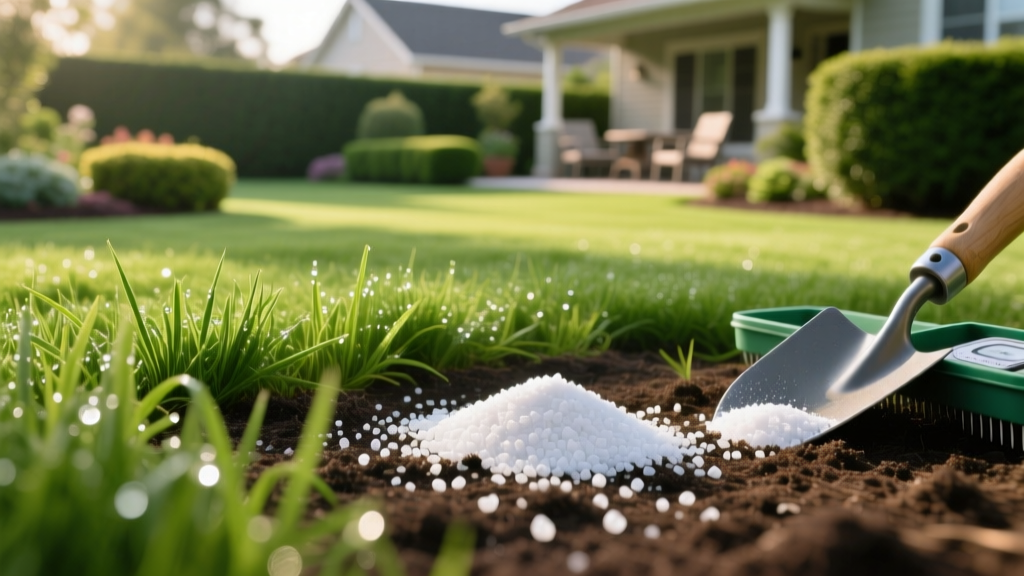
21-0-0 Fertilizer Guide: Using Ammonium Sulfate on Lawns
The Chemistry of 21-0-0: Why Ammonium Sulfate?
When managing turfgrass nutrition, the numbers on the bag only tell half the story. A 21-0-0 fertilizer is universally recognized as ammonium sulfate. It contains 21% nitrogen (N), 0% phosphorus (P), and 0% potassium (K). However, the hidden component that makes this formulation uniquely valuable is its 24% sulfur content. Unlike standard urea or ammonium nitrate, 21-0-0 provides a dual-action mechanism: it delivers immediately available ammoniacal nitrogen while actively acidifying the soil profile and supplying vital secondary macronutrients.
Ammoniacal Nitrogen vs. Urea in Cool Soils
Most synthetic lawn fertilizers rely on urea (46-0-0) as their primary nitrogen source. Urea requires the enzyme urease and active soil microbes to convert into ammonium before the grass can absorb it. In early spring or late fall, when soil temperatures drop below 55°F, microbial activity stalls, rendering urea largely ineffective and prone to runoff.
Because 21-0-0 is already in the ammonium form (NH4+), it bypasses the initial urease conversion step. Turfgrass roots can absorb ammonium directly, even in cold soils. Furthermore, ammonium carries a positive charge, allowing it to bind to negatively charged soil clay particles (cation exchange capacity), preventing it from leaching away during heavy spring rains.
The Sulfur Bonus: Since the passage of the Clean Air Act, atmospheric sulfur deposition has plummeted by over 60%. Many sandy soils and highly leached clay soils are now critically deficient in sulfur. The 24% sulfur in 21-0-0 is essential for synthesizing chlorophyll and amino acids like cysteine and methionine. If your grass is yellowing but soil tests show adequate iron and nitrogen, sulfur deficiency is the likely culprit.
Ideal Lawn Scenarios for 21-0-0 Fertilizer
Ammonium sulfate is not a universal maintenance fertilizer. Its distinct chemical behavior makes it a specialized tool for specific agronomic problems. According to turfgrass management guidelines from the University of Minnesota Extension, 21-0-0 is best reserved for the following scenarios:
1. Correcting Alkaline Soils (pH > 7.2)
When soil pH rises above 7.2, essential micronutrients like iron, manganese, and zinc become chemically locked up, leading to severe interveinal chlorosis (yellowing). The nitrification process of ammonium sulfate releases hydrogen ions (H+) into the soil. Specifically, for every 1 pound of nitrogen applied as ammonium sulfate, the soil generates enough acidity to require approximately 5.3 pounds of calcium carbonate (lime) to neutralize. This makes 21-0-0 a mild, continuous soil acidifier.
2. Centipedegrass and Acid-Loving Turf
Centipedegrass thrives in acidic soils with a pH between 5.0 and 6.0. Applying standard nitrate-based fertilizers to centipedegrass can cause rapid pH spikes and iron chlorosis. 21-0-0 is the industry standard for centipedegrass maintenance because it maintains the low pH environment this specific warm-season grass requires.
3. Early Spring Green-Up for Cool-Season Grasses
For Kentucky bluegrass and perennial ryegrass in northern climates, a light application of 21-0-0 in early spring (when soil temps are 45°F–50°F) provides a rapid green-up without the massive top-growth flush associated with heavily fortified NPK blends.
| Soil pH Range | Turfgrass Type | 21-0-0 Recommendation |
|---|---|---|
| 4.5 - 5.5 | Centipedegrass, Carpetgrass | Highly Recommended (Primary N source) |
| 5.5 - 6.5 | Bermudagrass, Zoysia, Fescue | Use Cautiously (Monitor pH annually) |
| 6.5 - 7.5 | Kentucky Bluegrass, Ryegrass | Recommended (Helps lower high pH) |
| > 7.5 | St. Augustine, Buffalograss | Avoid (Use sulfur-coated urea instead) |
Calculating Application Rates and 2026 Costs
The standard turfgrass requirement is 1.0 pound of actual nitrogen per 1,000 square feet per application. Because 21-0-0 contains 21% nitrogen, the math requires precise calibration.
The Formula: Target N rate (1.0) ÷ Percentage of N (0.21) = 4.76 lbs of product per 1,000 sq ft.
Cost Analysis: As of early 2026, agricultural-grade ammonium sulfate typically retails between $22.00 and $28.00 for a 50-pound bag at rural feed stores or specialized turf suppliers. At 4.76 lbs per 1,000 sq ft, a single 50 lb bag will cover approximately 10,500 square feet. This equates to roughly $0.22 to $0.26 per 1,000 square feet per application, making it one of the most cost-effective nitrogen sources available, provided you do not need the phosphorus or potassium found in more expensive blended fertilizers.
Step-by-Step Application Protocol
Ammonium sulfate prills are generally smaller and denser than standard urea prills. Failure to adjust your spreader will result in overlapping streaks and severe fertilizer burn. Follow this exact protocol:
- Verify Soil pH First: Never apply 21-0-0 without a recent soil test. If your pH is already below 5.8 (for cool-season grasses), applying ammonium sulfate will drive the pH into toxic aluminum-releasing territory.
- Calibrate the Spreader: Ammonium sulfate is heavy. If using a Scotts EdgeGuard rotary spreader, start with a setting of 5.5 to 6.0 for 21-0-0 prills. Always perform a catch-test on a driveway to ensure you are dispensing exactly 4.76 lbs over a measured 1,000 sq ft area.
- Apply to Dry Foliage: Broadcast the 21-0-0 onto dry grass. If the grass is wet from dew, the prills will stick to the blades and cause localized leaf burn.
- Water Immediately: Unlike slow-release methylene urea, ammonium sulfate is highly soluble. You must water the lawn with exactly 0.25 inches of irrigation immediately after application to wash the prills off the leaf tissue and into the soil root zone.
- Clean Hardscapes: Sweep any stray prills off concrete driveways and sidewalks. Ammonium sulfate will react with the calcium in concrete, causing permanent etching and spalling.
Seedling Burn Risk: 21-0-0 has a salt index of 69. While lower than ammonium nitrate (105), it is still high enough to cause osmotic stress on newly germinated seedlings. Do not use 21-0-0 on lawns seeded within the last 45 days. Wait until the turf has been mowed at least three times before applying ammoniacal nitrogen.
21-0-0 vs. Other High-Nitrogen Fertilizers
Understanding how 21-0-0 stacks up against other common straight-nitrogen sources is critical for building an annual turf nutrition program. The Texas A&M Agrilife Extension notes that matching the nitrogen source to your soil's cation exchange capacity (CEC) and pH is the hallmark of advanced turf management.
| Fertilizer | N-P-K | N Source | Soil pH Effect | Volatilization Risk |
|---|---|---|---|---|
| Ammonium Sulfate | 21-0-0 | Ammoniacal | Acidifying (High) | Low |
| Urea | 46-0-0 | Urea | Slightly Acidifying | High (if not watered in) |
| Ammonium Nitrate | 34-0-0 | Ammoniacal / Nitrate | Slightly Acidifying | Low |
| Calcium Nitrate | 15.5-0-0 | Nitrate | Alkaline (Raises pH) | None |
Managing Long-Term Soil Acidification
The most common failure mode when using 21-0-0 fertilizer is ignoring the long-term acidification effect. If you apply 4 pounds of actual nitrogen per 1,000 sq ft annually using exclusively ammonium sulfate, you are introducing enough acidity to require over 21 pounds of lime per 1,000 sq ft just to maintain the baseline pH.
To prevent your soil from becoming toxically acidic, integrate 21-0-0 into a rotational feeding program. Use ammonium sulfate for your early spring and late fall applications when soil microbes are sluggish and sulfur is needed. For your heavy summer feeding applications, switch to a methylene urea or sulfur-coated urea (SCU) product that provides slow-release nitrogen without the aggressive pH drop. Always pair your fertilizer purchases with an annual soil test to track your pH trajectory and base saturation levels.

