
Lawn Care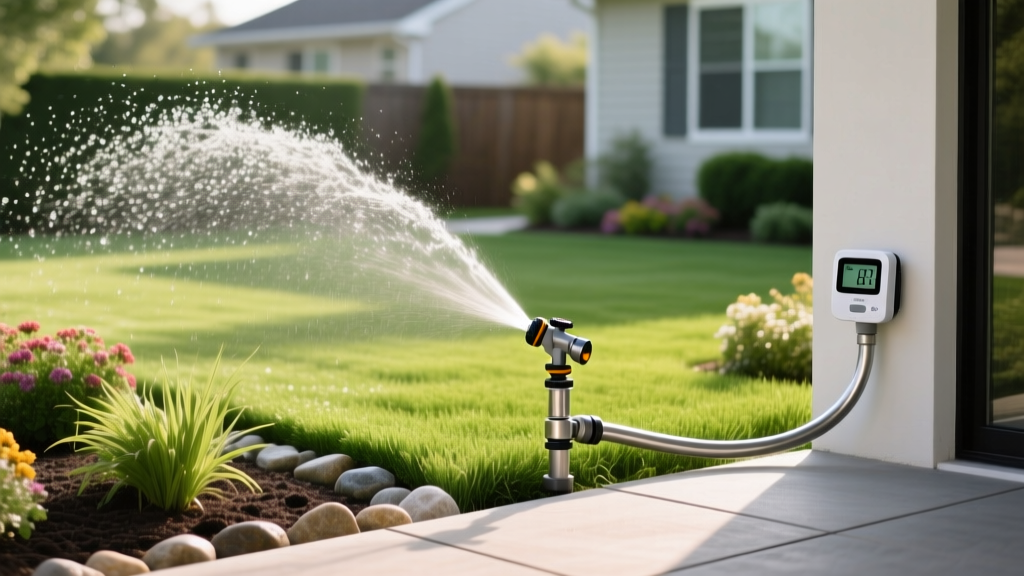
Above Ground Lawn Sprinkler System: Layout, Setup & Smart Timers
Installing an in-ground irrigation system requires trenching, PVC gluing, and a budget that frequently exceeds $3,500. For homeowners seeking precise lawn hydration without the invasive construction, an above ground lawn sprinkler system offers a highly effective, modular alternative. When engineered correctly with proper hose sizing, matched precipitation rates, and smart automation, above-ground setups can deliver water as efficiently as subterranean rotor systems while remaining entirely portable.
2026 Cost Baseline: A complete above ground lawn sprinkler system for a 5,000 sq. ft. yard costs between $180 and $320. This includes two 3/4-inch rubber hoses ($80), three premium sprinkler heads ($90), a 4-way brass manifold ($40), and a Wi-Fi smart hose timer ($110).
The Case for Above-Ground Irrigation
The primary advantage of an above ground lawn sprinkler system is adaptability. Lawn geometries change; you might add a garden bed, expand a patio, or deal with localized soil compaction. In-ground systems are static and expensive to modify. Above-ground components can be reconfigured in minutes. Furthermore, above-ground heads are significantly easier to maintain. When an impact sprinkler jams from mineral buildup, you simply unscrew it from the hose and soak it in white vinegar—no digging required.
According to the EPA WaterSense program, outdoor water use accounts for nearly one-third of total residential water consumption in the United States, with a significant portion lost to evaporation and runoff. An optimized above-ground system mitigates this by allowing you to easily adjust spray patterns and heights to bypass wind drift and target specific turf zones.
Matching Sprinkler Heads to Lawn Geometry
Selecting the correct sprinkler head is not about brand preference; it is about matching the head's precipitation rate (inches per hour) and spray geometry to your lawn's shape and soil absorption rate. Clay soils absorb water at roughly 0.2 inches per hour, while sandy soils can absorb over 0.5 inches per hour. Applying water faster than the soil can absorb it guarantees runoff.
| Sprinkler Type | Best Use Case | Required PSI | Top 2026 Model |
|---|---|---|---|
| Oscillating | Rectangular lawns, wide open spaces | 20 - 40 PSI | Melnor XT Metal 4000 |
| Impact (Spike) | Circular zones, large acreage, windy areas | 30 - 50 PSI | Rain Bird 42SA Spike |
| Traveling | Long, narrow strips, sloped terrain | 40 - 60 PSI | Orbit Traveling Sprinkler |
Pro-Tip on Wind Drift: Oscillating sprinklers shoot water high into the air, making them highly susceptible to wind drift. If you live in a consistently windy region (average afternoon gusts over 10 mph), rely on low-angle impact sprinklers or traveling models that keep the water trajectory below 3 feet.
Calculating Flow Rate and Precipitation
The most common failure mode in above ground lawn sprinkler systems is overlapping zones with mismatched precipitation rates. If you run an oscillating sprinkler (which applies water at ~0.5 inches/hour) on the same timer schedule as a traveling sprinkler (~0.2 inches/hour), one zone will drown while the other starves.
The Catch-Cup Calibration Method
Forget the outdated 'tuna can' test. Tuna cans have ridges that distort water measurement. Use straight-sided plastic catch cups (available at irrigation supply stores for about $2 each).
- Grid Placement: Place 6 to 8 catch cups in a grid pattern across the sprinkler's intended coverage zone, spacing them 4 to 5 feet apart.
- Timed Run: Turn on the sprinkler and run it for exactly 15 minutes. Ensure your hose bib is fully open.
- Measure and Average: Use a ruler to measure the water depth in each cup in inches. Add the measurements together and divide by the number of cups to find the average depth.
- Calculate Hourly Rate: Multiply the 15-minute average by 4. If your average is 0.15 inches, your precipitation rate is 0.60 inches per hour.
According to Colorado State University Extension, cool-season lawns typically require 1 to 1.5 inches of water per week during peak summer. If your system outputs 0.6 inches per hour, you need to run that specific zone for 2.5 hours per week, split across two or three watering days to prevent runoff.
The Hidden Variable: Hose Diameter and Friction Loss
An above ground lawn sprinkler system is only as good as the hose feeding it. Most homeowners use standard 5/8-inch vinyl hoses, which is a critical mistake for irrigation. Water moving through a hose experiences friction, which drops the pressure (PSI) and flow (GPM) by the time it reaches the sprinkler head.
If your spigot outputs 10 GPM at 50 PSI, pushing that water through 100 feet of 5/8-inch hose will result in a pressure drop of nearly 15 PSI. Your impact sprinkler at the end of the line will only see 35 PSI, causing it to stall or fail to complete its rotation. The fix: Use a 3/4-inch heavy-duty rubber hose (like the Gilmour Flexogen or Craftsman Premium Rubber) for your main trunk lines. A 3/4-inch hose reduces that same friction loss to roughly 4 PSI, ensuring your sprinkler heads receive the pressure they require to operate at peak efficiency.
Automating with Smart Hose Timers
Manual twisting of spigots leads to overwatering and wasted money. Modern smart hose timers connect to your home Wi-Fi and adjust watering schedules based on hyper-local weather data, pausing irrigation when rain is in the forecast.
Orbit B-hyve XR
Price: ~$110 (2-Zone)
Pros: Excellent weather intelligence, integrates with smart home ecosystems, physical override dial on the unit.
Cons: App interface can be cluttered; requires a strong 2.4GHz Wi-Fi signal at the spigot.
Rachio 3 Hose Timer
Price: ~$130 (1-Zone)
Pros: Best-in-class app UI, highly accurate local weather APIs, seamless integration with Rachio flow meters for leak detection.
Cons: Higher price point per zone; physical buttons are less intuitive than a dial.
Common Failure Modes and Troubleshooting
Even well-designed above ground lawn sprinkler systems encounter mechanical and environmental issues. Here is how to diagnose and fix the most frequent edge cases.
- Sprinkler Fails to Rotate (Impact Heads): Usually caused by debris in the bearing seal or insufficient water pressure. Fix: Remove the head, flush the hose for 10 seconds to clear sediment, and check your PSI. If PSI is below 30, switch to a lower-flow nozzle (e.g., from 1.5 GPM to 1.0 GPM) to increase localized pressure.
- Oscillator Stalls Mid-Sweep: The internal water turbine is clogged with hard water scale. Fix: Submerge the sprinkler base in a 50/50 mix of white vinegar and warm water for two hours. Do not use chemical descalers, which can degrade the internal rubber O-rings.
- Puddling at the Sprinkler Base: The hose connection is leaking due to thermal expansion. Fix: Replace standard plastic washers with heavy-duty brass quick-connects and use double O-ring rubber gaskets. Brass expands and contracts at a much lower rate than plastic under direct summer sun.
Pro-Tip: The Manifold Hack for Multi-Zone Watering
If you have a high-flow spigot (12+ GPM) and want to run two impact sprinklers simultaneously to cut watering time in half, do not use cheap plastic Y-splitters. They restrict flow and crack under UV exposure. Invest in a solid brass 4-way manifold with individual quarter-turn ball valves (such as the Melnor Brass 4-Way Splitter, ~$35). This allows you to balance the flow between two hoses, ensuring both sprinklers receive equal pressure without starving one another.
Frequently Asked Questions
Can I leave my above ground sprinkler system out during winter?
No. Even premium brass and metal sprinklers contain internal water chambers that will freeze, expand, and crack the housing when temperatures drop below 32°F. Disconnect all hoses, drain the sprinkler heads by shaking out residual water, and store them in a garage or shed. Hoses should be drained and coiled loosely to prevent kink-memory formation.
How do I prevent my hose from kinking when dragging it across the lawn?
Kinking is primarily a material and temperature issue. Vinyl hoses become rigid and prone to kinking in cool morning temperatures. Rubber hoses remain pliable. Additionally, always pull the hose from the sprinkler end rather than dragging it from the spigot end, which twists the hose along its longitudinal axis and creates structural weak points.
Is an above ground system viable for sloped lawns?
Yes, but you must adjust your watering strategy. On slopes greater than a 5% grade, water will run off before it penetrates the root zone. Use a 'cycle and soak' method via your smart timer: run the sprinkler for 10 minutes, pause for 30 minutes to allow absorption, and repeat. Traveling sprinklers are particularly effective on slopes because their slow, continuous movement prevents localized pooling.

