
Lawn Care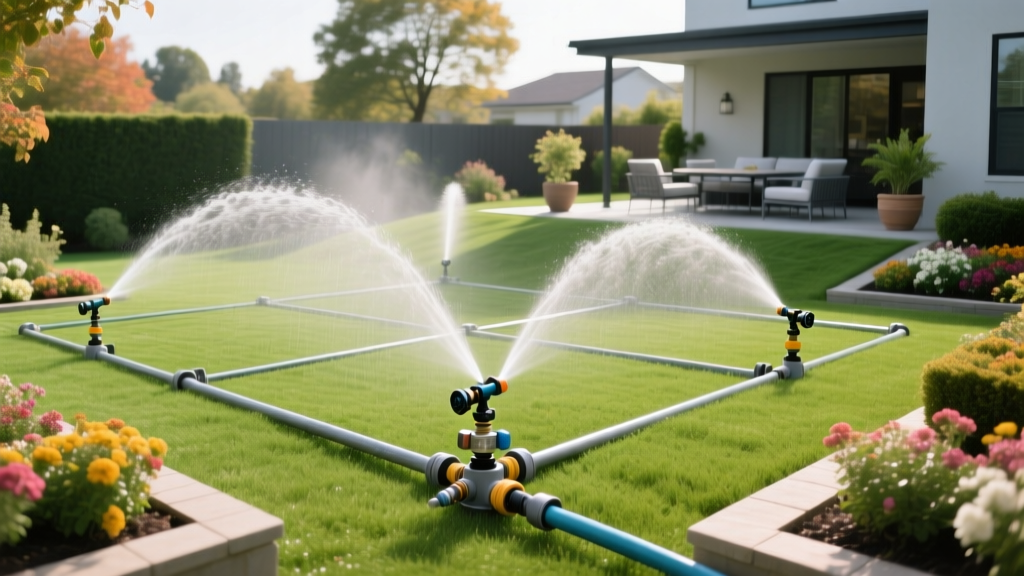
Above Ground Sprinkler Systems: Layout, Spacing, and Setup Guide
The Case for Above Ground Irrigation
While in-ground PVC systems dominate new construction, above ground sprinkler systems remain the most practical, cost-effective solution for established lawns, rental properties, and homeowners avoiding the $3,500 to $6,000 excavation costs of buried infrastructure. When engineered correctly using modern poly tubing and smart hose timers, an above ground setup can deliver the exact same head-to-head uniformity as a subterranean system, but with zero trenching and complete seasonal portability.
System Cost Comparison (Average 5,000 sq ft Lawn):
- Professional In-Ground PVC: $4,500 - $6,500
- DIY In-Ground PVC: $1,800 - $2,500 (plus heavy excavation labor)
- Above Ground Poly/Hose System: $350 - $600 (fully automated with smart timers)
Step 1: Measure Your Static Water Pressure and Flow Rate
The most common failure point in above ground sprinkler systems is attempting to run too many heads on a single spigot without verifying the source water metrics. You must establish your Gallons Per Minute (GPM) and Pounds per Square Inch (PSI) before purchasing any sprinkler heads.
The 5-Gallon Bucket Flow Test
- Ensure no other water fixtures in the house are running (dishwashers, washing machines, showers).
- Place a standard 5-gallon bucket directly under your outdoor hose bib.
- Turn the spigot on fully and start a stopwatch simultaneously.
- Stop the watch the exact moment the water reaches the 5-gallon fill line.
- Calculate GPM: Divide 300 by your total seconds. (e.g., 300 / 45 seconds = 6.6 GPM).
Most residential 3/4-inch hose bibs deliver between 5 and 8 GPM at 50-65 PSI. If your flow rate is below 5 GPM, you will need to design smaller zones with low-flow rotary nozzles rather than high-volume impact sprinklers.
Step 2: Select Sprinkler Heads by Zone Geometry
Achieving uniform coverage requires matching the sprinkler head's trajectory and precipitation rate to your lawn's specific geometry. According to irrigation design principles outlined by Colorado State University Extension, overlapping spray patterns (head-to-head coverage) are mandatory to prevent dry spots between zones.
| Sprinkler Type | Recommended Model | Max Range | Avg GPM | Best Application |
|---|---|---|---|---|
| Oscillating | Melnor XT4200 | 4,200 sq ft | 4.5 - 6.0 | Wide, open rectangular lawns |
| Rotary Rotor | Rain Bird 32SA | 24 ft radius | 1.5 - 3.0 | Curved edges, irregular boundaries |
| Impact Sprinkler | Orbit 58322 | 85 ft diameter | 5.0 - 7.5 | Large, open square acreage |
| Whirling Rotary | Gilmour 800 | 30 ft diameter | 2.0 - 3.5 | Small patches, low-pressure zones |
Step 3: Pipe Sizing and Manifold Configuration
Friction loss is the silent killer of above ground sprinkler systems. As water travels through a hose or poly tubing, friction against the inner walls reduces the available pressure at the sprinkler head. Most homeowners default to standard 5/8-inch or 3/4-inch garden hoses, which creates massive pressure drops over distance.
The Friction Loss Math
If you are pushing 6 GPM through 50 feet of tubing:
- 3/4-inch Poly Tubing: Loses approximately 11.5 PSI over 50 feet.
- 1-inch Poly Tubing: Loses only 1.5 PSI over 50 feet.
Actionable Fix: Use 1-inch black polyethylene tubing (often sold as rural water pipe) as your main trunk line from the spigot. Use a brass 1-inch to 3/4-inch reducer only at the final connection point to the sprinkler head. This preserves your static pressure and allows you to run up to three rotary heads simultaneously on a single trunk line via a 3-way manifold splitter.
Step 4: Automating with Smart Hose Timers
Manual valve turning leads to overwatering and fungal diseases like brown patch. Modern smart hose timers connect to local weather stations via Wi-Fi, automatically skipping watering cycles when rain is forecast. The EPA WaterSense program notes that weather-based smart controllers can reduce outdoor water use by up to 20% compared to standard clock timers.
Recommended Smart Timers for Current Setups
Orbit B-hyve XD (Model 21045)
Price: $75 - $90
Features: Wi-Fi enabled, WeatherSense technology, heavy-duty brass swivel inlet. Best for single-zone above ground systems requiring precise flow adjustments.
Melnor Wi-Fi AquaTimer (Model 71016)
Price: $80 - $95
Features: 4-zone capability with individual solenoid valves. Ideal for complex above ground layouts requiring four distinct watering schedules from a single spigot.
Overcoming Low Pressure Edge Cases
If your bucket test reveals a flow rate under 4 GPM, standard impact and oscillating sprinklers will fail to achieve their advertised radius, resulting in a concentrated donut of water directly around the head. To fix this without upgrading your municipal water line:
- Switch to MP Rotator Nozzles: While typically used in PVC systems, you can buy MP Rotator stand-alone spike bases. These apply water at 0.4 inches per hour (compared to 1.5 inches per hour for standard sprays), allowing low-flow systems to run longer without runoff.
- Install a Booster Pump: A 1/2 HP shallow well jet pump (like the Flotec FP4012, approx. $180) can be plumbed inline between your spigot and your 1-inch poly trunk line, artificially boosting your PSI from 40 to 65, ensuring full rotor extension.
Winterization and Storage Protocol
Unlike buried PVC systems that require blow-outs with industrial air compressors, above ground systems require complete drainage to prevent freeze-thaw cracking of plastic housings.
'Never leave water trapped inside the internal diaphragm of a hose timer during freezing temperatures. Even a few ounces of expanding ice will fracture the brass inlet or crack the plastic solenoid housing, rendering a $80 smart timer useless by spring.' — Texas A&M AgriLife Extension
End-of-Season Checklist
- Disconnect all smart timers and store them indoors in a climate-controlled space.
- Elevate one end of all poly tubing and garden hoses to gravity-drain residual water.
- Bring oscillating sprinklers inside; the internal gear tracks will crack if water freezes inside the chassis.
- Leave brass impact sprinklers and rotary rotors outdoors if desired, but ensure they are fully drained and stored upside down in a shed to prevent debris accumulation in the nozzle orifices.

