
Lawn Care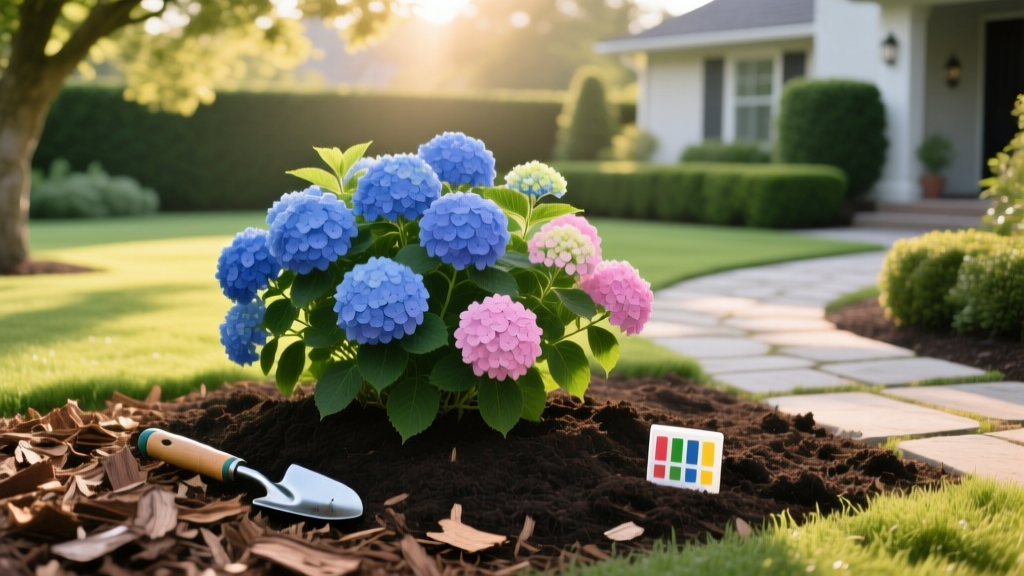
Mastering Hydrangeas Soil pH: Mulch and Amendment Guide
The Science of Hydrangeas Soil pH and Bloom Color
Unlike most garden shrubs, the bloom color of Hydrangea macrophylla (bigleaf) and Hydrangea serrata (mountain) is not genetically fixed. It is dictated by the availability of aluminum ions (Al³⁺) in the soil, which is strictly controlled by your hydrangeas soil pH. Aluminum is the pigment catalyst; without it, blooms default to pink or red. When the soil pH drops below 5.5, aluminum becomes soluble and is absorbed by the roots, turning the sepals blue. When the pH rises above 6.5, aluminum binds to phosphorus and becomes locked up, resulting in pink blooms.
pH to Color Data Matrix:
- pH 4.5 – 5.4: Deep, vibrant blue (high aluminum availability).
- pH 5.5 – 6.4: Purple, mauve, or muddy mixtures (transitional aluminum uptake).
- pH 6.5 – 7.5: Clear, vibrant pink (aluminum locked up).
Step-by-Step Soil Testing Protocol
Do not rely on cheap, dye-based soil test kits from big-box stores; their margin of error is often ±1.0 pH, which is useless for precision color tuning. Accurate adjustment requires precise baseline data.
Recommended Testing Methods
- University Extension Labs: Mail a 1-cup composite soil sample (taken from 4 inches deep across the root zone) to a lab like the UMass Soil and Plant Nutrient Testing Laboratory. For roughly $20, you receive exact pH, buffer pH, and cation exchange capacity (CEC) data.
- Professional Digital Meters: If you manage multiple hydrangea beds, invest in the Bluelab Soil pH Pen (retailing around $110). It features a replaceable double-junction probe and ATC (Automatic Temperature Compensation), providing lab-grade accuracy in 15 seconds.
Lowering pH (Acidifying) for Blue Blooms
If your soil tests above 6.0 and you want blue blooms, you must lower the pH and ensure aluminum is present. There are two primary chemical pathways to achieve this, each with distinct timelines and risks.
Elemental Sulfur (The Safe, Long-Term Route)
Elemental sulfur requires soil bacteria (Thiobacillus) to oxidize it into sulfuric acid. This biological process means it takes 3 to 6 months to see a pH drop. Products like Espoma Organic Soil Acidifier (30% sulfur) are the industry standard.
- Application Rate: 3/4 cup per 10 square feet to lower pH by 1.0 point.
- Timing: Apply in early spring and again in late fall. Incorporate lightly into the top 2 inches of mulch/soil without damaging shallow hydrangea roots.
Aluminum Sulfate (The Fast, High-Risk Route)
Aluminum sulfate dissolves instantly, dropping pH within weeks while simultaneously flooding the soil with aluminum. However, it carries a severe risk of aluminum toxicity, which manifests as marginal leaf necrosis and root burn.
Warning: Never exceed 1/2 pound of aluminum sulfate per 10 square feet in a single application. If your soil already contains high baseline aluminum (common in clay-heavy native soils), avoid aluminum sulfate entirely and use elemental sulfur instead.
Raising pH (Alkalizing) for Pink Blooms
To lock up aluminum and force pink blooms, you must raise the hydrangeas soil pH above 6.5. Avoid wood ashes, which contain unpredictable levels of potassium and heavy metals that can disrupt soil structure. Instead, use agricultural limes.
- Calcitic Lime (Calcium Carbonate): Use products like Pennington Fast Acting Lime. This is the default choice for raising pH. Apply 1 cup per 10 square feet to raise pH by 1.0 point.
- Dolomitic Lime (Calcium + Magnesium Carbonate): Only use this if your university soil test explicitly indicates a magnesium deficiency. Excess magnesium can compete with calcium uptake, leading to blossom end rot in nearby vegetable gardens and nutrient lockout in shrubs.
Amendment Application Matrix and Timelines
| Amendment | Target pH Shift | Rate (per 10 sq ft) | Time to React | Longevity |
|---|---|---|---|---|
| Elemental Sulfur | Lower by 1.0 | 3/4 cup | 3 – 6 months | 1 – 2 years |
| Aluminum Sulfate | Lower by 1.0 | 1/2 cup (max) | 2 – 4 weeks | 3 – 6 months |
| Calcitic Lime | Raise by 1.0 | 1 cup | 2 – 3 months | 1 – 3 years |
| Dolomitic Lime | Raise by 1.0 | 1 cup | 3 – 4 months | 2 – 4 years |
The Role of Mulch in Long-Term pH Buffering
Mulch is not just for moisture retention; it acts as a slow-release pH buffer in the rhizosphere. As organic mulches decompose, they release organic acids and alter the cation exchange capacity of the topsoil. According to research from the Clemson University Home & Garden Information Center, matching your mulch to your target pH reduces the frequency of chemical amendments.
Mulch Selection for Blue Blooms (Acidic)
- Pine Bark Nuggets / Pine Needles: While the myth that pine needles drastically acidify soil is exaggerated (they only drop pH by roughly 0.2 as they break down), they are excellent for maintaining an already acidic profile without adding alkaline buffers.
- Oak Leaf Mold: High in tannins and naturally acidic, making it a premium top-dressing for blue hydrangea beds.
Mulch Selection for Pink Blooms (Alkaline)
- Hardwood Bark Mulch: As hardwood decomposes, it tends to push soil pH slightly toward neutral or alkaline, supporting pink color retention.
- Mushroom Compost: Often boasts a pH between 7.0 and 7.5. Applying a 1-inch layer annually will slowly buffer acidic soils upward, reducing the need for heavy lime applications.
Hydrangea Species That Ignore Soil pH
Before purchasing amendments, verify your hydrangea species. The pH-to-color mechanism only applies to macrophylla and serrata varieties. The following species will remain white, cream, or green regardless of how much sulfur or lime you apply:
- Hydrangea paniculata (e.g., 'Limelight', 'Bobo'): Blooms age from white to pink/red due to anthocyanin expression triggered by cool autumn nights, not soil chemistry.
- Hydrangea arborescens (e.g., 'Annabelle', 'Incrediball'): Strictly white or pale green.
- Hydrangea quercifolia (Oakleaf): White blooms that age to dusty rose; foliage turns crimson in fall.
For these species, abandon color-chasing and maintain a hydrangeas soil pH between 5.5 and 6.5 to optimize overall nutrient uptake and prevent iron chlorosis.
Frequently Asked Questions
Can I use coffee grounds to lower hydrangeas soil pH?
No. Used coffee grounds have a pH of roughly 6.5 (near neutral) because the acidic compounds are water-soluble and end up in your cup. They will not lower soil pH enough to turn hydrangeas blue, though they are a fine nitrogen-rich compost additive.
Why did my blue hydrangea turn pink after mulching?
If you used municipal compost or hardwood bark mulch, the decomposition process likely introduced calcium carbonates, raising the pH above 6.0 and locking up the aluminum. Switch to pine bark and apply elemental sulfur to reverse the shift.

