
Lawn Care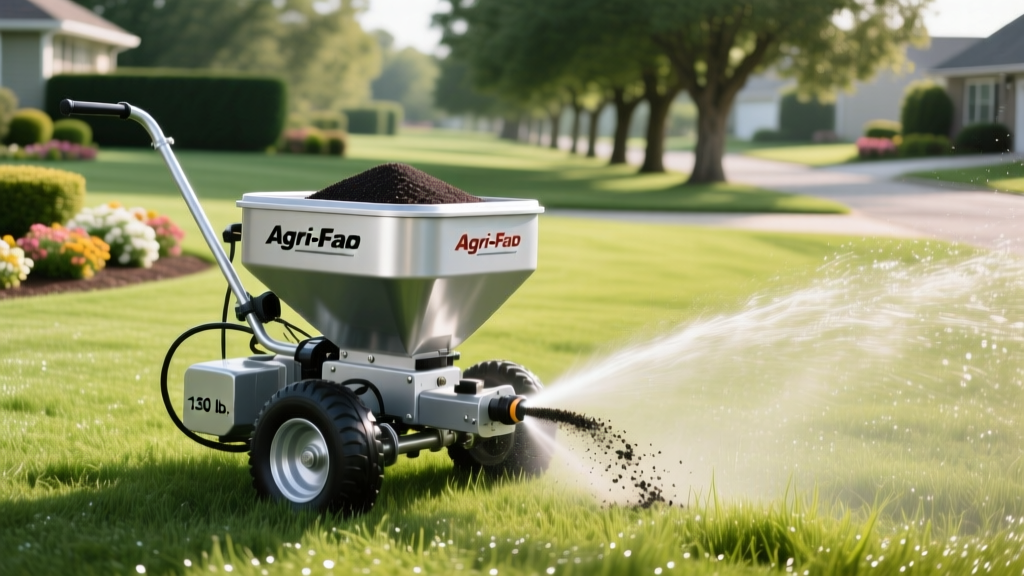
Agri-Fab 130 lb. Tow Behind Broadcast Spreader: 2026 Coverage & Cost Guide
Managing properties that exceed one acre requires a shift from manual push equipment to tractor-mounted implements. The Agri-Fab 130 lb. tow behind broadcast spreader (commonly referenced under model series 45-0543) remains a benchmark for mid-to-large residential estates and small commercial plots. With a 12-foot broadcast swath and a high-capacity polyethylene hopper, it drastically reduces application time. However, owning the equipment is only the first step; understanding precise dosage calibration, real-world coverage limitations, and long-term operational costs is what separates a healthy lawn from a chemically burned one.
2026 Pricing and Cost-to-Coverage Analysis
As of early 2026, the retail price for the Agri-Fab 130 lb. tow behind broadcast spreader fluctuates between $380 and $430, depending on seasonal promotions and retailer inventory. When evaluating this cost, it is essential to measure it against the cost-per-acre application compared to push spreaders.
ROI Decision Framework: If your usable lawn area is under 0.75 acres, a $120 push broadcast spreader is more economical and maneuverable. If your property exceeds 1 acre of open turf, the Agri-Fab 130 lb. model pays for itself in time savings within three applications, reducing a 4-hour push job to a 45-minute tow operation.
Hopper Capacity vs. Real-World Coverage
The 130 lb. hopper capacity is a hard physical limit, but the actual square footage covered per load depends entirely on the material's density and the required application rate. Many homeowners mistakenly assume a full hopper equals one full acre of coverage. The math tells a different story.
Material Coverage Matrix (Per Full 130 lb. Load)
| Material Type | Standard Application Rate | Sq. Ft. Covered per 130 lbs | Approx. Acreage per Load |
|---|---|---|---|
| Synthetic Fertilizer (e.g., 24-0-6) | 3.2 lbs / 1,000 sq ft | 40,625 sq ft | 0.93 Acres |
| Tall Fescue Grass Seed | 5.0 lbs / 1,000 sq ft | 26,000 sq ft | 0.60 Acres |
| Kentucky Bluegrass Seed | 2.5 lbs / 1,000 sq ft | 52,000 sq ft | 1.19 Acres |
| Pelletized Lime | 40.0 lbs / 1,000 sq ft | 3,250 sq ft | 0.07 Acres |
| Ice Melt (Winter Use) | 15.0 lbs / 1,000 sq ft | 8,666 sq ft | 0.20 Acres |
Note: Pelletized lime is exceptionally dense and requires heavy application rates. Expect to refill the 130 lb. hopper 12 to 15 times to treat a single acre for severe soil acidity.
Precision Dosage: The 100-Foot Calibration Method
Relying solely on the manufacturer's dial settings (usually numbered 1 through 10) is a recipe for over-application. Manufacturing tolerances, material humidity, and tire pressure alter the output. According to turfgrass management protocols outlined by the University of Minnesota Extension, physical calibration is mandatory before every new material application.
- Measure a Test Strip: Mark off a straight 100-foot distance on your driveway or a flat section of turf.
- Calculate Target Area: The Agri-Fab broadcasts a 12-foot wide swath. 100 ft (length) × 12 ft (width) = 1,200 square feet of coverage.
- Determine Required Ounces: Check your product label for the rate per 1,000 sq ft. If the bag requires 3.5 lbs per 1,000 sq ft, multiply by 1.2 to get the requirement for 1,200 sq ft (4.2 lbs, or 67.2 ounces).
- Weigh the Catch: Place a clean bucket or tarp beneath the spreader. Fill the hopper with your material, set the dial to the recommended starting point, and engage the PTO/lever while pushing the spreader manually over the 100-foot distance.
- Weigh and Adjust: Weigh the captured material. If you caught 75 ounces, your dial is open too far. Adjust down, reset the bucket, and test again until you hit exactly 67.2 ounces.
Warning: Never calibrate over the lawn. Spilling concentrated fertilizer during the testing phase will result in severe nitrogen burn, leaving yellow or brown streaks that can take months to recover.
Operational Costs and Maintenance Breakdown
The initial $400 purchase price is only the beginning of the cost lifecycle. Tow-behind spreaders endure significant mechanical stress, particularly in the drivetrain. The Agri-Fab 130 lb. model utilizes an enclosed gearbox to protect the internal gears from corrosive fertilizers, a critical upgrade over older open-chain designs.
Annual Maintenance Ledger
- Grease and Lubrication ($15/year): The axle bearings and gearbox require lithium-based grease annually. Neglecting this leads to axle seizure, a $60+ repair.
- Tire Pressure Management ($0 cost, high impact): The 16-inch pneumatic tires must be kept at exactly 20 PSI. A 3 PSI difference between the left and right tire will cause the spreader to pull, creating overlapping 'windrows' of double-applied fertilizer.
- Corrosion Prevention ($25/year): Despite the poly hopper, the steel frame and impeller shaft are vulnerable. Washing the unit with a low-pressure hose (never a pressure washer, which forces water into the gearbox seals) and applying a silicone-based rust inhibitor post-wash is mandatory.
Troubleshooting Uneven Spread Patterns
Even with perfect calibration, field conditions can disrupt the broadcast pattern. The Texas A&M AgriLife Extension notes that visual streaking in the turf is almost always a mechanical or operational failure, not a chemical one.
Symptom: Heavy Windrows on the Left Side
Cause: The impeller is spinning counter-clockwise. If the left side is heavier, the right-side deflector may be bent, or the gearbox is experiencing internal drag on the right-side gear. Check the impeller fins for caked, hardened fertilizer from previous seasons.
Symptom: Alternating Dark and Light Green Stripes
Cause: Incorrect overlapping. A 12-foot broadcast pattern does not mean you should space your tractor tire tracks exactly 12 feet apart. The edges of a broadcast pattern receive 30% to 40% less material than the center. You must overlap each pass by 2 to 3 feet (roughly 25% overlap) to achieve a uniform distribution.
Symptom: Clumping and Surging Material
Cause: High humidity or poor storage. Fertilizers like urea are highly hygroscopic (they absorb moisture from the air). If left in the hopper overnight, or if the product was stored in an unsealed bag in a damp garage, it will bridge inside the 130 lb. hopper and then collapse, dumping 20 lbs of material in a single spot. Always use an agitator or physically break up clumps before loading.
Final Verdict for Large Property Managers
The Agri-Fab 130 lb. tow behind broadcast spreader is a high-utility implement that bridges the gap between residential push units and $2,000+ commercial zero-turn mounted spreaders. For properties ranging from 1 to 4 acres, its 12-foot swath and 130 lb. capacity offer the optimal balance of coverage speed and material efficiency. By adhering to strict 100-foot calibration protocols and maintaining consistent tire pressures, homeowners can achieve professional-grade turf health while keeping long-term operational costs well under $50 annually.

