
Lawn Care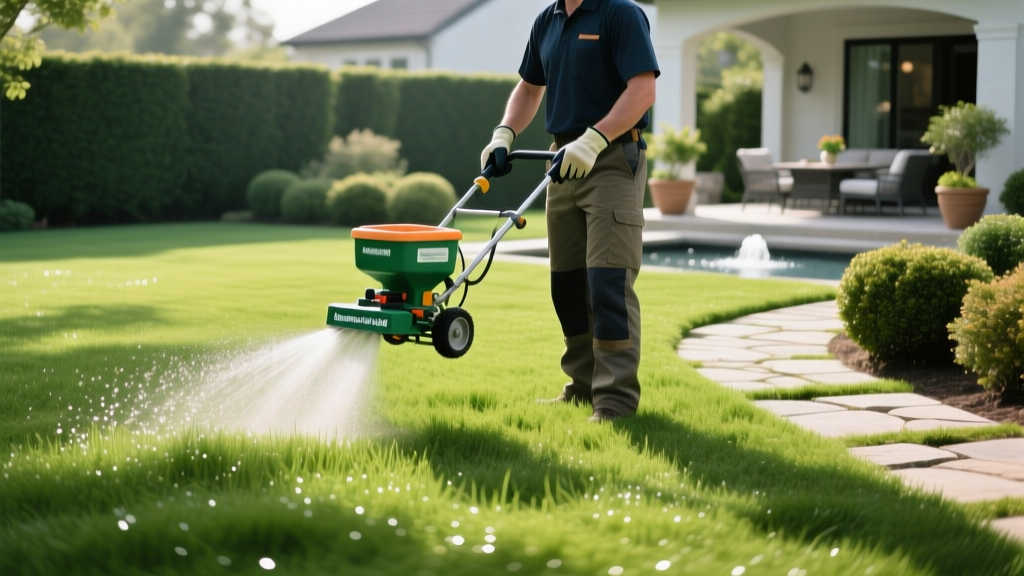
AMS Fertilizer for Lawns: How to Use Ammonium Sulfate Safely
What is AMS Fertilizer? The 21-0-0 Profile
AMS fertilizer, chemically known as ammonium sulfate, is a highly soluble, fast-acting inorganic nitrogen source widely used in professional turf management and residential lawn care. Its NPK ratio is strictly 21-0-0, meaning it delivers 21% nitrogen and zero phosphorus or potassium. However, the hidden value of AMS lies in its secondary macronutrient profile: it contains approximately 24% sulfur in the sulfate form.
The Chemistry of AMS: When ammonium sulfate dissolves in soil moisture, it dissociates into two ammonium ions (NH4+) and one sulfate ion (SO4 2-). The grass roots can absorb the ammonium directly, but soil bacteria also convert it into nitrate (NO3-) through a process called nitrification. This nitrification process releases hydrogen ions (H+) into the soil, which is why AMS has a pronounced acidifying effect.
Unlike slow-release organic fertilizers that take weeks to show results, AMS provides an immediate flush of available nitrogen. This makes it an exceptional choice for rapid spring green-up, recovering damaged turf, or correcting nitrogen deficiencies in high-pH (alkaline) soils where other nutrients might be locked up.
AMS vs. Urea vs. Ammonium Nitrate: A Turf Manager's Comparison
Selecting the right nitrogen source requires understanding how each chemical interacts with your specific soil environment. According to NC State TurfFiles, matching the fertilizer to your soil's pH and cation exchange capacity (CEC) is critical for preventing nutrient loss and turf burn.
| Feature | AMS (21-0-0) | Urea (46-0-0) | Ammonium Nitrate (34-0-0) |
|---|---|---|---|
| Nitrogen Content | 21% | 46% | 34% |
| Sulfur Content | 24% (High) | 0% | 0% |
| Burn Potential | Moderate (High salt index) | High (Requires immediate watering) | Very High |
| Soil pH Impact | Strongly Acidifying | Mildly Acidifying | Mildly Acidifying |
| Volatilization Risk | Low | High (if left on surface) | Low |
The primary advantage of AMS over urea is its low volatilization risk. Urea can off-gas into the atmosphere as ammonia if it sits on the soil surface without being watered in, especially in warm weather. AMS remains stable in the soil matrix, making it a safer bet for homeowners who cannot irrigate immediately after application.
Calculating Exact Application Rates
The most common mistake homeowners make with AMS fertilizer is applying it at the same volume as standard 4-1-2 or 3-1-2 lawn fertilizers. Because AMS is a concentrated, single-nutrient product, you must calculate the application based on desired nitrogen delivery.
The 1-Pound Nitrogen Rule
Turfgrass generally requires 0.5 to 1.0 pounds of actual nitrogen per 1,000 square feet per application. To deliver exactly 1 pound of nitrogen using AMS (21% N), use this formula:
100 ÷ 21 = 4.76 pounds of AMS per 1,000 square feet.
If you have a 5,000 square foot lawn and want to apply 1 lb of N per 1,000 sq ft, you will need exactly 23.8 pounds of AMS fertilizer. A standard 50-pound bag will cover approximately 10,500 square feet at this maximum rate.
Step-by-Step Application Protocol
Ammonium sulfate has a relatively high salt index (69). If applied to dry turf and left to sit in hot sun, it will draw moisture out of the grass blades, causing severe fertilizer burn. Follow this protocol to ensure safe, effective absorption.
- Test Soil pH First: AMS lowers soil pH. It is ideal for lawns with a pH between 7.0 and 8.0 (common in arid western states or soils with high clay/limestone content). If your soil pH is already below 6.0, avoid AMS; use calcium nitrate or a pH-neutral slow-release nitrogen instead.
- Mow Before Application: Cut your grass to its standard height and remove heavy clippings to ensure the granules reach the soil surface rather than getting trapped in the thatch layer.
- Calibrate Your Spreader: For a standard Scotts rotary spreader, a setting of 5 to 6 typically delivers the correct volume for AMS granules. Always perform a test pass on a driveway to verify the spread pattern and sweep up any granules to prevent concrete staining.
- Apply in Split Passes: Apply half the required amount walking north-to-south, and the other half walking east-to-west. This cross-hatching prevents striping and ensures uniform coverage.
- Water Immediately: Apply 0.25 inches of irrigation immediately after spreading. This dissolves the granules, moves the ammonium into the root zone, and completely eliminates the risk of foliar burn.
Strategic Timing: When to Use Ammonium Sulfate
Because AMS is a quick-release fertilizer, it causes a rapid surge in top-growth. Timing this surge is critical for turf health.
- Warm-Season Grasses (Bermuda, Zoysia, Centipede): Apply AMS in late spring (May/June) to push the grass out of winter dormancy quickly, or in late summer (August) to aid recovery from summer stress before fall. Avoid applying during peak July heat, as the salt stress combined with drought can damage the turf.
- Cool-Season Grasses (Fescue, Kentucky Bluegrass, Ryegrass): Use AMS in early spring (April) for a rapid green-up, or in late fall (November) to stimulate root growth before winter dormancy. Never use quick-release nitrogen on cool-season grasses during the heat of summer, as it forces vulnerable top-growth when the plant needs to conserve energy.
Managing the Acidifying Effect Over Time
According to soil management guidelines from the University of Minnesota Extension, continuous use of ammonium-based fertilizers will progressively lower soil pH. For every 100 pounds of actual nitrogen applied via AMS, the soil pH can drop by 0.1 to 0.3 units, depending on the soil's buffering capacity (CEC). If you rely heavily on AMS, you must test your soil annually and apply pelletized lime (calcium carbonate) to neutralize the acidity once the pH drops below 6.2.
2026 Pricing and Sourcing
As of early 2026, agricultural and turf-grade AMS fertilizer remains one of the most cost-effective nitrogen sources on the market, though prices fluctuate with global sulfur and natural gas markets. Expect to pay between $18 and $28 for a 50-pound bag at local agricultural co-ops, SiteOne Landscape Supply branches, or rural retailers like Tractor Supply Co. Big-box home improvement stores rarely carry pure 21-0-0 AMS, as they favor blended, slow-release consumer products.
Pro Tip for Bulk Buyers: If you manage over an acre of turf, purchase AMS in 2,000-pound super sacks from local farm co-ops. The cost per pound of nitrogen drops by nearly 40% compared to bagged retail pricing, but you will need a tractor or heavy-duty spreader to handle the bulk material.
Frequently Asked Questions
Can I mix AMS fertilizer with herbicides?
Yes, AMS is frequently used as a spray adjuvant in liquid tank mixes. Adding 1 to 2 pounds of dissolved AMS per 100 gallons of water softens hard water and improves the efficacy of weak-acid herbicides like glyphosate and 2,4-D. However, do not mix AMS with copper-based fungicides, as the sulfate can cause phytotoxic reactions.
Will AMS fertilizer kill weeds?
No. AMS is strictly a nutrient source. In fact, if you apply AMS to a lawn heavily infested with weeds, you will fertilize the weeds just as aggressively as the turfgrass. Always address broadleaf or grassy weeds with targeted herbicides before initiating a heavy nitrogen fertilization program.
Is ammonium sulfate safe for pets?
Once the granules are watered into the soil and the surface dries, AMS is safe for pets and children. However, ingestion of the dry, concentrated granules directly from the bag or immediately after spreading can cause severe gastrointestinal distress and oral burns due to the high salt and ammonium content. Keep pets off the lawn until the post-application irrigation is complete and the grass blades are dry.
For more comprehensive nutrient management strategies, including phosphorus and potassium balancing, consult the Texas A&M AgriLife Extension turfgrass guidelines to ensure your soil profile supports long-term root development alongside the rapid vegetative growth provided by AMS.

