
Lawn Care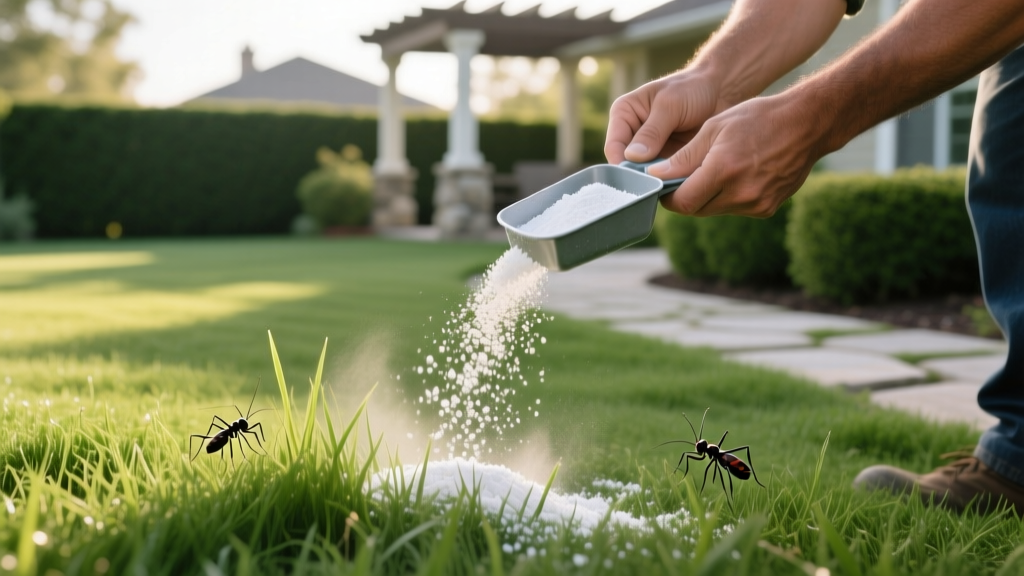
How to Apply Diatomaceous Earth for Lawns: A Step-by-Step Guide
The Mechanics of Diatomaceous Earth in Turfgrass
Diatomaceous earth (DE) is a siliceous sedimentary rock formed from the fossilized remains of diatoms, a type of hard-shelled microalgae. When milled into a fine powder, it acts as a mechanical insecticide. Under a microscope, DE particles resemble shards of glass. When crawling insects with exoskeletons—such as fleas, ticks, and ants—walk across treated turf, these microscopic shards abrade their waxy outer cuticle. This causes the pests to lose their ability to retain moisture, leading to fatal desiccation within 24 to 48 hours.
Unlike chemical neurotoxins, pests cannot develop a genetic resistance to DE. However, its efficacy in a lawn environment is entirely dependent on proper application techniques, moisture management, and selecting the correct grade of material. According to the National Pesticide Information Center (NPIC), DE is non-toxic to mammals when ingested, but inhalation of the fine dust poses respiratory risks that require strict mitigation during application.
CRITICAL SAFETY WARNING: Grade Selection
You must exclusively use Food-Grade Diatomaceous Earth (which contains less than 1% crystalline silica) for lawn applications. Never use Pool-Grade or Filter-Grade DE. Filter-grade DE undergoes calcination, converting amorphous silica into crystalline silica (up to 70% concentration), which is a known human carcinogen and causes severe silicosis when inhaled. Always verify the OMRI (Organic Materials Review Institute) listing or 'Food Chemical Codex' (FCC) designation on the packaging.
Step-by-Step Broadcast Application Procedure
Applying DE to a lawn requires balancing adequate coverage with the prevention of airborne dust clouds. Follow this precise protocol to ensure the powder reaches the thatch layer where pests reside without creating an inhalation hazard.
Step 1: Turf Preparation and Mowing
Mow your lawn to a height of 2 to 2.5 inches. If the grass is too tall, the DE will cling to the upper leaf blades where it is useless against soil-dwelling pests and easily blown away by wind. Rake the lawn thoroughly to remove wet clippings, leaves, and debris. The goal is to expose the thatch layer and soil surface as much as possible.
Step 2: Weather and Moisture Calibration
DE is completely inert when wet. Check your local forecast and ensure there is a minimum 48-hour window of dry weather. Do not apply if rain is expected, if heavy morning dew is forecasted, or if you plan to irrigate within two days. The soil surface should be dry to the touch before application.
Step 3: Personal Protective Equipment (PPE)
Because DE is a fine particulate, the CDC's National Institute for Occupational Safety and Health (NIOSH) mandates respiratory protection when handling silica dust. Wear a NIOSH-approved N95 or P100 particulate respirator, safety goggles, and long sleeves. While food-grade DE is safe on the skin, it is highly desiccating and will strip natural oils from your hands.
Step 4: Spreader Calibration and Loading
For broadcast applications, use a drop spreader (such as the Scotts Classic Drop Spreader). Do not use a rotary/broadcast spreader, as the spinning impeller will launch the fine dust into the air, creating a massive inhalation hazard and wasting product. Set the drop spreader to a low setting (typically 2 or 3 out of 10). The target application rate for general lawn pest control is 5 to 8 pounds per 1,000 square feet. If the DE is clumping, mix it 50/50 with dry, fine play sand to improve flow through the spreader hopper.
Step 5: Application and Settling
Walk at a steady pace of 3 feet per second, overlapping your drop spreader wheel tracks by 2 inches to ensure uniform coverage. Once the lawn is covered, use a leaf blower on its lowest setting—or a gentle sweeping motion with a push broom—to knock the powder off the grass blades and down into the thatch and soil crevices. Do not water the lawn. A common misconception is that DE should be 'watered in' like granular fertilizers. Watering dissolves the powder's static charge and renders it useless until it completely dries out again.
Target Pests: Efficacy Matrix
Diatomaceous earth is not a universal cure-all for every lawn pest. Its effectiveness is dictated by the pest's anatomy, habitat, and behavior. Below is an efficacy matrix for common turfgrass pests based on field observations and entomological data.
| Target Pest | Efficacy | Mechanism & Limitations |
|---|---|---|
| Fleas | High | Excellent for adult fleas in the thatch. Does not kill pupae; requires reapplication to catch emerging adults. |
| Ticks | High | Desiccates questing ticks on grass blades and in leaf litter. Highly effective at lawn perimeters. |
| Chinch Bugs | High | Targets nymphs and adults at the soil-thatch interface of St. Augustine and Zoysia grasses. |
| Ants | Moderate | Acts as a barrier. Worker ants may avoid treated zones or track it back to the colony, but it rarely eliminates deep nests. |
| White Grubs | Low | Ineffective. Grubs live deep in the soil profile and possess a thick, mucous-coated exoskeleton that resists abrasion. |
Environmental Limitations and Reapplication Triggers
The primary failure mode of diatomaceous earth in lawn care is environmental degradation. Because DE relies on physical abrasion and lipid absorption, any condition that coats the particles or fills their microscopic pores will neutralize them.
- Rainfall and Irrigation: Even a light shower of 0.1 inches will wash DE down into the soil profile where it is useless against surface pests, or cause it to clump and lose its abrasive properties. You must reapply after any rain event.
- Heavy Dew: In humid climates, morning dew can temporarily deactivate DE. It regains efficacy once the sun dries the turf, but prolonged moisture accelerates the breakdown of the powder into the soil.
- Wind Erosion: If applied to bare soil or dormant, brown winter turf without thatch to anchor it, wind speeds above 10 mph can strip the application. The 'brooming' step mentioned in the application procedure is vital to wedge the powder into soil cracks and thatch fibers.
- Earthworm Impact: DE is generally safe for earthworms, as their thick mucous coating protects them from desiccation. However, heavy broadcast applications can temporarily alter soil surface pH and microbial activity.
Cost Breakdown and Sourcing Guide (2026 Pricing)
Purchasing DE in small retail shaker bottles is economically unviable for lawn care. To achieve the required 5-8 lbs per 1,000 sq ft, you must source bulk agricultural or food-grade bags.
Bulk vs. Retail Cost Analysis
- Retail Shaker Cans (2.5 lbs): $12.00 - $18.00 (Approx. $5.00 - $7.20 per lb). Only viable for treating localized ant mounds or pet resting areas.
- Bulk Agricultural Bags (25 lbs - 50 lbs): $25.00 - $45.00 (Approx. $0.75 - $1.00 per lb). Required for broadcast lawn applications.
- Recommended Brands: Harris Food Grade DE, Safer Brand Ant & Crawling Insect Killer (for small spots), and DiatomaceousEarth.com (for 50lb bulk sacks).
Storage Tip: Store bulk DE in a sealed, heavy-duty plastic tote with a desiccant packet. If the powder absorbs ambient humidity in your garage, it will clump and jam your drop spreader.
Targeted Crack and Crevice Treatment vs. Broadcast
While broadcast application is ideal for widespread flea and tick infestations, a targeted approach is often more effective and economical for specific perimeter pests. Use a hand-held bulb duster (such as the JT Eaton 97100) to inject DE directly into:
- The expansion joints of concrete patios and driveways adjacent to the lawn (ant and earwig highways).
- Weep holes in brick retaining walls bordering garden beds.
- The base of tree trunks and wooden fence posts to create a 6-inch barrier against crawling insects.
When using a bulb duster, fill it only 1/3 full with DE and add a few pennies or small pebbles to the chamber. Shaking the duster will agitate the pebbles, breaking up clumps and ensuring a fine, even puff of dust rather than a heavy, wasteful clump.

