
Lawn Care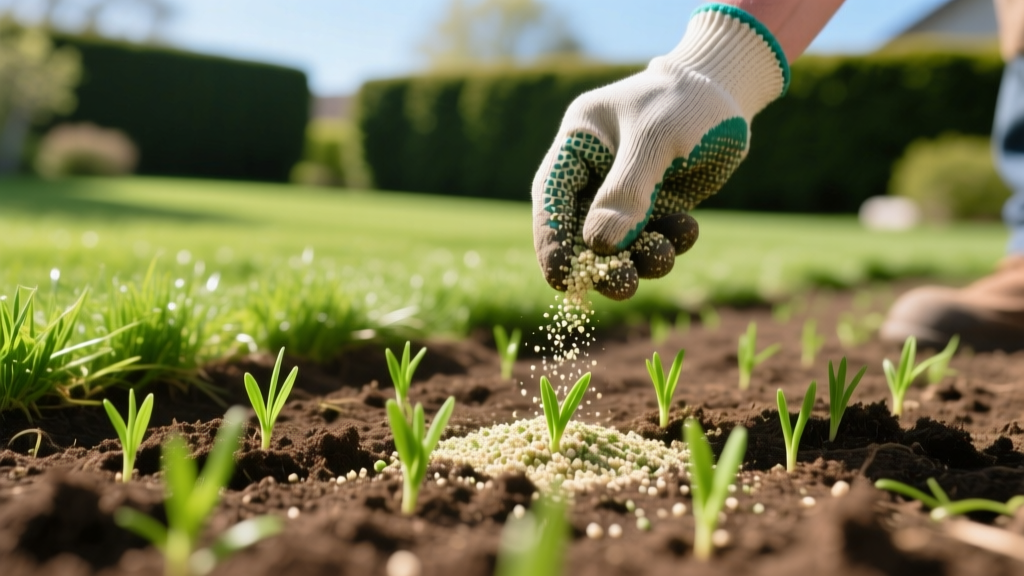
When and How to Apply Grass Starter Fertilizer for Seed
The Science Behind Grass Starter Fertilizer
Grass starter fertilizer is a specialized nutrient blend engineered specifically for the germination and establishment phases of turfgrass. Unlike maintenance fertilizers that prioritize high nitrogen (N) for foliar blade growth, starter formulations elevate phosphorus (P) levels to stimulate rapid root system development and ATP (adenosine triphosphate) energy synthesis in seedlings.
Established lawns typically extract sufficient phosphorus from existing soil reserves. However, newly planted grass seed or unrooted sod lacks the root mass required to access these deeper soil nutrients. Applying a high-phosphorus starter directly to the top 1 to 2 inches of the soil profile bridges this nutritional gap during the critical first 30 days of growth.
Warning: State-Level Phosphorus Bans
Due to the risk of phosphorus runoff causing eutrophication (toxic algae blooms) in local waterways, states like New York, New Jersey, Minnesota, and Washington strictly prohibit the use of phosphorus fertilizers on established lawns. However, agricultural extensions universally exempt newly seeded or sodded lawns from this ban. Always verify your local municipal codes and conduct a baseline soil test before application, as recommended by UMass Amherst Extension.
Due to the risk of phosphorus runoff causing eutrophication (toxic algae blooms) in local waterways, states like New York, New Jersey, Minnesota, and Washington strictly prohibit the use of phosphorus fertilizers on established lawns. However, agricultural extensions universally exempt newly seeded or sodded lawns from this ban. Always verify your local municipal codes and conduct a baseline soil test before application, as recommended by UMass Amherst Extension.
Step-by-Step Application Procedure
Proper application ensures the nutrients are positioned exactly where the emerging radicle (first root) will access them without causing osmotic seed burn.
Step 1: Soil Preparation and Grading
Before applying any fertilizer, grade your soil to a fine tilth. Remove rocks larger than 0.5 inches and break up compacted clay clods. If your soil pH is below 6.0, incorporate pelletized lime at a rate of 50 lbs per 1,000 square feet during this tilling phase, as acidic soils lock up phosphorus, rendering the starter fertilizer ineffective.
Step 2: Spreader Calibration
Calculate the exact application rate based on your chosen product's N-P-K ratio. The target application rate for new seed is generally 1.0 lb of actual phosphorus (P2O5) per 1,000 square feet. For a standard 10-18-10 starter fertilizer, this requires applying roughly 5.5 lbs of product per 1,000 square feet.
- Rotary Spreaders (e.g., Scotts EdgeGuard): Set the dial to the specific setting printed on the starter fertilizer bag (usually between 4.5 and 6.0 for granular starters).
- Drop Spreaders: Overlap wheel tracks by 2 inches to prevent visible striping and uneven nutrient bands.
Step 3: The Perimeter-and-Pass Pattern
Walk the perimeter of your lawn first with the spreader deflector engaged to prevent granules from landing on hardscapes or garden beds. Then, walk parallel back-and-forth passes across the interior. Apply the starter fertilizer before dropping your grass seed. This ensures the fertilizer rests slightly below the seed, encouraging roots to grow downward into the nutrient zone rather than staying near the surface.
Step 4: Seeding and Tamping
Broadcast your grass seed immediately after the starter application. Follow up with a lightweight lawn roller (filled only 25% with water) or drag a piece of chain-link fence over the area. This ensures seed-to-soil contact and presses the starter granules into the topsoil.
Step 5: Activation Watering
Apply exactly 0.1 inches of water immediately after seeding. This equates to roughly 62 gallons per 1,000 square feet. The goal is to dissolve the fertilizer prills into the soil solution without washing the seed away or creating anaerobic, waterlogged conditions.
Product Comparison: Top Starter Fertilizers
Selecting the correct N-P-K ratio depends on your soil test results and grass type. Below is a comparison of three industry-standard starter fertilizers available for the 2026 planting season.
| Product | N-P-K Ratio | Coverage / Bag Weight | Avg. Price | Best Use Case |
|---|---|---|---|---|
| Scotts Turf Builder Starter Food | 24-25-4 | 5,000 sq ft / 15 lbs | $24.99 | Standard residential overseeding and patching. |
| Pennington UltraGreen Starter | 10-18-10 | 5,000 sq ft / 14 lbs | $19.98 | Phosphorus-heavy soils needing balanced root support. |
| Lesco Professional Starter | 18-24-12 | 10,000 sq ft / 50 lbs | $42.50 | Full lawn renovations and professional sod installations. |
Troubleshooting Common Starter Fertilizer Failures
Even with precise application, environmental variables can disrupt the establishment phase. Use this diagnostic framework to address common issues.
Failure Mode 1: Seed Germinates but Turns Yellow at Week 3
The Cause: Starter fertilizers are designed to burn off quickly to accommodate the rapid early growth phase. By day 21, the initial nitrogen pulse is depleted, and the seedling has exhausted its endosperm energy reserves. This is known as the 'starvation gap'.
The Fix: Apply a secondary, half-rate nitrogen boost (0.5 lbs N per 1,000 sq ft) using a fast-release urea or ammonium sulfate product at the 4-week mark to sustain vegetative growth until the root system can access native soil nutrients.
Failure Mode 2: Severe Weed Invasion Before First Mow
The Cause: Standard pre-emergent herbicides (like prodiamine or dithiopyr) inhibit cell division. They cannot distinguish between weed seeds and your expensive turfgrass seed, resulting in total germination failure or severe stunting.
The Fix: If your soil has a high weed-seed bank, you must use a starter fertilizer that includes Mesotrione (the active ingredient in Tenacity). Mesotrione inhibits HPPD, an enzyme required for chlorophyll synthesis in broadleaf weeds and crabgrass, but it is entirely safe for germinating Kentucky bluegrass, tall fescue, and perennial ryegrass. Products like Scotts Triple Action Built for Seeding integrate mesotrione directly into the starter granule, providing 30 days of selective weed control without harming the new turf.
'Applying a standard pre-emergent to a newly seeded lawn is the most common and costly mistake homeowners make during spring renovations. Mesotrione is the only viable chemical bridge for weed control during the seedling stage.'
— Penn State Extension Turfgrass Management Guidelines
Post-Application Maintenance Schedule
The efficacy of your grass starter fertilizer relies entirely on your irrigation and mowing discipline during the first 45 days.
Days 1 to 14: The Germination Window
- Watering: Water 2 to 3 times daily for 5-10 minutes per zone. The top 1 inch of soil must remain constantly moist but never saturated. If the seed dries out for even 4 hours during germination, the emerging root will desiccate and die.
- Traffic: Zero foot traffic. The dissolving starter fertilizer creates a highly sensitive, salt-rich environment near the surface that can be easily compacted.
Days 15 to 30: Root Establishment
- Watering: Transition to once-daily, deeper watering (0.25 inches). This forces the developing roots to chase the moisture downward, pulling them directly into the phosphorus-rich zone created by the starter fertilizer.
- Mowing: Execute the first mow only when the turf reaches 3.5 inches in height. Set your mower deck to 2.5 inches and ensure the blade is freshly sharpened to prevent tearing the shallow-rooted seedlings out of the soil.
Day 45 and Beyond: Transition to Maintenance
By day 45, the starter fertilizer is fully depleted. Conduct a follow-up soil test. If phosphorus levels are now adequate, transition to a standard high-nitrogen, zero-phosphorus maintenance fertilizer (e.g., 32-0-4) to comply with environmental regulations and promote dense, dark-green foliar canopy development.

