
Lawn Care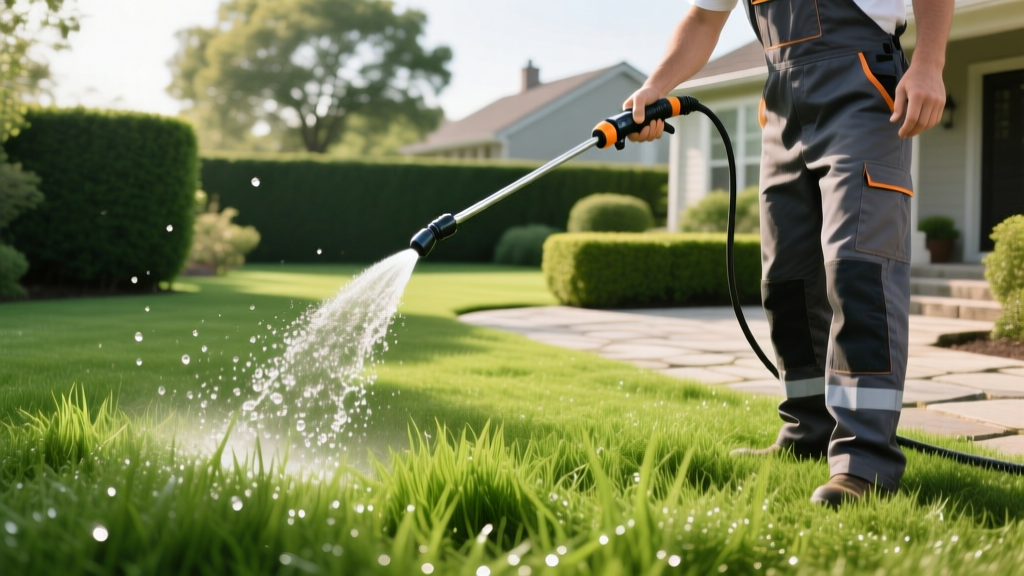
How to Apply Liquid Humic Acid for Lawns: A Step-by-Step Guide
The Science Behind Liquid Humic Acid for Lawns
Liquid humic acid is a concentrated soil conditioner extracted from oxidized lignite (leonardite). Unlike traditional N-P-K fertilizers that feed the grass directly, humic acid modifies the soil environment. It increases the soil's Cation Exchange Capacity (CEC), essentially giving the dirt a stronger magnetic charge to hold onto positively charged nutrients like potassium, calcium, and magnesium. According to soil health guidelines from the USDA NRCS, improving soil organic matter and humic substances is critical for long-term turf resilience, particularly in compacted or sandy soils that suffer from rapid nutrient leaching.
When applied in liquid form, humic acid is often blended with fulvic acid. Fulvic molecules are significantly smaller than humic molecules, allowing them to penetrate plant cell walls directly and act as a chelator, wrapping around micronutrients like iron and zinc to make them bioavailable to the turfgrass roots.
Liquid vs. Granular: Choosing the Right Formulation
Before stepping onto the grass, you must understand why liquid applications often outperform granular alternatives for immediate soil conditioning. Below is a comparative breakdown of the primary humic substances available to homeowners in 2026.
| Feature | Liquid Humic/Fulvic Blend | Granular Humic (Dispersing Granules) | Liquid Fulvic Acid Only |
|---|---|---|---|
| Primary Function | Soil conditioning & nutrient chelation | Long-term CEC building & microbial food | Foliar nutrient transport & cell penetration |
| Activation Time | Immediate (24-48 hours) | Slow (Requires 2-4 weeks of irrigation) | Immediate (12-24 hours) |
| Application Method | Hose-end or pump sprayer | Broadcast spreader | Pump sprayer (often foliar) |
| Ideal Use Case | Spring green-up, pairing with liquid iron | Fall aeration, new lawn establishment | Summer stress recovery, micronutrient deficiency |
| Average Cost (per 1,000 sq ft) | $1.50 - $3.00 | $2.00 - $4.50 | $2.50 - $5.00 |
Pre-Application: Product Selection and Soil Diagnostics
Applying humic acid to highly alkaline soil (pH above 7.8) without a prior acidifying treatment can result in the humic molecules binding with excess calcium, precipitating out of the solution and rendering them useless. Always conduct a soil test first. Penn State Extension recommends maintaining a turfgrass soil pH between 6.0 and 7.0 for optimal humic acid efficacy.
Top Liquid Humic Acid Products for 2026
- N-EXT Humic12 (1 Gallon): Priced around $49.95, this is a professional-grade 12% humic acid concentrate. At the standard rate of 6 oz per 1,000 sq ft, one gallon treats roughly 21,000 sq ft. It contains a robust fulvic fraction for rapid uptake.
- Simple Lawn Solutions Liquid Humic Acid (32 oz): Retailing for approximately $24.99, this consumer-friendly blend is pre-diluted for easier hose-end application. It covers about 3,200 sq ft and is ideal for smaller urban lawns.
- Greene County Fertilizer (GCF) Humic Acid: A premium, highly refined option that eliminates the risk of clogged sprayer nozzles, a common failure point with cheaper, unfiltered leonardite extracts.
Step-by-Step Application Procedure
Follow this exact protocol to ensure uniform coverage and prevent root-zone shock.
Step 1: Calibrate Your Equipment
For hose-end sprayers, set the dial to the manufacturer's recommended dilution rate (typically 4 to 6 oz of concentrate per gallon of water output). If using a backpack or pump sprayer, you must calibrate your walking speed and nozzle output. A standard 2-gallon pump sprayer should be pressurized to 40 PSI using a 110-degree flat fan nozzle to deliver roughly 1.5 gallons of mixed solution per 1,000 sq ft.
Step 2: Perform a Jar Test (If Tank Mixing)
Warning: Never mix liquid humic acid directly with calcium-based fertilizers (like Calcium Nitrate) or high-concentration iron sulfates without a jar test. Humic acid will chelate the metals and form a thick, sludge-like precipitate that will permanently clog your sprayer filters.
To perform a jar test: Mix 1 oz of your humic acid with 1 oz of your secondary liquid fertilizer in a clear glass mason jar. Shake vigorously and let it sit for 15 minutes. If the mixture remains a smooth, dark liquid, it is safe to tank mix. If you see clumping, flaking, or a gel-like consistency, apply the products on separate days.
Step 3: Apply to the Lawn
Apply the liquid humic acid during the early morning or late afternoon. UV radiation degrades the fulvic acid fraction rapidly, so avoiding the midday sun is critical. Walk in straight lines, overlapping each pass by 20% to prevent striping. Because humic acid is dark brown, it will temporarily stain concrete driveways and sidewalks; use a broom to sweep off any overspray immediately before it dries.
Step 4: Water In the Application
Unlike foliar sprays that are meant to sit on the grass blade, humic acid must reach the soil profile to interact with the root zone and clay particles. Immediately after application, run your irrigation system or attach a sprinkler to deliver exactly 0.1 to 0.2 inches of water. This is enough to wash the solution off the grass blades and push it into the top 2 inches of soil without causing deep leaching.
Troubleshooting Common Application Failures
Even with perfect technique, environmental variables can impact your results. Here is how to diagnose and fix common issues.
Issue: The Lawn Shows No Visible Greening
Cause: Humic acid contains virtually zero nitrogen, phosphorus, or potassium. It is a soil conditioner, not a primary fertilizer. If your soil is completely depleted of N-P-K, humic acid has no nutrients to chelate.
Fix: Pair your humic acid application with a fast-release nitrogen source like 46-0-0 urea or a balanced 20-20-20 liquid fertilizer. The humic acid will increase the efficiency of the nitrogen uptake by up to 30%.
Issue: Sprayer Nozzle Clogging Mid-Application
Cause: Low-quality liquid humic acids often contain suspended, unrefined leonardite particulate matter that settles at the bottom of the tank and blocks the mesh filter.
Fix: Switch to a micro-milled or fully refined product like GCF or N-EXT. If you must use a budget brand, pour the concentrate through a 100-mesh paint strainer bag into your sprayer tank before adding water.
Seasonal Timing Framework
Maximize your investment by aligning applications with the turfgrass growth cycle:
- Early Spring (Soil Temps at 55°F): Apply at 6 oz per 1,000 sq ft to stimulate early microbial activity and prepare the soil to receive spring nitrogen fertilizers.
- Peak Summer (Heat Stress): Reduce the rate to 3 oz per 1,000 sq ft. Combine with liquid kelp (seaweed extract) to mitigate drought stress and improve the grass's internal water retention.
- Late Fall (Pre-Dormancy): Apply at 8 oz per 1,000 sq ft alongside your winterizer fertilizer. The humic acid will bind the potassium in the soil, preventing it from leaching out during winter rains and ensuring the roots have immediate access to it during spring green-up.

