
Lawn Care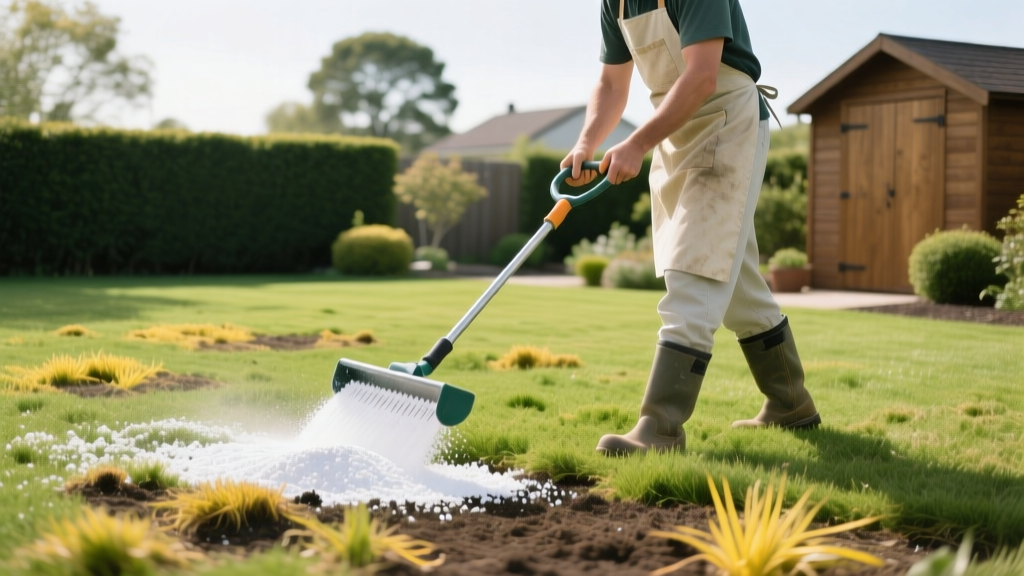
How to Apply pH Limestone to Correct Acidic Lawns
The Hidden Culprit Behind Yellowing, Stunted Turf
When turfgrass struggles to absorb nitrogen, phosphorus, and potassium despite regular fertilization, the root cause is often invisible: soil acidity. In regions with high rainfall or heavy clay soils, essential base cations leach away, dropping the soil pH below the optimal 6.0 to 7.0 range required for most cool- and warm-season grasses. Applying pH limestone is the most effective, scientifically proven method to neutralize active acidity, unlock bound nutrients, and restore the cation exchange capacity (CEC) of your soil. However, blindly broadcasting lime without understanding soil buffer capacity, limestone composition, and particle size will result in wasted money and uneven turf recovery.
Calcitic vs. Dolomitic pH Limestone: Which Do You Need?
Not all limestone is created equal. The two primary agricultural grades differ fundamentally in their mineral composition. Choosing the wrong type can induce secondary nutrient deficiencies, particularly involving magnesium and calcium imbalances.
| Feature | Calcitic Limestone | Dolomitic Limestone |
|---|---|---|
| Primary Compound | Calcium Carbonate (CaCO3) | Calcium-Magnesium Carbonate (CaMg(CO3)2) |
| Calcium Content | High (30-38%) | Moderate (18-23%) |
| Magnesium Content | Low (1-5%) | High (8-12%) |
| Best Used When | Soil tests show adequate Mg base saturation (>10%) | Soil tests indicate Mg deficiency (<10% base saturation) |
| Average Cost (2026) | $14 - $18 per 40lb bag | $18 - $24 per 40lb bag |
According to the University of Minnesota Extension, applying dolomitic lime to soils that already have high magnesium levels can lead to calcium deficiency and soil structure degradation, as excess magnesium disperses clay particles. Always let a comprehensive soil test dictate your choice.
Decoding Your Soil Test: Active vs. Reserve Acidity
The most common mistake homeowners make is calculating lime application rates based solely on the standard water pH reading. Water pH only measures active acidity (the hydrogen ions currently in the soil solution). To determine how much pH limestone is actually required, you must look at the Buffer pH (often listed as SMP Buffer or Adams-Evans Buffer on lab reports).
Expert Insight: Buffer pH measures reserve acidity (hydrogen ions bound to soil particles). A sandy soil and a heavy clay soil might both have a water pH of 5.2. However, the clay soil has a much higher CEC and holds vastly more reserve acidity. The clay soil's buffer pH will be lower, indicating it requires up to 50% more limestone to achieve the same pH shift as the sandy soil.
As a baseline, raising the pH of a loam soil by 0.5 points typically requires 50 lbs of limestone per 1,000 square feet. Sandy soils require roughly 25-30% less, while heavy clays require 20-30% more. Never apply more than 50 lbs per 1,000 sq ft in a single application; excess lime will coat soil particles and temporarily lock out micronutrients like iron and manganese, causing severe chlorosis.
Pelletized vs. Pulverized: Choosing the Right Format
- Pulverized (Powdered) Limestone: Reacts faster due to high surface area but creates massive dust clouds during application. Best applied via professional drop spreaders or bulk top-dressing equipment. Ideal for bare-ground renovation before seeding.
- Pelletized (Prilled) Limestone: Finely ground limestone bound into uniform, dust-free pellets using a clay or lignin binder. Slightly slower to react (takes 3-4 weeks longer to break down) but can be applied easily with standard rotary broadcast spreaders. This is the superior choice for established lawns.
The Amendment Protocol: Step-by-Step Application
Timing and integration are critical. Limestone is relatively insoluble and moves downward through the soil profile at a rate of only 1 to 2 inches per year. Therefore, fall application is optimal, allowing winter moisture and freeze-thaw cycles to drive the calcium and magnesium into the root zone before the spring growing season.
- Mow and Dethatch: Lower your mower deck to 2 inches and remove excessive thatch. Limestone must reach the soil surface; if it gets trapped in a 1-inch thatch layer, it will neutralize the thatch but fail to amend the underlying soil.
- Core Aerate: Pull 3-inch deep plugs across the lawn. This creates physical channels for the lime to bypass the surface and reach the deeper root zone, accelerating the neutralization process.
- Calibrate Your Spreader: Set your broadcast spreader to the manufacturer's recommended setting for pelletized lime (typically setting 'H' or '12' on Scotts rotary spreaders). Walk at a steady pace of 3 feet per second.
- Split Applications (If >50 lbs/1000 sq ft): If your soil test demands 80 lbs per 1,000 sq ft, apply 50 lbs in early autumn, and the remaining 30 lbs in late winter or early spring.
- Water Heavily: Apply 0.5 inches of irrigation immediately after spreading to wash dust off the grass blades and initiate the breakdown of the pellets.
Synergizing Limestone with Organic Mulch and Compost
When integrating pH limestone into a broader soil amendment strategy involving organic mulches and compost, sequence matters. The UMass Amherst Soil Testing Laboratory notes that organic matter naturally buffers soil pH, meaning highly composted soils resist rapid pH changes.
"Apply your pH limestone directly to the soil surface before top-dressing with compost or applying woody mulch beds. If you apply lime on top of a thick layer of wood chips or compost, the calcium will react with the organic acids in the decaying matter rather than neutralizing the mineral soil below."
For garden beds adjacent to your lawn where acidic mulches (like pine bark or oak leaves) are used, monitor the soil pH annually. While the myth that pine needles drastically acidify soil has been largely debunked, the continuous decomposition of woody mulches does consume base cations over time, necessitating maintenance applications of pH limestone every 2 to 3 years to maintain a 6.5 pH target.
Frequently Asked Questions
Can I apply pH limestone and nitrogen fertilizer at the same time?
No. Applying limestone simultaneously with ammonium-based nitrogen fertilizers (like ammonium sulfate or urea) causes a chemical reaction that volatilizes the nitrogen into ammonia gas, effectively wasting your fertilizer. Separate applications by at least 3 to 4 weeks.
How long does it take for pelletized limestone to work?
You will see a measurable shift in soil pH within 4 to 6 weeks after application, provided the soil is kept moist. Full neutralization of the root zone takes 3 to 6 months. Retest your soil 6 months post-application to verify the pH adjustment.

